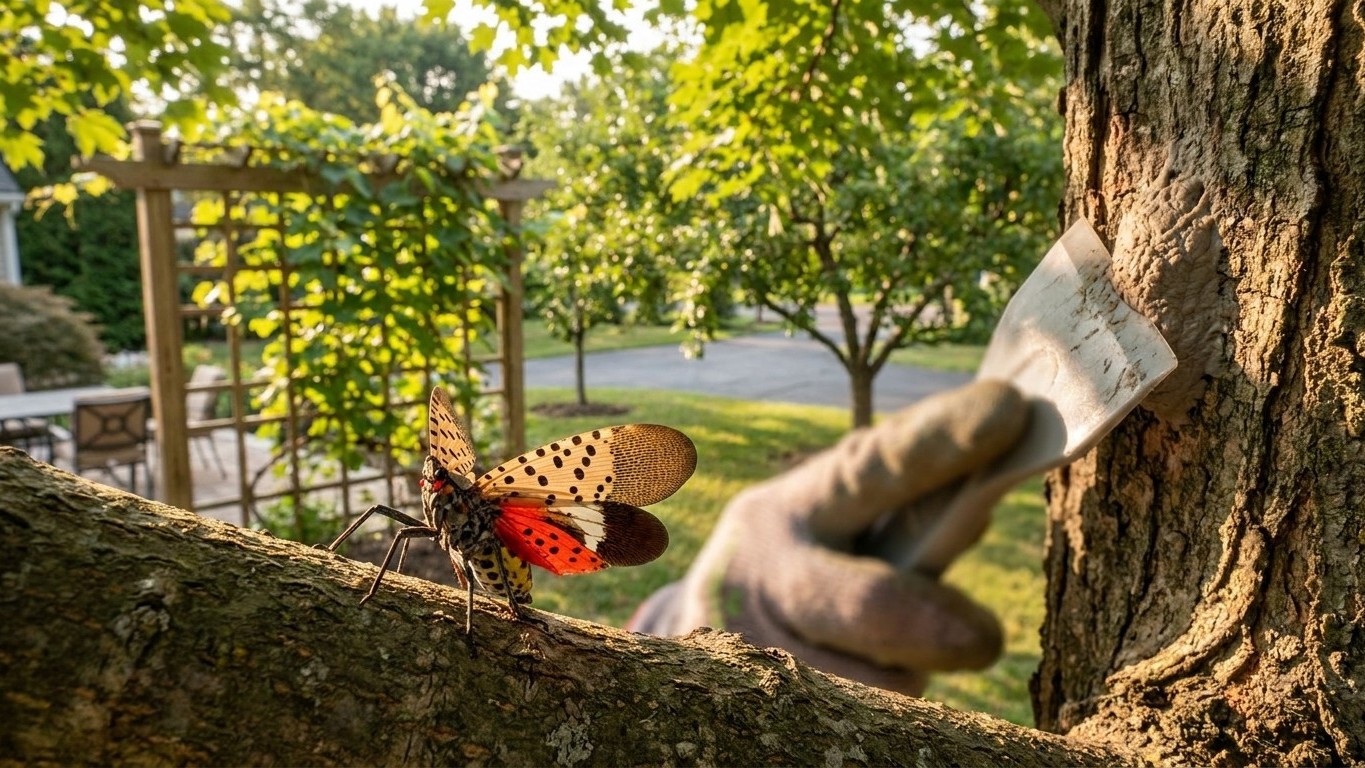

Spotted lanternfly shows up in New Jersey in three distinct waves tied to its life cycle: egg masses hatch into nymphs from late April through July, adults appear by mid-summer, and egg-laying runs from September into early winter. Nothing stops the insect completely once it’s established in a region, but scraping and destroying egg masses before they hatch, removing or treating Tree of Heaven (its favorite host), and applying targeted insecticide during the nymph stage cut populations enough to protect grapevines, maples, and backyard fruit trees.
Where Spotted Lanternfly Stands in New Jersey Today

New Jersey confirmed its first spotted lanternfly population in Mercer County in 2018, four years after the insect first turned up in Berks County, Pennsylvania, hidden in a shipment of stone. Since then it has spread to nearly every county in the state, moving along highways and rail lines where it lays eggs on car bumpers, shipping pallets, and even patio furniture.
The insect doesn’t fly far on its own, maybe a few hundred yards in a lifetime, but it hitchhikes extremely well. That’s the part homeowners underestimate: a single egg mass tucked under a wheel well can start a new colony fifty miles from where it was laid. The New Jersey Department of Agriculture has shifted its approach over the years from strict quarantine zones to broader public reporting and management guidance, reflecting a simple reality: the bug is now established statewide, and the fight has moved from containment to damage control.
For homeowners, that shift matters. Ten years ago the question was “how do we keep it out.” Today it’s “how do we keep the numbers low enough that our vines, trees, and patios stay usable.” The U.S. Department of Agriculture’s Animal and Plant Health Inspection Service tracks the pest’s spread nationally and offers identification resources at aphis.usda.gov.
The New Jersey Calendar: Egg to Adult, Month by Month
Spotted lanternfly behaves on a predictable schedule in the Mid-Atlantic, and New Jersey’s climate keeps it right on track. Knowing the calendar is the single most useful thing a homeowner can do, because the control method that works in May does nothing in September.
Egg masses: October through June
Females lay clusters of 30 to 50 eggs coated in a gray, putty-like substance that looks like dried mud smeared on bark. They’re laid from September through the first hard freeze and survive the winter attached to tree trunks, rocks, fence posts, and outdoor equipment. This is the longest window of the entire life cycle, roughly eight months, and it’s also the easiest stage to control because the eggs aren’t moving anywhere.
Nymphs: late April through July
Eggs hatch in a staggered fashion starting around the last week of April in southern New Jersey and running into May farther north. Young nymphs are black with white spots and about the size of a small ant, which makes them easy to miss on a tree trunk. By July they molt into a red-and-black stage that’s roughly a half-inch long. Nymphs feed aggressively during this window, and it’s the best time for insecticide applications because the insects are concentrated on host plants and haven’t yet developed the hardened, more resistant exoskeleton of adulthood.
Adults: July through the first frost
Adult spotted lanternflies, gray-winged with red underwings and black spots, become visible by mid-July and stick around into December in mild years. This is the stage most homeowners actually notice, since adults gather in large numbers on tree trunks at dusk and swarm porches and patios near infested trees. They’re also the stage responsible for the sticky, sugary honeydew that coats decks, cars, and outdoor furniture under heavily infested trees, which in turn attracts wasps and grows sooty black mold on leaves and siding.
What Attracts Spotted Lanternfly to a New Jersey Yard
The insect isn’t a picky eater, but it has a clear favorite: Tree of Heaven (Ailanthus altissima), an invasive species that grows fast along highway edges, vacant lots, and property lines across the state. Where Tree of Heaven grows, spotted lanternfly populations tend to explode first.
Beyond that preferred host, the insect feeds on more than 70 plant species, with a few standing out as real problems for New Jersey property owners:
- Grapevines, where heavy feeding can weaken or kill vines over a season or two, a serious concern for the state’s wine industry, concentrated in counties like Hunterdon and Warren
- Maple trees, a dominant shade tree across suburban New Jersey, which show sap oozing and blackened bark under sustained feeding
- Black walnut, river birch, and willow, all common in yards and along waterways
- Fruit trees including peach and apple, though damage here tends to be cosmetic rather than fatal
The feeding itself doesn’t chew leaves the way caterpillars do. Spotted lanternfly pierces bark and stems with a straw-like mouthpart and drinks sap, weakening the plant slowly rather than defoliating it outright. The honeydew byproduct is often the first sign homeowners notice, long before they spot the insect itself.
What Actually Stops Spotted Lanternfly
No single method eliminates spotted lanternfly from a property, but combining a few tactics at the right time in the calendar knocks populations down enough to matter. Rutgers Cooperative Extension and the New Jersey Department of Agriculture both point to the same core strategy: attack the eggs, manage the host trees, and treat nymphs early.
Scrape and destroy egg masses
Between October and April, before hatching begins, scraping visible egg masses off bark and hard surfaces into a bag of rubbing alcohol or hand sanitizer kills them on the spot. A single scraped mass can prevent 30 to 50 new insects from ever hatching, which makes this the highest-return, lowest-cost control available to any homeowner. Check trunks, the undersides of outdoor furniture, firewood stacks, and vehicle wheel wells, since egg masses on movable objects are exactly how the insect spreads county to county.
Manage Tree of Heaven strategically
Because spotted lanternfly gravitates toward Tree of Heaven, some property owners use a “trap tree” approach: leave a few female Tree of Heaven specimens standing (males don’t attract the insect as strongly) and treat them with a systemic insecticide that kills lanternflies feeding on the bark, while removing the rest of the stand. Cutting down every Tree of Heaven on a property without treatment can backfire, since surviving insects simply disperse to nearby maples and grapevines looking for a new host.
Sticky bands, used carefully
Wrapping trunks with sticky bands during nymph season traps crawling insects before they climb into the canopy. The catch is that these bands also snag birds, squirrels, and other wildlife. New Jersey Audubon and several extension offices now recommend covering sticky bands with mesh screening or wire cages so only the target insect gets trapped, not everything that touches the bark.
Targeted insecticide during nymph stage
Systemic insecticides applied to high-value trees, especially grapevines and ornamental maples, work best when nymphs are actively feeding, generally May through July. Contact insecticides can knock down adult populations gathered on trunks at dusk, though repeat applications are usually needed since adults keep arriving from neighboring properties. Homeowners dealing with a heavy infestation on valuable landscape trees often bring in a licensed pest control applicator, since commercial-grade systemic products aren’t available over the counter and require correct timing to avoid harming pollinators.
Vinegar sprays and homemade soap mixtures circulate widely online, and while some kill on direct contact, none of them provide residual protection or scale up to a heavily infested tree. They’re a stopgap at best, not a control strategy.
Reporting Still Helps, Even Without a Quarantine
New Jersey no longer enforces the strict quarantine zones it used in the early years of the infestation, but the state agriculture department still tracks sightings, particularly in counties where populations remain lower than the heavily infested southern and central regions. Reporting a sighting in a county with few prior records helps researchers understand where the insect is expanding and where control resources might do the most good, even if it won’t trigger a formal quarantine response the way it once did.
One detail that surprises a lot of homeowners: spotted lanternfly doesn’t actually kill most of the trees it feeds on, aside from grapevines under sustained pressure. The bigger economic hit lands on agriculture and outdoor hospitality, vineyards losing yield, wineries fielding customer complaints about swarms on patios, and landscapers spending extra hours each fall scraping bark that’s already been treated once that season.