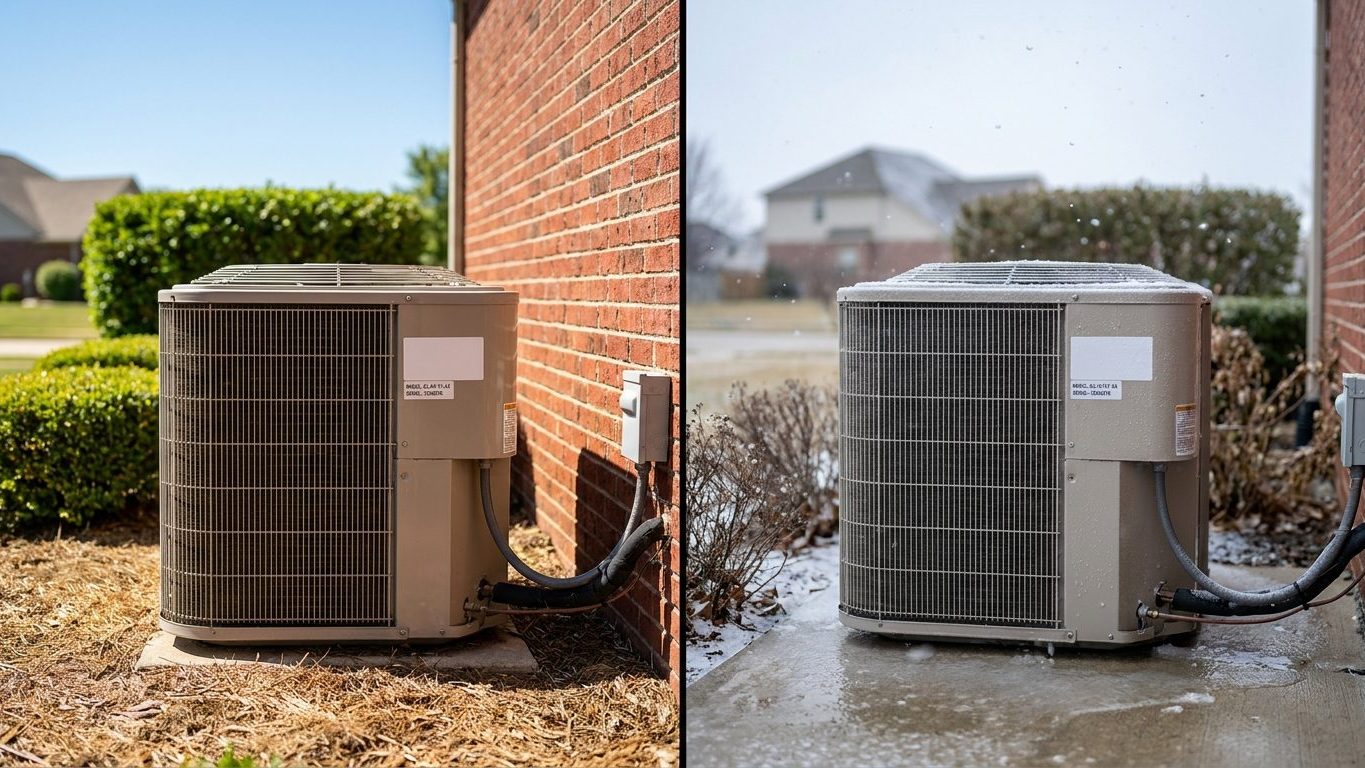

A Central Air Conditioner and an air-source heat pump are the same appliance, built by the same manufacturers with the same outdoor cabinet and the same indoor coil. The only mechanical difference is a reversing valve inside the heat pump that lets Refrigerant flow in either direction, pulling heat out of the house in summer and pulling heat into the house in winter. That single valve is why the two units look identical from the driveway but behave very differently once the thermostat is set to heat.
The same box, with one extra part
Pop the panel off a central air Conditioner and a heat pump and you will find almost the same layout: a compressor, a fan, coils, and refrigerant lines running to an indoor coil mounted on the furnace or air handler. Both systems move heat rather than generate it, which is why an air conditioner feels like magic on a 95-degree day. It is not creating cold. It is extracting heat from indoor air and dumping it outside.
A heat pump does the same job in reverse. The reversing valve, a small four-way component near the compressor, switches the direction refrigerant travels through the loop. Instead of the outdoor coil releasing heat, it absorbs heat from outside air, even when that air is cold, and sends it inside through the same indoor coil that cooled the house all summer. That is the entire distinction Between the Two machines. No second compressor, no separate ductwork, no different-looking cabinet.
This explains why a homeowner staring at an outdoor unit cannot tell the two apart by looking. The compressor sounds the same. The fan spins the same direction. Refrigerant lines run to the same spots. Manufacturers often use the same outdoor cabinet across both product lines and simply add the reversing valve and a bit of extra control wiring for the heat pump version. Even technicians sometimes need to open the electrical panel or check the model plate to be certain, because the visual cues are that subtle.
What does change, and change a lot, is winter behavior. A straight central air conditioner does nothing when the thermostat calls for heat. It sits idle while a furnace, boiler, or electric resistance system carries the entire heating load. A heat pump, by contrast, keeps running through the winter, cycling on whenever the thermostat calls for heat, right alongside whatever backup heat source the house has installed. That is the practical fork in the road: one machine is a fair-weather appliance, the other works twelve months a year.
Because the hardware is nearly identical, the confusion is not a sign of poor research. It is baked into how these systems are designed and marketed. The reversing valve is a small, cheap part relative to the rest of the unit, which is exactly why manufacturers build both versions on the same platform instead of engineering two separate product lines from scratch.
How to tell in two minutes
Confirming which system sits outside a given house does not require opening anything or calling a technician. It takes a functioning thermostat and about two minutes on a cool day, ideally when the outdoor temperature is below 65 degrees so the test is unambiguous.
- Set the thermostat to HEAT and raise the setpoint a few degrees above the current room temperature.
- Walk outside to the condenser unit and listen or watch for the fan and compressor to start running.
- If The Outdoor Unit turns on while the thermostat calls for heat, it is a heat pump. If it stays silent and only a furnace, radiator, or indoor air handler responds, it is a straight air conditioner paired with a separate heat source.
- Check the thermostat for an EM HEAT or AUX HEAT setting, which exists specifically to bypass or supplement a heat pump’s compressor and appears only on heat pump thermostats.
- If accessible, look at the low-voltage wiring terminals inside the thermostat base plate. A terminal marked O or B controls the reversing valve and is present only on heat pump wiring, never on a conventional air conditioner setup.
- As a final check, the manufacturer’s model plate on the outdoor unit usually includes a model number series that distinguishes air conditioner from heat pump lines, though the coding varies by brand.
None of this is trivia for its own sake. The answer changes how the equipment should be treated for the rest of the year. A straight air conditioner sitting idle all winter can reasonably be covered on top to keep debris and ice out, since it will not run again until spring. A heat pump cannot be covered the same way, because it needs to run through cold weather, and blocking airflow on a unit that is actively working can force it into short cycling or trigger frost buildup it cannot clear on its own.
The thermostat setback question depends on the same answer. A furnace paired with a straight air conditioner tolerates a deep nighttime setback just fine, dropping several degrees without issue. A heat pump generally handles smaller, shallower setbacks better, because recovering from a big temperature drop can force the system into backup heat mode, which is less efficient than letting the compressor work steadily. And if a homeowner ever needs to call for emergency heat during a cold snap or a service issue, knowing whether EM HEAT exists on the thermostat in the first place determines whether that option is even available.
What the answer changes
Once it is clear which system sits outside, a handful of practical decisions follow directly from that answer. The table below lays out where central air conditioners and heat pumps diverge in daily use, along with where to find more detail on each point.
| Situation | Central air conditioner (no reversing valve) | Heat pump (with reversing valve) |
|---|---|---|
| Covering the Outdoor Unit in winter | Safe to cover the top, since the unit is idle all season | Should not be fully covered; it runs through winter and needs clear airflow |
| Thermostat setback depth | Tolerates a deep nighttime or away setback without much penalty | Works best with a shallower setback to avoid triggering backup heat on recovery |
| Auxiliary or emergency heat | Not applicable; a separate furnace or boiler carries the full heating load | Auxiliary heat is a secondary heat source, often electric resistance, that kicks in when outdoor temperatures drop too low for the compressor to keep up alone |
| Defrost cycles | Never occurs; the unit is not running in cold weather | Normal and expected in cold months; the unit briefly reverses to melt frost off the outdoor coil, which can look and sound like a malfunction but is not one |
| Year-round maintenance load | Runs seasonally, so wear is concentrated in warm months | Runs in every season, so filters, coils, and airflow checks need attention on a year-round schedule rather than a seasonal one |
Two points apply to either version of this equipment and deserve to be stated plainly, without turning them into a project. The run capacitor near the compressor holds an electrical charge even after the unit is switched off or unplugged, and that charge does not discharge on its own just because the power is cut. And when a system is described as needing refrigerant added, that is not routine upkeep the way changing a filter is. Refrigerant lines are sealed, and a system that has lost charge has a leak somewhere in that loop, not a component that simply wears out with age.
Everything else in that table, the covering, the setback habits, the defrost behavior, the maintenance rhythm, follows directly from whichever answer the two-minute test above produced. There is no guessing required once that first question is settled.
Which is more common where
National figures from the U.S. Energy Information Administration’s 2020 Residential Energy Consumption Survey show that 89% of U.S. homes use some form of air-Conditioning equipment. Of that total, 67% run a central system, while 26% rely on individual equipment such as a ductless mini-split, a window or wall unit, or a portable unit. Those categories are reported separately in the survey, and central heat pumps are counted on their own line rather than folded into the central air conditioning figure, so the two should not be added or subtracted from each other to guess at a third number.
State-level numbers show how much that national split can shift. In Connecticut, 90% of homes have air conditioning, but only 34% of homes run a central system, meaning a much larger share of Connecticut households cool their homes with individual equipment than the national average suggests. Hawaii shows an even sharper tilt: 57% of homes have air conditioning at all, and 48% of that cooling comes from individual equipment rather than a central system.
| Geography | Any air conditioning | Central system | Individual equipment |
|---|---|---|---|
| United States (national) | 89% | 67% | 26% |
| Connecticut | 90% | 34% | higher share than national average |
| Hawaii | 57% | not the majority | 48% |
Where the survey reports a “Q” for a given category, that marks a sample too small to publish a reliable figure, not a value of zero. Treating a suppressed estimate as zero would misread the data, especially in smaller states where a modest number of homes can fall below the reporting threshold.
For a homeowner replacing aging equipment, the practical takeaway is that the national tilt toward central systems does not hold everywhere. In a state like Connecticut, a large share of the market runs on individual units, which changes the pool of comparable homes and installers a buyer might reference. The RECS breakdown is a reminder to check regional patterns rather than assume the national 67% figure applies locally.
Common questions
Can a central air conditioner be converted into a heat pump?
Not by adding a part after the fact in any simple way. The reversing valve and the control wiring that supports it are built into the unit during manufacturing, so converting an existing air conditioner into a heat pump generally means replacing the outdoor unit rather than modifying the one already installed.
Does a heat pump cost more to run than a furnace in cold climates?
That depends on outdoor temperatures, the backup heat source, and local energy prices, and it varies enough by climate and by household that no single figure applies everywhere. What is consistent is that a heat pump relies more on auxiliary heat as outdoor temperatures drop, which is a separate consideration from the equipment identification question this page addresses.
Why does the outdoor unit sometimes look like it is steaming or smoking in winter?
On a heat pump, that is almost always a defrost cycle, where the system briefly reverses to melt frost off the outdoor coil and the runoff produces visible steam. It looks alarming the first time someone sees it but is normal operation, not a fault.
Is a heat pump the same as a ductless mini-split?
No. A ductless mini-split is one form of individual, ductless heat pump equipment, cooling and heating a single room or zone without central ductwork. The central heat pump discussed on this page connects to a home’s existing duct system and a central thermostat, which is the distinction the RECS survey categories reflect.