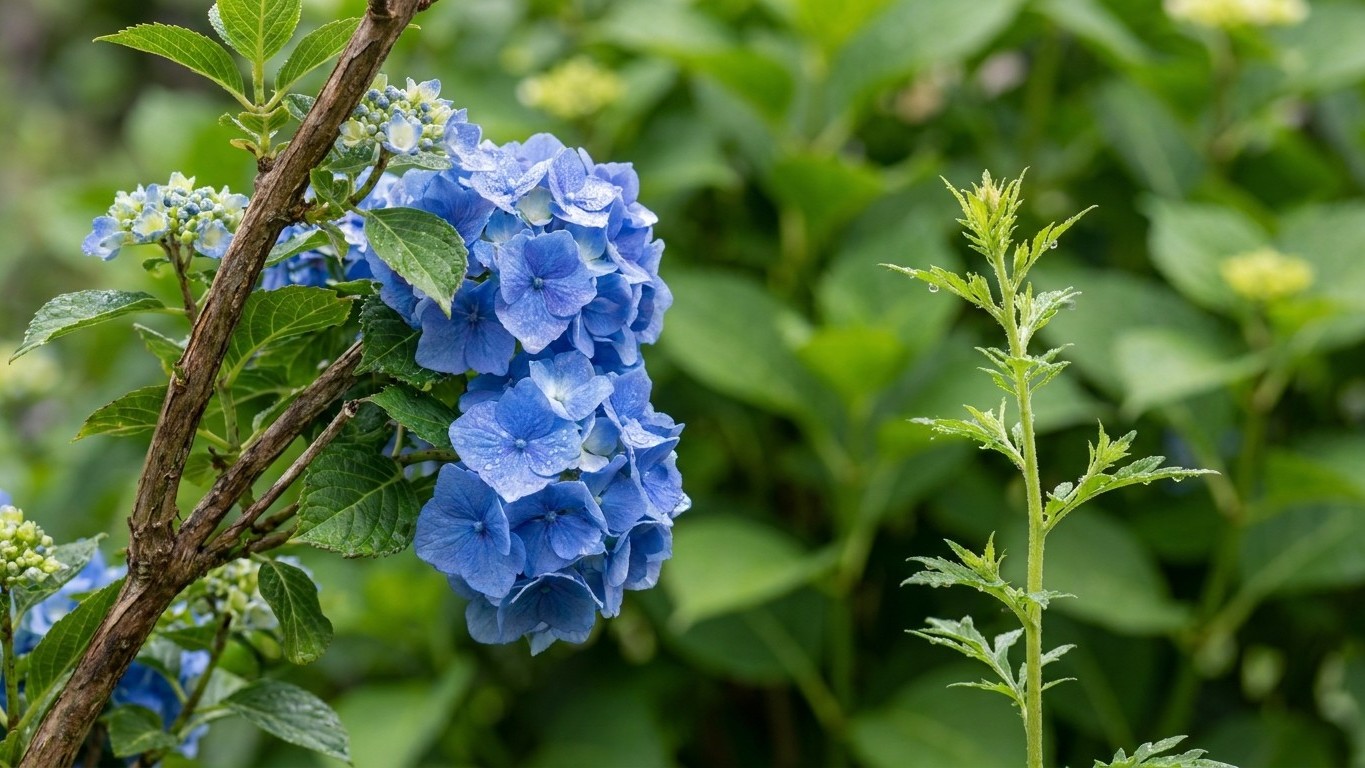

In Georgia, hydrangeas go in the ground either in early spring once the last frost risk has passed, or in early fall while soil is still warm enough for roots to settle before winter. Soil pH controls bloom color on certain types, oakleaf and panicle varieties handle the state’s heat and clay better than bigleaf types, and the biggest winter task is protecting old-wood flower buds, not the plant itself.
When to plant Hydrangeas in Georgia
NOAA’s 1991-2020 Climate Normals put the last spring freeze at the Atlanta station (USW00013874) somewhere between March 11 and March 29, with the first fall freeze landing between November 13 and December 1. Those numbers come from an airport surrounded by pavement and buildings, an urban heat island that runs warmer than the surrounding countryside. Head into the mountains around Blairsville or Dahlonega and that freeze arrives weeks earlier in fall and lingers weeks later in spring. Drop down to the coastal plain near Valdosta or Savannah and both windows shift the other way, milder falls, earlier spring safety.
Most home gardeners aren’t starting hydrangeas from seed. Seed-grown plants take years to flower and rarely match the parent, so nurseries sell rooted cuttings or container plants instead. That still leaves an acclimation step. A hydrangea raised in a climate-controlled greenhouse arrives soft. Set it straight into a Georgia afternoon in April and the leaves can scorch before roots have a chance to establish. Give it 7 to 10 days in a sheltered spot, morning sun only, before it goes into its permanent bed.
Counting back from the frost window
Working from Atlanta’s spring range, the safer planting date sits after the tail end of that window, closer to the first week of April for most of the metro and Piedmont counties. Plant earlier and a late cold snap can bite the new leaves already pushing on a hydrangea just settling in. North Georgia gardeners should push that date back further, since their local freeze risk runs later than the Atlanta figure suggests. Coastal plain gardeners have more room to plant early, since their frost risk clears sooner.
Fall planting works just as well, sometimes better, because cooler air and warm soil push root growth without stressing the top of the plant. Aim to get the plant in the ground by early to mid-October across most of the state, giving at least six weeks of root establishment before that November 13 to December 1 freeze window arrives. Wait too long and the plant enters winter with an unsettled root system, which shows up the following summer as slow growth and wilting.
Soil and site preparation
Most hydrangeas want morning sun and afternoon shade in Georgia’s climate. Full sun all day works for panicle and oakleaf types once established, but bigleaf hydrangeas will wilt hard by 2 p.m. under a Piedmont summer sun even with plenty of water in the ground.
Georgia’s red clay drains slowly and compacts easily, which is the opposite of what hydrangea roots want. Work several inches of compost or aged pine bark into the planting area weeks before putting anything in the ground, not the same afternoon. That gives the amendment time to blend with the native soil instead of sitting as a separate pocket that traps water like a bowl. On sites that stay soggy after rain, building a raised bed 8 to 12 inches high solves more problems than any amount of soil tinkering.
Space plants according to their mature spread rather than how they look in the pot. Bigleaf and oakleaf varieties often reach 4 to 6 feet across, panicle types can push wider, and crowding them invites the humid, still air that fungal leaf spot loves.
Soil pH and flower color
On bigleaf hydrangeas that carry the color-shifting pigment, flower color tracks how available aluminum is in the soil, which in turn tracks soil pH. Acidic soil, roughly below 5.5, frees up aluminum and pushes blooms toward blue. Soil closer to neutral or above 6.5 locks that aluminum away and shifts the same variety toward pink. This has nothing to do with fertilizer color or any additive sold for the purpose beyond simple soil acidifiers or lime, and it has no effect at all on oakleaf, panicle, or smooth hydrangeas, whose blooms stay white or green regardless of what the soil test says.
Varieties that suit Georgia
The trait that matters most here isn’t cold hardiness in the abstract, it’s whether a variety blooms on old wood, new wood, or both. Georgia’s spring weather swings hard, warm stretches followed by a hard freeze, and that swing is exactly what kills flower buds that already set on old wood the previous fall.
Bigleaf hydrangea (Hydrangea macrophylla) is the classic mophead or lacecap look, and it blooms on old wood. A late frost after a warm February can wipe out that season’s flowers even though the plant itself survives fine. Reblooming cultivars within this species set some buds on new wood as a backup, giving a second chance at flowers even after a rough spring, which is a real advantage in a state where frost timing is inconsistent from one county to the next.
Panicle hydrangea (Hydrangea paniculata) blooms exclusively on new wood, so a late frost is irrelevant to that year’s flowering. It also tolerates more direct sun and summer heat than bigleaf types, making it a workhorse choice for open, sunny Piedmont yards.
Oakleaf hydrangea (Hydrangea quercifolia) is native to the Southeast and handles heat and drought once its roots are established better than any other type discussed here. It blooms on old wood but sets those buds later in the season than bigleaf types, giving it some built-in buffer against early frost damage. It also carries strong resistance to the leaf diseases that plague humid Georgia summers, plus fall foliage color the others don’t offer.
Smooth hydrangea (Hydrangea arborescens), the type behind familiar rounded white blooms, flowers on new wood and tolerates cold well into the mountains. It’s a solid choice for shadier spots and less fussy about soil than bigleaf types.
What to plant alongside
Shade-loving perennials that share a hydrangea’s water and light preferences make the best neighbors. Hostas, ferns, astilbe, and heuchera all want the same filtered light and consistent moisture, so they aren’t fighting the shrub for resources. Azaleas and camellias share a preference for acidic, well-drained soil, which makes bed planning simpler if they’re grouped together rather than mixed with plants that want lime.
Pollinator-friendly plants like salvia or catmint set at the sunnier edge of a hydrangea bed draw in bees without competing directly, since their root systems sit shallower and occupy different soil space than a shrub’s deeper roots.
Avoid pairing hydrangeas with plants that want full sun and dry feet, lavender and rosemary being the obvious examples. Both will sulk or rot in the moist, part-shade conditions a hydrangea needs, and the hydrangea won’t thrive in the dry, baked spot those herbs prefer either. Shallow, aggressive groundcovers planted right against the base can also rob surface moisture from a hydrangea’s root zone during dry spells.
Online claims that garlic, marigolds, or other companion plants repel hydrangea pests don’t hold up to scrutiny. No solid evidence backs that pairing for this shrub. Treat it as garden folklore rather than a control strategy.
Watering, feeding and support
A newly planted hydrangea needs consistent moisture through its first two Georgia summers while roots spread into the surrounding clay. A deep soak equivalent to about an inch of water weekly, applied at the soil surface rather than over the leaves, keeps roots growing down instead of staying shallow and drought-prone. Overhead watering also wets the foliage, which is exactly the condition fungal leaf spot needs to spread.
A 2 to 3 inch mulch layer, kept a few inches back from the stems, does double duty in Georgia’s climate. It slows moisture loss during summer dry spells and keeps clay soil from baking into a hard crust that sheds rain instead of absorbing it.
Feed lightly as new growth starts in spring. Too much nitrogen, especially on old-wood bloomers, pushes leafy growth at the expense of flowers. Stop feeding by mid-summer so new wood has time to harden before cooler weather arrives, since soft late-season growth is the wood most likely to suffer winter dieback.
Panicle varieties with heavy flower clusters can flop over once blooms fill out, especially after a hard rain. A simple ring of stakes set early in the season, before the plant needs it, holds the shape without the awkward look of tying up an already-drooping shrub. Prune according to bloom type: old-wood bloomers get cut back right after they finish flowering, while new-wood bloomers wait until late winter, before spring growth starts. Getting this backward is the single most common reason a healthy-looking hydrangea produces no flowers at all.
Common problems
No blooms is the complaint that brings most gardeners looking for answers, and it almost always traces back to one of two causes: pruning at the wrong time and cutting off next year’s buds, or a late frost killing buds that had already set on old wood. Neither means the plant is sick, just that this year’s flower show got interrupted.
Afternoon wilting on bigleaf hydrangeas is normal, not a symptom. The large leaves lose water faster than roots can replace it during the hottest stretch of the day, and the plant perks back up by evening. Check soil moisture before assuming drought stress; if the ground is damp and the plant still wilts by 3 p.m. every day, that’s the plant behaving normally, not failing.
Leaf spot, often Cercospora, shows up as dark spots ringed with a yellow halo, worse in humid stretches and made worse by overhead watering that keeps foliage wet overnight. Better air circulation between plants and watering at the base instead of over the leaves slows it down considerably.
Powdery mildew appears as a white, dusty coating on leaves, usually on plants crowded into shade with poor airflow, most common late in the summer. Thinning nearby growth to improve air movement helps more than any spray.
Root rot shows up as yellowing leaves and general wilting that doesn’t recover with watering, the telltale sign of roots sitting in waterlogged clay. This is a site problem more than a plant problem, and the fix is a raised bed or better drainage before replanting, not a different watering schedule.
Pests that actually show up in Georgia
The UGA Cooperative Extension’s home-garden pest list in Bulletin 577 leans heavily toward vegetable crops: pickleworm, melonworm, squash vine borer, cowpea curculio, tomato fruitworm, Mexican bean beetle, Colorado potato beetle. None of those touch a hydrangea. Two pests on that same list matter for hydrangeas specifically, and a third only briefly.
Aphids cluster on soft new growth tips in spring, small and soft-bodied, and leave behind a sticky honeydew that attracts ants and can grow sooty black mold on the leaf surface below. A strong spray of water knocks most of them off, and insecticidal soap handles a heavier infestation.
Spider mites show up during hot, dry stretches of summer, leaving fine yellow stippling across the leaf surface and, in bad cases, thin webbing on the undersides. Plants under drought stress are far more vulnerable, so keeping up with watering through August does more to prevent mites than any spray applied after the fact. Rinsing leaf undersides with a hose periodically during dry weeks also helps keep populations from building.
Cutworms only matter in the first few weeks after a young hydrangea goes into the ground, chewing through a tender stem right at soil level overnight. A simple collar, a section of cardboard tube or similar barrier pushed into the soil around the base, stops them cold during that vulnerable window.
If something on a hydrangea doesn’t match these three, the county extension office is the right call for identification before reaching for any treatment.
Harvest and end of season
Cutting hydrangea blooms is really the only “harvest” involved. For fresh arrangements, cut when petals feel firm and slightly papery rather than soft and floppy, ideally in the cooler morning hours when stems are fully hydrated. For drying, wait until the petals have started to feel papery on the plant itself, a sign the bloom has matured past its peak fresh stage and will hold its shape once the water’s gone.
As the first fall freeze approaches, somewhere in that November 13 to December 1 window for the Atlanta area and earlier for the mountains, add a thicker mulch layer, 3 to 4 inches, over the root zone. This matters most for bigleaf hydrangeas, the least cold-hardy of the common types, where protecting the root system and the base of the stems helps preserve next year’s old-wood flower buds. In the northern counties where frost lands weeks ahead of the Atlanta date, wrapping marginal plants with burlap adds another layer of insurance.
Leave spent flower heads on through winter. They add structure and interest to an otherwise bare shrub and offer the buds beneath some physical protection from wind and ice. Save the pruning for the correct season, late winter for new-wood bloomers, right after flowering for old-wood types, rather than doing any hard cutback in fall.
Local help
Frost dates and pest pressure both vary by county, and a soil test tells you far more about your actual planting bed than any general guideline can. The University of Georgia Cooperative Extension offers county-level frost data, soil testing, and pest identification support through local offices across the state.
Common questions
Do hydrangeas need full sun in Georgia? Bigleaf types generally do better with morning sun and afternoon shade in Georgia’s heat. Panicle and oakleaf types tolerate more direct sun once established.
Can I change my hydrangea’s flower color? Only on bigleaf varieties that carry the color-shifting pigment, and only by adjusting soil pH and aluminum availability. Oakleaf, panicle, and smooth hydrangeas don’t respond to this at all.
Why didn’t my hydrangea bloom this year? Usually either pruning at the wrong time for that variety’s bloom type, or a late frost killing buds already set on old wood the previous season.
Are hydrangeas deer resistant? Deer pressure varies enormously by neighborhood and season, and no figure for Georgia specifically is published here. Treat any blanket claim of deer resistance with caution.
When should I prune my hydrangea? It depends entirely on whether the variety blooms on old or new wood. Old-wood bloomers get pruned right after flowering finishes; new-wood bloomers wait until late winter before spring growth starts.