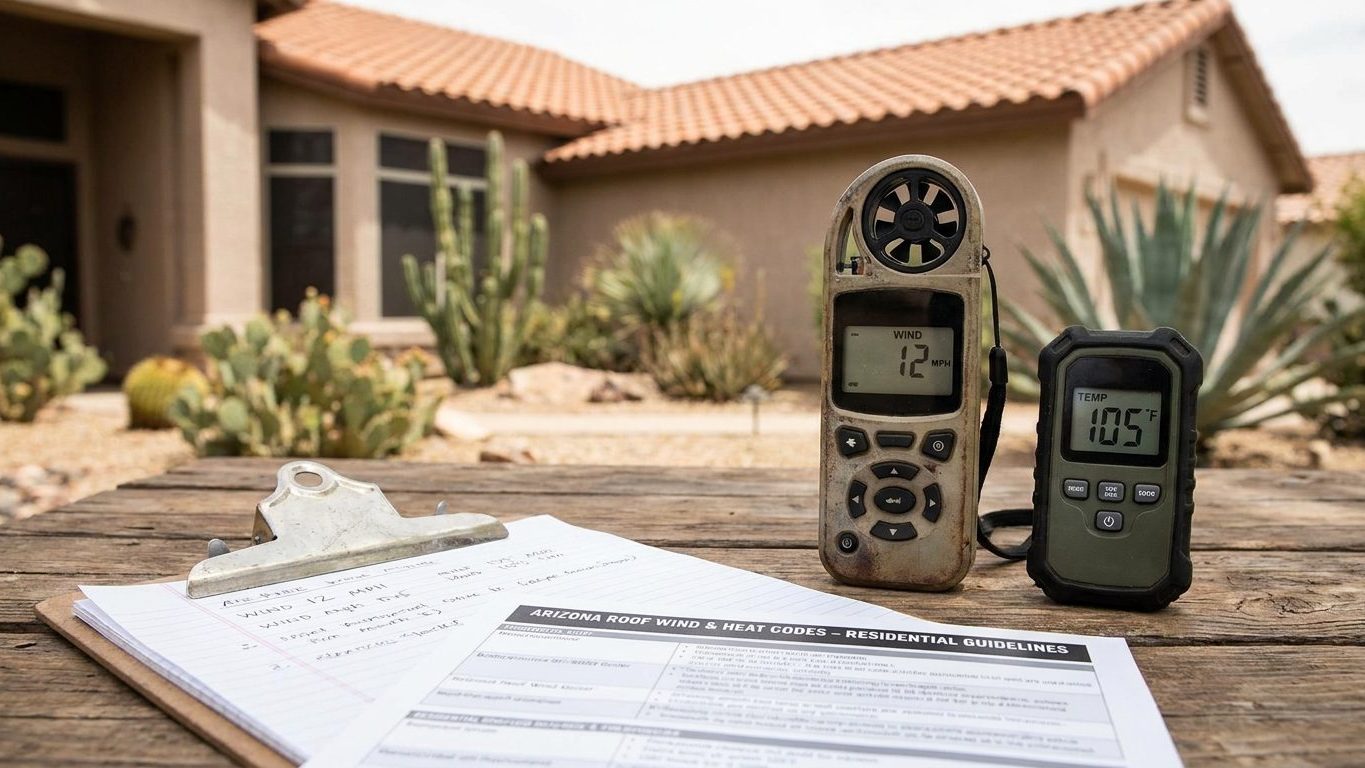

Arizona’s wind speed number doesn’t carry the coastal baggage that comes with it in Florida or the Carolinas. Around Phoenix, a roof has to withstand a 101 mph gust under the wind provisions builders use today, and that figure never reaches the threshold that triggers impact-glass and shutter rules on hurricane-coast pages. There’s also no statewide code forcing one standard across the state, so the edition your permit actually uses depends on what your county or city has adopted. Check with your local building department for the wind speed and code edition your jurisdiction currently enforces before you spec fasteners or shingles.
What wind speed must a roof withstand in Arizona?

At Phoenix, the basic design wind speed is 101 mph under ASCE 7-16, the edition IRC/IBC 2021 makes applicable in most states, and ASCE’s newer 7-22 maps the same point at the same 101 mph. That number is not a sustained wind and not what a weather forecast calls “wind speed.” It’s a 3-second gust measured at 33 feet above open, flat ground (Exposure C), for an ordinary house in Risk Category II. A momentary gust during a storm can read higher on a home weather station without changing the design figure a structural engineer works from.
This number is what the whole roof assembly gets built around in a state with no snow load to speak of. It sets the wind rating a shingle needs to carry, the nailing pattern that holds it down, how the sheathing panels get fastened to the rafters or trusses, and the metal connectors, straps and clips that tie the roof structure back down to the walls. None of that is cosmetic. Uplift is a suction force, not a push, and it concentrates hardest at specific places on a roof:
- Roof edges and rakes, where wind separates from the surface and pulls upward
- Ridges and hips, where two planes meet and pressure spikes
- Corners, where two edge conditions overlap
Those are the spots that lose shingles first in a windstorm, and they’re the spots a competent installer reinforces with tighter nailing or fastening schedules. The 101 mph figure belongs to Phoenix specifically. Wind speeds mapped by ASCE run higher in some other parts of the state, including higher terrain and areas away from the low desert, so a number pulled from a Phoenix-focused page should never be assumed to cover a mountain town or a different county without checking the local map. A neighboring state’s coast tells a very different story: the same wind maps that give Phoenix its 101 mph put the design speed at some points on the North Carolina coast well above 130 mph, which is the kind of gap covered on the California’s roof wind speed and heat rules page for that state’s coastal counties.
Does Arizona require impact-rated roofing or shutters?
No, not around Phoenix. The requirement for impact-rated glazing or approved shutters on windows, doors and skylights only switches on once the design wind speed crosses a 140 mph threshold, and Phoenix’s 101 mph figure sits well below that line. That’s a real difference from the pages covering Gulf and Atlantic coastal counties, and from island territory like the one covered on the Hawaii’s roof wind speed and heat rules page, where the wind figures and the debris-region rules that follow from them look nothing like Arizona’s.
Understanding why that threshold exists is worth a minute even where it doesn’t apply. The rule is about openings, not roofing material. If a window, door or skylight fails in high wind, the wind that rushes into the building pressurizes the interior from the inside out, and that internal pressure pushes up against the roof deck on top of the external suction already pulling at it from above. A roof that would have held under wind load alone can fail once an opening goes first. That’s the mechanism, and it’s why in the states where it applies, the code treats windows and the roof as one connected problem rather than two separate ones.
What a roof still does on its own
Even without a debris-region requirement, the roof assembly still carries the wind load by itself, and a few details matter more than the shingle brand ever will: a fully sealed roof deck (taped or sealed seams at the sheathing joints), ring-shank nails rather than smooth shank for sheathing fastening, a secondary water barrier under the covering, and the connectors that carry uplift load down through the wall framing to the foundation. Arizona has no statewide residential code and no state agency that administers one; the state legislature simply lets a county board of supervisors or a city council adopt a code by reference if it chooses to, so the edition governing these details in your case is whichever one your county or city has adopted. That’s a local answer, and your building department is the only place to get it.
Does snow ever matter for a roof in Arizona?
Not around Phoenix. The design ground snow load there is 0 psf under ASCE 7-16, the edition behind the IRC/IBC 2021 code that most states apply, and it’s the figure a Phoenix-area permit and truss drawing are built on. ASCE’s newer 7-22 maps the same point at 3 psf, but that figure runs on a different, strength-level basis than the older nominal figure, so the two aren’t measuring the same thing and the difference is not a sign of a worsening climate or an undersized older roof. Either way, snow load isn’t what shapes a roof design in this part of the state. Wind is.
That doesn’t mean an unusual snowfall does nothing. A roof that was never designed to shed snow load can still run into trouble through drainage rather than weight, especially on flat and low-slope roofs where scuppers and drains can clog with debris and then ice over, leaving standing water with nowhere to go once it melts. That’s a maintenance and drainage issue, not a structural one, and it’s worth checking scuppers and roof drains before a winter storm rather than after.
How much does heat shorten a roof in Arizona?

Heat, not wind, is what wears out a roof covering here year after year. NOAA’s 1991-2020 climate normals put Phoenix at 168.9 days a year reaching 90°F or higher, which is the real measure of the summer heat load a roof surface has to absorb, day after day, for most of the year. That’s a very different exposure than the wind load discussed above: wind is an occasional structural event, heat is a constant chemical one.
What the heat actually does to the material
Asphalt shingles rely on volatile oils in the asphalt to stay flexible. Ultraviolet light and sustained heat drive those oils out of the mat over time, and as they go the shingle stiffens and loses the flexibility that let it lie flat and seal against wind. Once the mat is brittle, granules stop staying put, and a shingle in that state is more likely to crack, curl, or lose its grip in the next windstorm the 101 mph design figure was built around. This is a slow process, but a hot climate runs it faster than a cool one.
A dark shingle on a poorly vented roof deck can run its surface temperature far above the surrounding air temperature on a summer afternoon, and the attic underneath absorbs a share of that heat too. That’s why attic ventilation is a roof-lifespan question as much as a comfort one: a vented attic that moves hot air out keeps both the underside of the deck and the living space below it cooler than a sealed, stagnant one. The IECC’s 2021 climate zone map splits Arizona’s 15 counties across four zones (5 counties in zone 3B, 5 in zone 2B, 3 in zone 5B, and 2 in zone 4B), and that spread is exactly why insulation and ventilation specs pulled from a national guide need to be checked against the right county’s row in the local table rather than assumed for the whole state.
What roofing material suits Arizona best?
Around Phoenix, where wind sets the design load and snow doesn’t factor in at all, the honest starting point isn’t which covering to buy. It’s that the fastening and the deck underneath the covering matter more than the covering itself. A shingle rated for high wind speeds and then nailed to a lower fastening standard on site performs to the lower standard, not to the rating printed on the wrapper. That single fact matters more than any material comparison that follows.
With that said, the categories do behave differently under this state’s combination of wind load and heat load:
| Material | Wind performance | Heat performance |
|---|---|---|
| Architectural asphalt shingles | Carries a manufacturer wind rating tied to a specific nailing pattern, uplift resistance depends on that pattern being followed exactly | Asphalt mat loses flexibility fastest under prolonged heat and UV exposure |
| Standing-seam metal | Uplift resistance comes from concealed clips fastened to the deck rather than exposed fasteners | Reflective finishes can shed more radiant heat than a dark surface, moderating deck temperature |
| Concrete or clay tile | Heavy overall, but individual tiles and their fasteners can be vulnerable at the edges and ridges where uplift concentrates | Long-lived under direct sun, the tile body itself is largely inert to UV degradation |
Where the heat load is as high as it is around Phoenix, a more reflective roof surface, light in color or specifically designed to reflect solar radiation, lowers the surface and deck temperature compared to a dark one exposed to the same sun. That changes the thermal stress the material sees over the roof’s life, though it doesn’t change the wind design figure at all. None of this substitutes for a permit review: whichever material and fastening schedule you land on still has to be checked against the wind speed, exposure category and fastening schedule your local building department applies at your address.