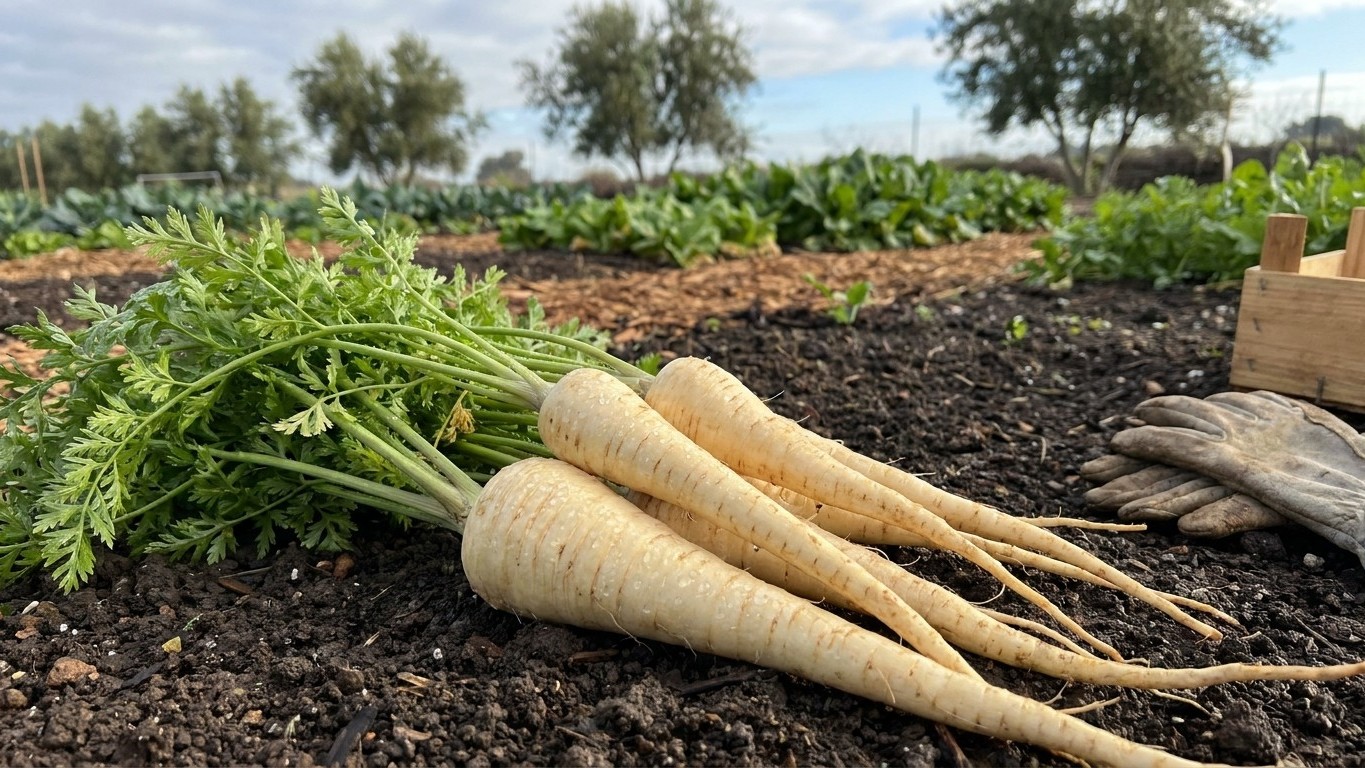

South Dakota gardeners lose parsnip mostly to soil pests early in the season and chewing insects later, not to one single named enemy. SDSU Extension documents twelve garden pests for this state, but only a handful ever touch parsnip roots or foliage: wireworms below ground from planting on, then flea beetles, grasshoppers, and blister beetles above ground as the frost-free season runs its course. Which one you’re looking at depends on what got eaten, and when.
Which pests attack parsnip in South Dakota

SDSU Extension documents twelve pests statewide across garden vegetables: Asparagus beetles, Blister beetles, Cabbage looper, Colorado potato beetle, Cucumber beetles, Diamondback moth caterpillar, Flea beetles, Grasshoppers, Imported cabbageworm, Squash bug, Squash vine borer, and Wireworms. That is the complete list for this territory as the service records it. It does not lengthen just because a garden grows a dozen different vegetables side by side.
Most of that list has nothing to do with a root crop. Asparagus beetles feed only on asparagus spears and fern growth, a plant family parsnip does not belong to. Colorado potato beetle targets potato-family foliage, meaning potato, eggplant, and tomato leaves, not the carrot-family top a parsnip carries. Cucumber beetles concentrate on cucurbit vines, cucumbers, squash, and melons, and rarely bother a parsnip bed unless it happens to sit right next to a squash patch. Cabbage looper, diamondback moth caterpillar, and imported cabbageworm are all cole-crop specialists, feeding on cabbage, broccoli, and kale leaves and leaving unrelated crops alone. Squash bug and squash vine borer are named for their host for a reason, and neither one has a documented reason to cross into a parsnip row.
That leaves four pests worth watching on parsnip specifically. Wireworms live in the soil and feed on seeds and root tissue, which puts them in direct conflict with a crop that is grown entirely for its root. Flea beetles chew tiny shot holes in young seedling leaves across many vegetable types, parsnip included, and do their worst damage before a plant has built up much size. Grasshoppers are true generalists that will strip foliage off almost anything standing in a garden once their numbers build, and a parsnip top is no exception. Blister beetles feed in clusters on foliage and can move quickly between adjacent garden rows, sometimes stripping a patch of leaves in a matter of days.
What decides whether a pest belongs on a parsnip page is simple: does it feed underground on the root, or aboveground on leaves the root still needs in order to bulk up. Everything else on the SDSU Extension list feeds on a plant family, or a plant part, that parsnip does not have.
When each one shows up, and what it does first
Parsnip is sown directly into the garden bed, not transplanted, so there is no transplant date to anchor a calendar to. What there is, is a frost-free window: the last spring frost in the reference area runs April 29 to May 9, and germination itself takes 14 to 21 days, so the earliest sign of trouble usually shows before a seedling has even finished sprouting.
Wireworms are active in the soil from the moment seed goes in the ground, feeding on the seed itself before it germinates or on the tender root right after. The first sign is rarely a visible insect. It is a patchy stand, seeds that never come up, or a seedling that wilts and topples over within days of emerging, even though the row was watered and the soil looked fine on top.
Flea beetles show up right around the end of that 14-to-21-day germination window, as soon as the first true leaves unfold. The first sign is small, round, shot-hole feeding scars scattered across the youngest leaves, concentrated on the newest growth rather than spread evenly across the plant.
Grasshoppers build up gradually as the frost-free season runs on, and damage tends to worsen the longer the season goes without a hard freeze. The first sign is ragged notches chewed from the outer edge of the leaves, which grows more extensive over successive days rather than appearing all at once.
Blister beetles tend to arrive later in the season and in clusters, since they move as loose groups from one host plant to the next. The first sign is fast, dense defoliation appearing suddenly in one section of the row, sometimes with several beetles visible together on the same plant, rather than scattered singly across the whole bed.
Telling the damage apart from everything else
Insects are not the only reason a parsnip root looks wrong or a leaf loses tissue. Heavy, stony soil and inconsistent watering both distort roots, and neither one is a pest. A forked or split root has two separate possible causes here, heavy or stony ground on one hand and overwatering on the other, and they do not have the same fix, so treating both as one problem wastes effort.
A quick table helps separate what is chewed from what is just grown wrong:
| Symptom | Likely cause | What tells them apart |
|---|---|---|
| Root forked or split | Heavy/stony soil or overwatering | Dig one root: stones or clay clumps point to soil; even, soggy ground with no obstruction points to watering |
| Patchy stand, seeds never sprout | Wireworms or cold, wet soil delaying germination | Dig near an unsprouted seed: a hollowed, chewed seed means wireworm; a swollen but intact seed points to soil temperature |
| Small round holes in young leaves | Flea beetles | Holes cluster on the newest leaves right after the germination window, not spread evenly across older growth |
| Leaf edges chewed ragged | Grasshoppers or mechanical/hail damage | Grasshopper damage builds gradually across days; hail or mechanical damage appears all at once, uniformly, on a single date |
| Foliage stripped fast in one patch | Blister beetles or foliar disease | Insect feeding leaves chewed tissue with beetles often still visible nearby; disease shows spotting or discoloration before tissue is lost |
None of this replaces an actual look at the plant in front of you. If a symptom does not clearly match one column of that table, that is exactly the case worth sending to a local extension office rather than guessing.
What actually works here, and what is a waste of time
On a short season, timing beats product every time. A lightweight floating cover laid over the row at seeding, before the 14-to-21-day germination window even finishes, keeps flea beetles and grasshoppers off the youngest, most vulnerable leaves without anything sprayed on the plant. Because parsnip is grown for its root and does not need insect pollination to produce a harvest, that cover can stay on far longer than it could on a squash or cucumber row, where blossoms eventually need access.
Installing the barrier before the first shot-hole appears is the decision that matters; putting it on after the damage is already visible protects nothing that hasn’t already been eaten.
Wireworms are harder to intercept once seed is in the ground, since they live in the soil and the damage is already done to that season’s crop by the time a gap in the stand shows up. Working the bed and letting it dry out between plantings, rather than keeping soil constantly wet at seeding time, reduces the conditions wireworms favor, though it will not undo damage to a stand already in the ground.
Hand-removing blister beetles works when populations are small, but they should be handled with care rather than crushed against skin, since a bare-hand approach with this particular beetle group is a common mistake. Tilling a bed after an infestation is already visible is mostly a wasted afternoon: it does not reach wireworms already established below the row, and it does nothing at all for foliage feeders already active above ground. Broad treatment without checking what is actually labeled for use on a root vegetable in this state is also a waste of time and money, since not every product sold for garden pests is approved for every crop.
Where to check this for your own county
SDSU Extension is the source for the pest list on this page, and it documents these species at the state level, not garden by garden. What is recorded statewide is a starting point for what to watch for, not a guarantee of what is actually present in one particular yard. A garden two counties over from another can have wireworms in heavy numbers while a neighboring county sees almost none, depending on soil, crop rotation, and what was planted there in past seasons.
The most useful next step for a specific yard is a call or visit to the county extension office tied to SDSU Extension, where staff see what is actually turning up locally that season, not just what the statewide list documents in general. That local office can also confirm which control options are labeled for use on a root crop in South Dakota, which this page does not attempt to prescribe.
Bring a sample if possible: a chewed leaf, a forked root, or a photo of the damage pattern. That single piece of physical evidence tends to resolve a question faster than a description over the phone, and it lets the office rule out the soil and watering causes covered above before assuming an insect is responsible at all.
Common questions
Do parsnips need frost to taste good in South Dakota?
Yes. According to Utah State University Extension, parsnip sweetness comes from several weeks of cool, frosty weather that converts stored starch into sugar. That sweetening comes from actual exposure to frost, not simply from living in a cold-hardy zone, so leaving roots in the ground into the frosty part of the season matters more than the winter minimum temperature alone.
How long does parsnip take to mature here?
Utah State University Extension puts it at 100 to 120 days from seeding, with germination alone taking 14 to 21 days. Given a last spring frost between April 29 and May 9 and a first fall frost between September 24 and October 4, that window fits, though roots left in the ground past that first fall frost are exactly what gets the frost-sweetening benefit.
What does the first sign of insect damage on parsnip seedlings look like?
Usually small, round shot holes in the first true leaves, appearing right around the end of the 14-to-21-day germination window. A patchy stand or a seedling that wilts and falls over before that window even finishes points underground, toward wireworms, rather than toward a leaf-feeding insect.
Should I spray a pesticide on parsnip for these pests?
That decision, and which product is actually labeled for a root vegetable in South Dakota, is a question for the county extension office tied to SDSU Extension. This page does not name or recommend specific products, since label approval varies by crop and by state.