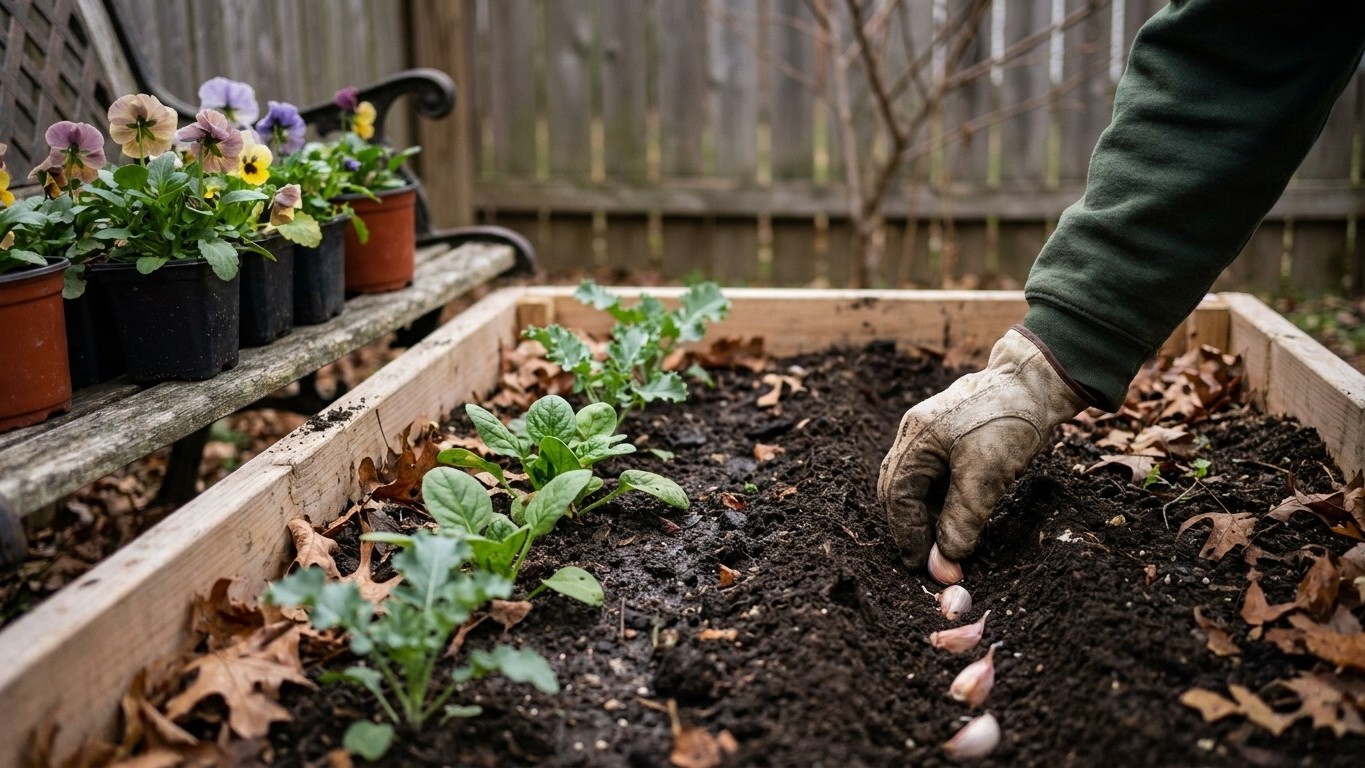

What can you actually put in the ground this month? Garlic and shallots go into loose, well-drained soil right now, and hardy greens like spinach or mâche can still be sown, but only if you’re covering them with a cold frame or low tunnel. Everything else tender is done for the year. Before you dig anything in, walk out and check your soil temperature and the local frost forecast, since that tells you more than the date on the calendar ever will.
What goes in the ground in October

By October the window for anything that fears frost has effectively closed across most of the state. OSU Extension’s reference figures for Columbus put the first fall frost between October 5 and October 15 for zone 6a, and the USDA Plant Hardiness Zone Map, using the 1991-2020 climate normals, places Ohio across zones 5b to 6b, with the colder end running along the higher ground and the lake shore lagging behind it in a different way. That range means a gardener in the hills of southeastern Ohio, or up near Lake Erie, should expect the same frost to land on a different week than Columbus does.
What still goes in the ground
Garlic and shallots are the main direct-plantings of the month, following on from the alliums and hardy greens started in What to Plant in Ohio in September. Cloves and sets go into loosened, well-drained soil while the ground is still workable, ahead of a hard freeze, so the roots can establish before winter without pushing top growth that a frost would only burn back. Garlic planted this month needs a mulch layer once it goes in, both to buffer temperature swings and to keep frost heave from pushing cloves back up over winter.
Hardy greens are the other real option, and only under some kind of cover. Spinach, mâche, claytonia and tough lettuces can be direct sown into a cold frame or under a low tunnel of row cover, where the added few degrees of protection buy enough time for germination before soil temperatures drop too far. Left uncovered in open beds, the same seed sown this late is a gamble against the first hard freeze rather than a bet on a harvest.
Cover crops belong in any bed that has already finished for the season. Cereal rye and winter wheat germinate in cool soil and hold the ground against erosion and weeds over winter, then get turned under before spring planting. Bare-root fruit trees, roses and canes can also go in this month, since the plant is dormant or heading that way and the roots have the whole winter to settle before spring growth starts. None of this replaces the frost check: match the job to the ground temperature and the forecast, not the date on the calendar.
What to start under cover
Counting forward from a spring frost date does not help this month. The count that matters now runs backward from the point where cool soil and short days stop reliable germination, which for direct-seeded greens tracks closely with OSU Extension’s first fall frost window of October 5 to October 15 for the Columbus area. Seed sown much after that window sits in cold soil and often never germinates before the ground shuts down for winter.
Sowing spinach and mâche under cover
Spinach, mâche and claytonia sown in a cold frame or under a low tunnel in the first half of October have the best odds, because the soil still holds enough warmth from summer to sprout the seed within the frost window rather than after it. Wait until the back half of the month in most of the state and the same seed can sit ungerminated until spring, if it survives at all.
The two ways this goes wrong run in opposite directions. Sow too early, while the cold frame is still trapping real heat on sunny days, and greens can bolt or stretch toward the light the way a windowsill seedling does, turning leggy before they ever toughen up for winter. Sow too late, after the ground has cooled past the point of reliable germination, and there is no season left to finish the job. The safest habit is to sow in a narrow window right at the start of the month and check for germination within a week or two, rather than spreading sowings out and hoping one of them lands right.
Indoors, this is also the point to pot up any tender herbs worth carrying through winter on a windowsill, such as rosemary or bay, since a plant already stressed by a first cold snap outdoors transplants worse than one moved in ahead of it.
What is ready to pick
October is a harvest deadline more than a harvest month. Whatever tender crop is still on the vine when OSU Extension’s first fall frost window of October 5 to October 15 arrives near Columbus needs to be in before that date, not after it, since a hard freeze ends tomatoes, peppers and basil outright.
Finishing the tomato patch
Tomato plants set out in mid-to-late May, on the usual OSU Extension frost calculation, are well past their first fruit by October and often still loaded. Indeterminate varieties like Cherokee Purple, Brandywine and Amish Paste, along with paste types like San Marzano II and Tiren, keep setting and ripening fruit right up until frost or a hard chill stops them, so the last picking of the season is often a green-tomato harvest done ahead of the forecast rather than a ripe one. Green fruit finishes indoors on a windowsill or in a paper bag faster than most gardeners expect.
Winter squash and pumpkins should already be off the vine by now if the skin resists a fingernail press and the stem has dried and corked over. Leave them in the field past that point and they gain nothing, but a stem that is still green means the fruit is not done storing sugar yet.
Roots, alliums and stored crops
Potatoes, onions and garlic harvested earlier in the season need a check now rather than a harvest: go through the storage crates and pull anything that has gone soft, sprouted or started to smell, since one rotting onion spreads faster than it looks like it should in a bin of otherwise sound ones. Leeks, kale, Brussels sprouts and other hardy brassicas can stay in the ground and often taste better after the first frost sweetens them, so there is no rush to bring those in before the freeze arrives, only after. For what the garden looks like once that freeze has fully arrived, see What to Plant in Ohio in November.
The jobs that matter this month

October’s real workload is cleanup and preparation, and skipping it costs more than a skipped planting does. Beds that go into winter with disease-ridden plant debris left in place carry that same blight or wilt into next season’s soil, so pulling and destroying, not composting, diseased tomato and squash vines matters more than almost anything else on this list.
Soil, compost and tools
This is also the month to pull a soil test from any bed that struggled, since amendments like lime take months to shift pH and are far more useful added now than in spring when planting is already pressing. A compost pile that has sat all summer benefits from one more turn before the cold slows it down, and any tools that will not see use again until spring should be cleaned of soil, oiled and sharpened while there is time to do it properly rather than rushed in a spring scramble.
- Pull and destroy diseased vines rather than composting them.
- Pull a soil sample from any bed that underperformed, and amend based on the result.
- Turn the compost pile one last time before cold slows it down.
- Clean, oil and sharpen tools that are done for the season.
- Walk the fence line and raised bed frames for repairs before winter weather makes them worse.
- Check stored squash, potatoes and onions for the first signs of rot.
Fruit trees and cane fruit are heading toward dormancy but are not fully there yet in most of the state this month, so major structural pruning is better held for deeper winter once the leaves are down and the wood is clearly dormant. What can happen now is removing anything obviously dead, damaged or diseased, since that kind of cut does not depend on dormancy the way a shaping cut does.
Seed catalogs for the following season often start circulating in the back half of the year, and the varieties that sell out first tend to be the ones with strong disease resistance packages, so placing an order early costs nothing and protects against a favorite running out. Planning next year’s rotation on paper now, while this season’s successes and failures are still fresh, beats trying to reconstruct it from memory in spring.
What not to do in October
The most common mistake is trusting the air temperature over the soil and the calendar. A run of warm, sunny days in early October can feel like an invitation to tuck in one more round of lettuce or beans in open ground, but OSU Extension’s first fall frost window of October 5 to October 15 for the Columbus area is a soil and air event, not a mood, and a single clear, calm night is often all it takes to end anything tender regardless of how the afternoon felt.
Fertilizer, mulch and timing errors
Nitrogen fertilizer applied this month is close to wasted effort on anything headed into dormancy, and worse than wasted on a plant that is not, since it pushes soft new growth right when the plant needs to be hardening off instead. Hold off on nitrogen from here through winter and let whatever is still growing slow down on its own schedule.
Don’t pull mulch back after one mild spell. A week of warm weather does not mean the freezing nights are done, and newly planted garlic or a cold frame bed of greens that gets uncovered too soon can take a harder hit than if it had never been mulched or covered at all, since the plant has already started to lose the hardening it built up.
Tilling wet soil this month compacts it in a way that does not fix itself before spring. If a bed is being turned over or cleared for cover crop seed, wait for it to dry enough that a handful crumbles instead of smearing.
Checking this against your own county
Every figure above is anchored to Columbus, and OSU Extension notes that Ohio spans zones 5b to 6b on the USDA Plant Hardiness Zone Map, with real differences between the northeast lake counties, the higher ground in the southeast, and the milder Ohio River valley. A frost that lands in the first days of October in a low-lying inland county can arrive weeks later along the lake shore, where the water moderates the air well into fall.
Treat every date and window in this piece as a starting point to check, not a fixed instruction. OSU Extension maintains local county offices and a state planting calendar built for exactly this kind of adjustment, and cross-referencing the Ohio planting calendar against your own recent frost history is worth the few minutes it takes.
Common questions
Can I still plant tomatoes or peppers in October in Ohio?
No. Both are frost-tender, and OSU Extension’s first fall frost window of October 5 to October 15 near Columbus ends their season outright. Any transplant set out this late would need to reach harvest before that window, which none of the catalogue varieties commonly grown in Ohio can do from an October start.
Is it too late to plant garlic in October?
Not usually, as long as the ground is still workable and not frozen. Garlic wants a few weeks of root growth before a hard freeze locks the soil, so planting earlier in the month gives more margin than planting at the very end of it, and a heavy mulch layer helps make up the difference either way.
What can I do if my whole garden is done for the year already?
Use the month for jobs that do not depend on anything actively growing: soil testing, compost turning, tool maintenance, and clearing out diseased plant debris. A bed that gets this attention in October is a head start on spring rather than a bed frozen in whatever state the last harvest left it.
Will frost actually kill my kale and Brussels sprouts?
No, and it usually helps rather than hurts. Both crops convert starches to sugars in response to cold, so a light frost tends to make them taste better rather than damaging them, and they can generally stay in the ground well past the first freeze rather than needing an early harvest.