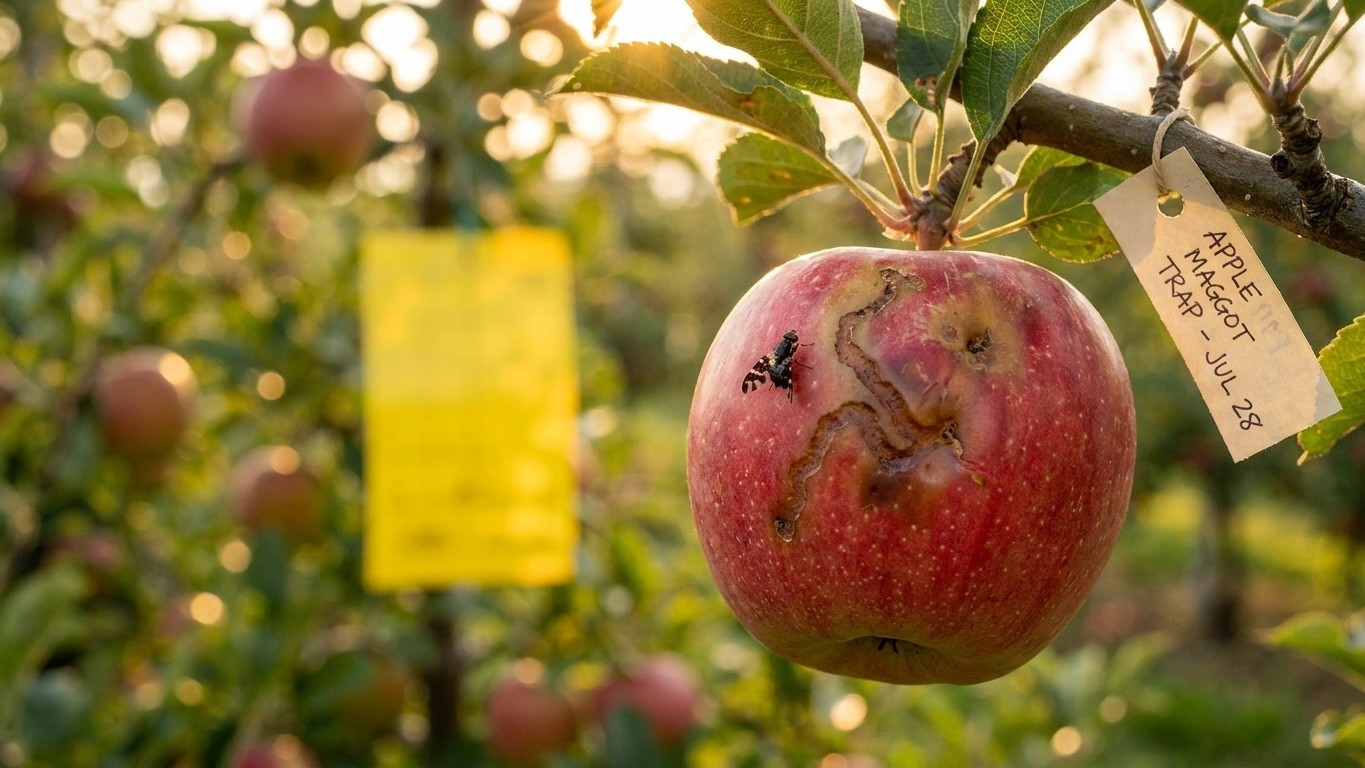

Apple maggot flies emerge in Quebec orchards from mid-July through late August, with peak activity typically hitting between late July and mid-August depending on the season’s heat accumulation. That six-to-eight week window is when the real damage happens, as female flies lay eggs just under the skin of ripening apples and the larvae tunnel through the flesh, turning fruit into a brown, mushy mess. Stopping them means combining timing, sanitation, and targeted traps rather than relying on a single fix.
The weeks to watch

Rhagoletis pomonella, the scientific name for the apple maggot fly, spends most of the year underground as a pupa. Cold winters don’t kill it off. The insect overwinters in the top few inches of soil beneath host trees and waits for soil temperatures to warm enough to trigger emergence, usually once accumulated heat units reach a threshold that Quebec growers track through degree-day models similar to those used across New England and Ontario.
In most Quebec growing regions, from the Montérégie to the Eastern Townships, adult flies start appearing in orchards around the last week of June or the first week of July. Numbers build slowly at first. By mid-July, trap counts climb sharply, and the window from late July through the third week of August is when most egg-laying happens. A single female can lay dozens of eggs over her lifespan, inserting each one individually into the fruit’s skin with a needle-like ovipositor.
Cooler, wetter summers push the emergence curve later. A hot, dry June can pull the first flies out earlier than usual. That’s part of why relying on the calendar alone doesn’t work well here. Growers and home orchardists who track soil temperature or simply hang monitoring traps by late June get a much more accurate read on local timing than anyone guessing from a generic date.
One Generation, Big Consequences
Quebec’s climate typically supports just one generation of apple maggot per year, unlike some warmer regions where partial second generations can occur. That single generation still causes outsized damage because the larval feeding period stretches across most of late summer, and infested fruit often looks fine on the outside for weeks before the internal tunneling becomes obvious.
Host range matters too. Apple maggot doesn’t limit itself to cultivated apple trees. Hawthorn, wild crabapple, and chokecherry growing in hedgerows or along fence lines act as reservoir hosts, letting populations build up even in years when a nearby orchard is well managed. A property with old, unmanaged crabapples nearby faces a much harder battle than one surrounded by open field or lawn.
Signs of Infestation in Fruit
The external clue is subtle: a small dimple or slightly discolored puncture mark where the female fly deposited an egg. Cut the apple open a few weeks later and the picture changes fast. Brown, winding trails run through the flesh, sometimes converging into soft, rotten pockets. Growers call this “railroad worm” damage, a nickname that captures the branching tunnel pattern almost perfectly.
Fruit that drops early is often the first visible warning sign in a backyard tree. Apple maggot larvae push infested apples toward premature ripening and drop, so a sudden scatter of apples on the ground in July, well before normal harvest, deserves a closer look. Cutting open a handful of those dropped apples takes two minutes and tells you immediately whether maggots are the cause.
Commercial packers reject fruit with any visible tunneling, which makes apple maggot as much an economic pest as a cosmetic one. Even light infestation rates can push a harvest below fresh-market grade, forcing growers to sell at processing prices instead.
What Actually Stops Apple Maggot
No single tactic handles apple maggot on its own. Effective control in Quebec orchards and home plantings layers several approaches across the season, starting well before the flies even emerge.
Sanitation Comes First
Removing dropped and infested fruit from under trees on a regular basis, ideally every few days during the danger window, breaks the life cycle at its weakest point. Larvae that finish feeding inside a dropped apple burrow into the soil to pupate within days, so fruit left on the ground for a week or more is already feeding next year’s population. Home growers sometimes skip this step because it’s tedious, but it’s the cheapest and most effective single action available.
Clearing or managing nearby wild hosts helps too. Cutting back hawthorn thickets or unmanaged crabapples near an orchard reduces the reservoir population that reinfests trees year after year.
Traps: Monitoring and Mass Reduction
Red sticky sphere traps, designed to mimic a ripening apple, are the standard monitoring tool. Baited with an apple-scent lure, they attract female flies looking for egg-laying sites. Hung at eye level on the sunny side of the tree canopy starting in late June, these traps let growers pinpoint exactly when local flies begin emerging rather than guessing from regional averages.
For small home orchards with just a handful of trees, dense trap deployment, sometimes several traps per tree, can meaningfully reduce the population through direct capture, not just monitoring. Commercial operations generally can’t rely on trapping alone at that density across acres of trees, so traps there function mainly as an early-warning system that triggers other control measures.
Timed Insecticide Applications
Once trap counts show flies are active, targeted insecticide sprays timed to adult activity remain the backbone of commercial control. Because apple maggot lays eggs almost immediately after mating, the goal is to kill adults before they get the chance, which means spray timing tracks trap counts closely rather than following a fixed calendar. Quebec’s agricultural extension network, through the Ministère de l’Agriculture, des Pêcheries et de l’Alimentation (MAPAQ), publishes seasonal pest bulletins that track regional emergence and help growers time applications than they could on their own.
Home growers with just a tree or two often skip broad insecticide use in favor of physical barriers instead, which brings less risk to pollinators visiting nearby flowers on other plants.
Physical Barriers and Repellents
Kaolin clay, a fine white mineral powder sprayed onto fruit and foliage, works by making the surface unrecognizable and unappealing to egg-laying females. It needs reapplication after rain and doesn’t eliminate risk entirely, but it’s a low-toxicity option that fits well with smaller-scale or organic growing.
Individual fruit bagging, using small mesh or paper bags slipped over young apples shortly after fruit set, offers close to complete protection for backyard trees. It’s labor-intensive on a large scale but genuinely effective for someone with three or four trees who wants clean fruit without chemical sprays.
Which Quebec Regions See the Heaviest Pressure
Apple maggot pressure tracks closely with Quebec’s main apple-growing regions: the Montérégie south of Montreal, the Eastern Townships, and parts of the Outaouais and Laurentides where older orchards and abundant wild hosts overlap. These areas combine warm summer heat accumulation with a long history of apple cultivation, both factors that favor stable, well-established maggot populations.
Newer orchards planted on previously non-agricultural land, or properties farther from established apple-growing areas, sometimes see lighter early pressure simply because the local population hasn’t built up yet. That advantage tends to erode within a few years as flies migrate in from surrounding hosts, which is why prevention works better started early rather than waiting for the first sign of damage.
One detail that surprises a lot of backyard growers: apple maggot doesn’t need a commercial orchard nearby to become a problem. A single untended crabapple two properties over can sustain a population large enough to infest a well-cared-for dwarf apple tree in a suburban yard, which is why regional awareness matters as much as what happens inside a single fence line.