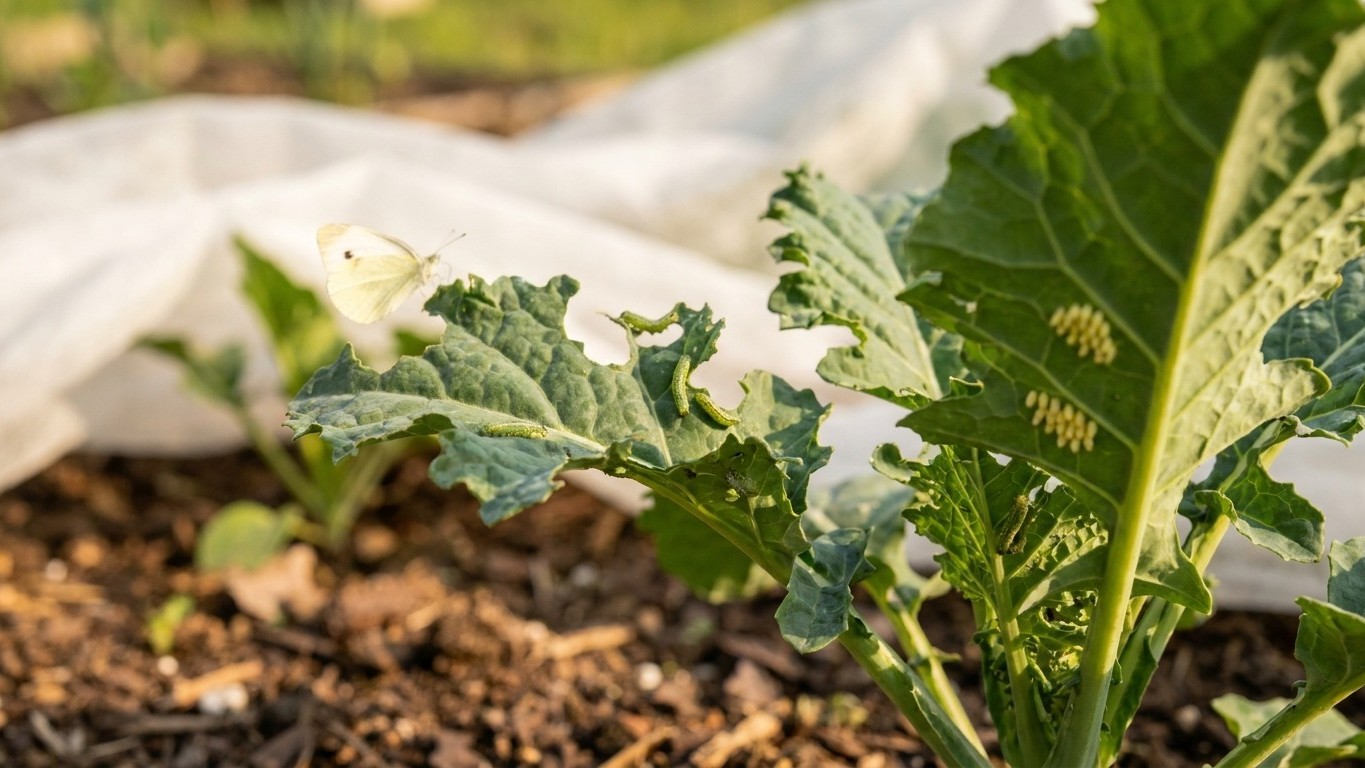

Imported cabbageworm larvae start chewing through Virginia brassicas as early as mid-April in the Tidewater region and can keep feeding into late October, with three to four overlapping generations hatching out between spring and fall. The single most reliable stop is Bacillus thuringiensis (Bt) sprayed while larvae are still small, backed up by floating row covers installed before the first white butterflies show up in your yard.
Virginia’s Cabbageworm Calendar: Three to Four Generations a Year

The imported cabbageworm (Pieris rapae) survives Virginia winters as a pupa tucked into plant debris, fence posts, or garden mulch. Once soil temperatures climb into the mid-50s, adults emerge as the small white butterflies you’ve probably seen fluttering low over kale and broccoli beds. In the Coastal Plain and Hampton Roads area, that emergence often happens by late March. In the Shenandoah Valley and the mountains of Southwest Virginia, it can lag two to three weeks behind.
Each female lays pale yellow, bullet-shaped eggs singly on the undersides of leaves, sometimes more than 100 over her lifetime. Eggs hatch in three to seven days depending on temperature, and the resulting larvae feed for roughly two to three weeks before pupating. That whole cycle, from egg to adult, takes about a month in warm weather. Virginia’s growing season is long enough to squeeze in three full generations most years, and a fourth partial one in warmer counties near the North Carolina line.
Damage tends to spike twice: once in late May through June as the first generation matures on spring cabbage and broccoli, and again in August and September when populations peak on fall brassica plantings. That second wave is usually the more destructive one, since larvae numbers have compounded across two or three generations by then.
Spotting the Damage Before It Spreads
Imported cabbageworm larvae are velvety green, faintly fuzzy, and blend in so well with cabbage and collard leaves that they’re often missed until the damage is obvious. They’re frequently confused with cabbage looper caterpillars, but there’s an easy tell: cabbageworms have four pairs of prolegs and crawl steadily, while loopers have fewer prolegs and move with a distinctive arching hump, the way inchworms do.
Look for irregular holes chewed between leaf veins, ragged edges on outer leaves, and small dark green pellets of frass caught in the leaf folds near the center of the plant. On cabbage and Brussels sprouts, larvae often bore into the developing head itself, which is the damage gardeners notice too late, after harvest. Checking the undersides of leaves weekly, starting the moment transplants go in the ground, catches infestations while they’re still just a few larvae per plant.
Broccoli, cauliflower, kale, collards, mustard greens, and turnips are all fair game, but cabbage and collards tend to draw the heaviest pressure in Virginia gardens, partly because they’re planted in such volume for both spring and fall harvests.
What Actually Stops Imported Cabbageworm in Virginia Gardens
Bt sprays timed to larval stage, not calendar dates
Bacillus thuringiensis var. kurstaki remains the standard control recommended by land-grant extension programs across the mid-Atlantic. It works by disrupting the digestive tract of caterpillars that eat treated leaves, but it only affects larvae, not eggs or adult butterflies, and it breaks down within a week under sunlight and rain. That means spraying by the calendar is a mistake. The better approach is scouting first, then applying Bt as soon as young larvae appear, ideally when they’re still under half an inch long, since older larvae are more resistant and cause damage faster than the spray can catch up to.
Because Virginia’s humid summers bring frequent thunderstorms, reapplication every seven to ten days during active feeding periods is typical, and always after a heavy rain washes residue off the leaves.
Row covers installed before the butterflies find your bed
Lightweight floating row covers, the spun polyester kind sold at most garden centers, physically block adult butterflies from laying eggs in the first place. The catch is timing: covers only work if they go on before adults start visiting, which in most of Virginia means right after transplanting or seeding, not after you’ve already spotted white butterflies patrolling the bed. Covers need to be sealed at the edges with soil or stakes, since a gap of just a few inches gives egg-laying females an opening.
This method works best on brassicas that don’t need pollinators, which covers almost all cabbage-family crops grown for leaves or heads rather than seed.
Natural enemies already working in Virginia yards
Parasitic wasps in the genus Cotesia and Trichogramma attack cabbageworm eggs and larvae, and they’re present in most Virginia gardens without any introduction needed. Birds, especially chickadees and sparrows, pick off larvae from exposed foliage, and predatory stink bugs and lacewing larvae feed on eggs. Broad-spectrum insecticides wipe out these allies along with the pest, which is one reason extension entomologists generally steer gardeners toward Bt over synthetic sprays for cabbageworm specifically, since it spares the parasitoids and predators doing free work in the background.
Leaving a strip of flowering plants near brassica beds, dill and yarrow both work well in Virginia’s climate, gives those parasitic wasps a nectar source and keeps them established near the crop they’re protecting.
Hand-picking and rotation for small plantings
For a raised bed or two, checking leaves every few days and squashing eggs and larvae by hand keeps populations low without any spray at all. It’s tedious but effective, particularly early in the season before numbers build. Rotating brassica plantings to a different part of the yard each year also matters, since pupae overwintering in soil and debris near last year’s cabbage patch give the first spring generation a head start if the crop goes right back in the same spot.
Regional Differences: Coastal Plain, Piedmont, and the Mountains
Virginia’s geography stretches across USDA hardiness zones 5b to 8a, and that range shows up directly in cabbageworm timing. Tidewater and Hampton Roads gardeners, working in zone 7b to 8a, see the earliest spring emergence and often get a fourth generation squeezed in before frost. The Piedmont, around Richmond and Charlottesville, runs about two weeks behind the coast. Southwest Virginia and the higher elevations of the Blue Ridge, down in zone 5b to 6a, see later spring emergence, generally mid-to-late April, and a shorter window overall, which tends to cap populations at three generations.
Fall brassica crops face the sharpest regional divide. In eastern Virginia, gardeners can plant collards and kale into early September and still expect a full harvest before frost, but that window also means those late plantings run straight into the year’s largest cabbageworm population. In the mountains, an earlier fall planting deadline, usually mid-August, cuts the overlap with peak larval activity, which is one reason mountain gardeners sometimes report less fall damage than their counterparts near the coast, even with a shorter growing season overall.
One detail that surprises a lot of home gardeners: imported cabbageworm butterflies are active on cool, overcast days too, not just bright sunshine, which means egg-laying doesn’t pause during the humid, hazy stretches so common in a Virginia July. Scouting on a cloudy afternoon isn’t wasted effort, and skipping a week because the weather looked unpromising for butterflies is exactly how a small infestation turns into a defoliated cabbage head.
Related guides
- Imported cabbageworm in Tennessee: When It Shows Up and What Stops It
- Imported cabbageworm in North Carolina: When It Shows Up and What Stops It
- Imported cabbageworm in Wisconsin: When It Shows Up and What Stops It
- Imported cabbageworm in Alabama: When It Shows Up and What Stops It
- Imported cabbageworm in New York: When It Shows Up and What Stops It