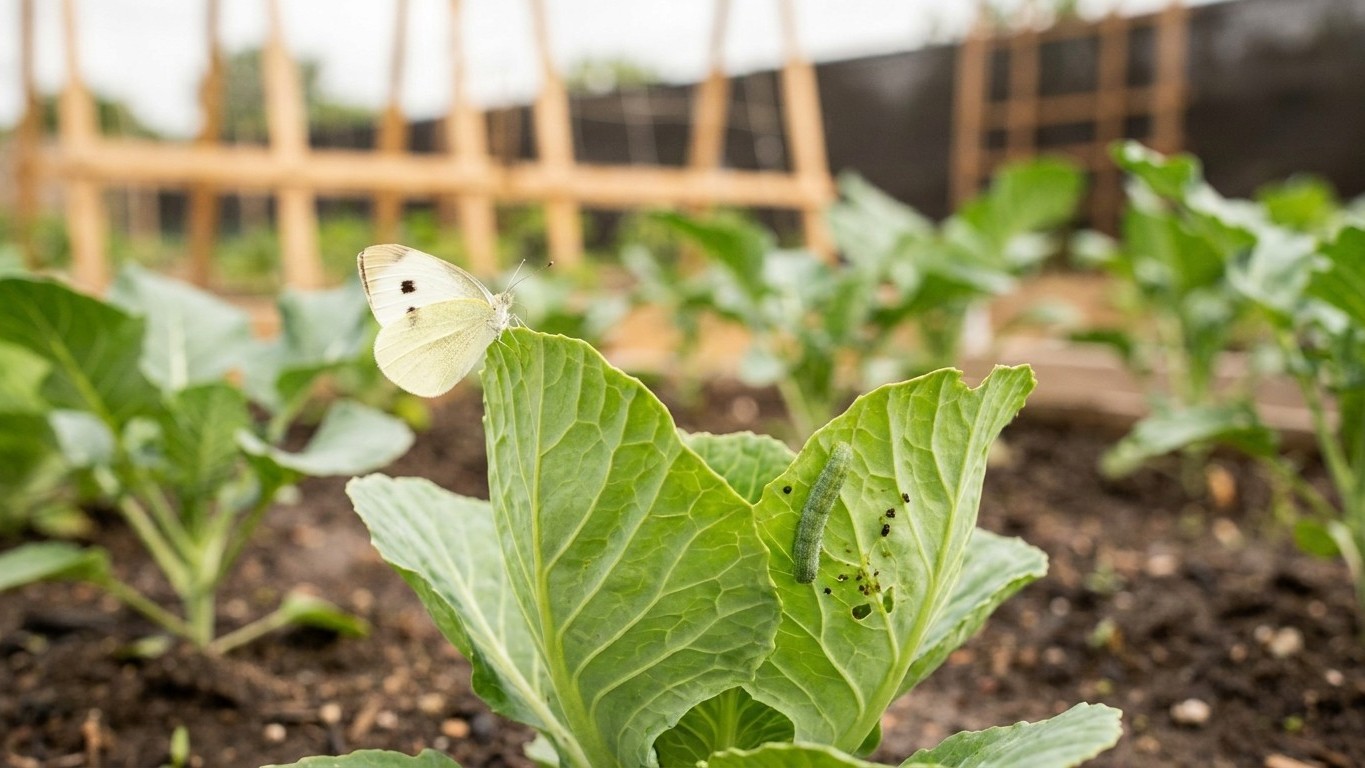

Imported cabbageworm larvae start chewing through Wisconsin cole crops as early as mid-May in the southern counties, once the first generation of adult butterflies has laid eggs on young cabbage, broccoli, and kale transplants. Cool nights don’t stop this pest the way they do some others. The white butterflies with the telltale black wing spots show up almost as soon as gardens get planted, and by late June the velvety green caterpillars are already boring into heads of cabbage across the state.
The weeks to watch

The adult butterfly, Pieris rapae, overwinters as a pupa attached to plant debris, fence posts, or the undersides of garden structures. Wisconsin’s extended cold snaps don’t kill it off the way you might expect. Research from cold-climate entomology programs shows the pupal stage tolerates hard freezes just fine, which is why the first generation of adults emerges reliably each spring once temperatures climb into the 50s for several consecutive days.
In southern Wisconsin, that first flight typically happens between late April and mid-May. Northern counties lag a couple of weeks behind, with first sightings more common in late May. From there, the cycle repeats. A single female can lay 300 to 400 eggs over her lifetime, spaced individually on the undersides of leaves rather than in clusters. Those eggs hatch in three to seven days depending on temperature, and the larvae feed for two to three weeks before pupating.
Wisconsin’s growing season allows for three to four overlapping generations, running from May through the first frosts of October. That overlap is the real headache for gardeners. Just when one wave of caterpillars finishes feeding, the next batch of eggs is already hatching. By August, home gardens can have all life stages present at once, which is why a single spray or a single hand-picking session rarely finishes the job.
How to Tell It Apart From Other Cole Crop Pests
Wisconsin gardeners deal with three look-alike caterpillars on brassicas, and mixing them up leads to wasted effort on the wrong control method. The imported cabbageworm is velvety, solid green, and moves slowly. It sits still when disturbed rather than thrashing around.
The cabbage looper, by contrast, arches its back into a distinctive loop as it crawls, earning its name the way an inchworm does. Diamondback moth larvae are smaller, more slender, and wriggle violently when touched, often dropping off the leaf on a silk thread. Knowing which one you’re facing matters because some biological controls work better on one species than another.
- Imported cabbageworm: solid green, velvety texture, slow-moving, single faint yellow stripe down the back
- Cabbage looper: pale green with white stripes, arches into a loop while crawling
- Diamondback moth larva: small, tapered at both ends, thrashes and drops on silk when disturbed
Feeding damage also differs slightly. Cabbageworms tend to bore straight into the head of cabbage or cauliflower, leaving behind wet, greenish droppings packed into the crevices. That contamination is often the bigger problem for gardeners planning to eat what they grow, since a head riddled with frass isn’t appetizing even after the worms are gone.
What Actually Stops It
Floating row cover, installed right after transplanting and sealed at the soil line, remains the single most reliable non-chemical barrier. Because the adult butterfly needs direct access to lay eggs on leaf surfaces, a physical barrier stops the problem before it starts. The catch is timing. Cover has to go on before the first flight of adults in your area, not after damage is already spotted.
Bacillus thuringiensis subspecies kurstaki, sold under various commercial names as a biological insecticide, remains the go-to treatment once caterpillars are actively feeding. It’s a bacterium that produces a protein toxic specifically to caterpillar digestive systems, meaning it leaves bees, beneficial beetles, and other non-target insects unharmed. The Environmental Protection Agency classifies Bt products as having low toxicity to humans and most wildlife, which is part of why extension programs across the Midwest recommend it as a first-line treatment for home gardens. It needs reapplication after rain and works best on young larvae, so catching an infestation early still matters even with a biological option in hand.
Wisconsin also benefits from an established biological control that most gardeners never see at work. Cotesia glomerata, a small parasitic wasp introduced to North America roughly a century ago specifically to fight imported cabbageworm, has become a permanent part of the state’s insect community. The wasp lays its eggs inside young caterpillars, and the developing larvae eventually kill the host from within, emerging as a cluster of small yellow cocoons attached to the dead caterpillar’s body. Finding those cocoons on a plant is actually good news. It means natural predation is already reducing pressure without any intervention.
Hand-picking still works for small home plots, particularly since the caterpillar’s slow movement and lack of camouflage against the pale undersides of leaves make it one of the easier garden pests to spot. Checking plants every two to three days during peak season, focusing on leaf undersides near the center of the plant where eggs concentrate, catches most infestations before they cause serious damage.
Crop Rotation and Timing Tricks
Delaying transplant dates by even two weeks can shift a crop out of sync with the first generation’s egg-laying window, though this trades off against Wisconsin’s already short growing season for slower crops like cauliflower. Gardeners who succession-plant broccoli or kale sometimes find that later plantings actually face heavier pressure, since they coincide with the second and third generation flights in July and August, which tend to be larger than the spring emergence.
Interplanting with strong-scented herbs like dill, thyme, or sage has shown modest results in university trials, likely by disrupting the visual and chemical cues butterflies use to locate host plants, though it won’t replace row covers or Bt as a primary strategy. Removing crop debris after harvest also denies the pupal stage a place to overwinter close to next year’s planting bed, which can reduce the size of the first spring generation on that specific plot.
Regional Differences Across Wisconsin
Southern Wisconsin counties, including the areas around Madison and Milwaukee, see the longest exposure window and the most generations per season because of a longer frost-free period. Gardeners there often deal with pressure from May through early October.
Northern counties near Lake Superior compress that window considerably. A shorter frost-free season, sometimes 30 to 40 days shorter than the southern part of the state, generally limits the pest to two or three generations rather than four. That said, cooler summer temperatures don’t slow the caterpillar down much once it’s established, so northern gardeners shouldn’t assume lighter pressure means less vigilance.
Commercial cabbage and cauliflower operations in Wisconsin, a state that ranks among the top producers of processing cabbage in the country, monitor cabbageworm populations using pheromone traps and threshold-based spraying rather than calendar-based schedules. Home gardeners can borrow that logic even without traps, simply by checking plants on a regular schedule rather than spraying preventively on a set calendar.
When Damage Crosses a Threshold Worth Treating
Not every cabbageworm sighting requires action. A few caterpillars scattered across a healthy stand of kale rarely threaten the harvest, and natural predators including birds, spiders, and the parasitic wasps mentioned above often bring numbers down before damage becomes serious. The threshold most extension guidance points to is noticeable feeding on more than 10 to 20 percent of leaf area on young transplants, or any visible tunneling into developing heads on cabbage and cauliflower, since that kind of damage doesn’t heal and can invite secondary rot.
Broccoli and cauliflower are more vulnerable at the head-forming stage than at earlier growth, since a caterpillar boring into a developing floret ruins that portion for harvest even if the rest of the plant looks fine. Cabbage, with its dense wrapped leaves, can sometimes tolerate feeding damage on the outer leaves without affecting the marketable head underneath, which is one reason some gardeners choose to treat kale and broccoli more aggressively than cabbage itself.
One detail that surprises a lot of first-time vegetable gardeners: the caterpillar itself isn’t what ruins most home harvests. It’s the frass left behind in the crevices of a cabbage head, which can be nearly impossible to rinse out completely once the plant has matured past the point of easy inspection. That’s the practical argument for checking plants early and often rather than waiting for a head to fill out before dealing with an infestation that started weeks earlier.