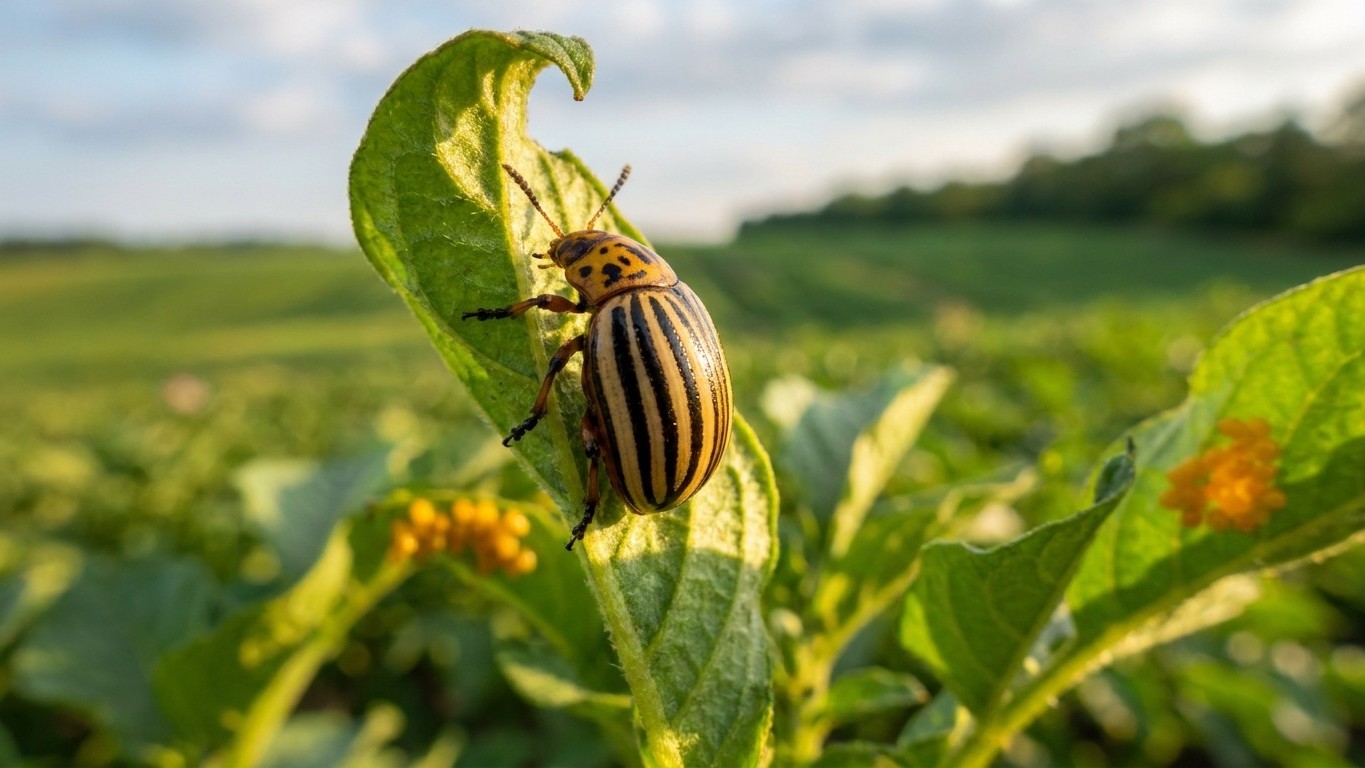

Colorado potato beetles start showing up in Prince Edward Island potato fields in late May through June, once soil temperatures hold steady above 50°F for several consecutive days. That timing lines up almost exactly with early potato emergence, which means the pest and its favorite food source break ground together. Stopping it comes down to three things done consistently: rotating fields away from last year’s potato ground, scouting for egg masses before they hatch, and rotating insecticide classes so the beetle doesn’t build resistance faster than growers can adapt.
When Colorado Potato Beetles Show Up on PEI

The beetle spends winter as an adult buried six to eight inches deep in soil, often right at the edge of last season’s potato field. Cold doesn’t kill it. Snow cover on the Island actually insulates overwintering beetles rather than freezing them out, which is one reason a hard winter rarely translates into a lighter beetle year the following spring.
Emergence depends on soil warming, not the calendar. In a cool, wet spring, beetles might not surface until mid-June. In a warm year, late May is common. Once adults dig out, they walk or fly short distances to the nearest host plants, feed for a week or two, then start laying eggs in tight clusters of 20 to 40 on the underside of leaves. Those eggs are bright orange-yellow and easy to spot if you’re actually looking for them, which most gardeners aren’t until damage is already visible.
Larvae hatch within a week and go through four growth stages over roughly two to three weeks, doing the bulk of their feeding damage in the final stage before dropping to the soil to pupate. Adults emerge from the soil 10 to 14 days later. In PEI’s shorter growing season, most fields see one full generation with a partial second generation showing up in August, whereas warmer regions further south can push through two or three complete cycles. That single-generation pattern is actually a break for Island growers, since it narrows the window when control measures matter most.
Why the Timing Window Matters
The highest-risk period runs from beetle emergence through the first larval hatch, typically a three to four week stretch starting sometime in June. Miss that window and a grower is reacting to established larvae instead of preventing them. Extension specialists in Atlantic Canada consistently point to early-season scouting as the difference between a manageable infestation and one that requires repeated insecticide applications later in the summer.
Why PEI’s Potato Fields Are Ground Zero
Prince Edward Island grows more potatoes per capita than almost anywhere else in North America. Potatoes cover roughly a quarter of the Island’s farmland in a typical year, and that concentration creates exactly the kind of habitat Colorado potato beetles thrive in: dense, predictable, and close together. A beetle that survives winter in one field doesn’t have far to travel to find its next meal.
That density has a downside beyond simple pest pressure. Colorado potato beetle is famous among entomologists for developing insecticide resistance faster than almost any other agricultural pest in North America. It has shown resistance to DDT, organophosphates, carbamates, pyrethroids, and in some regions, certain neonicotinoids. When a single chemical class gets used repeatedly across a tight geographic area like PEI’s potato belt, the beetle population adapts within a handful of seasons. This is why the Island’s potato industry, working with agronomists and Agriculture and Agri-Food Canada researchers, pushes hard on rotating modes of action rather than leaning on one product year after year.
Soil type plays a role too. The sandy loam common across much of PEI drains well and warms quickly in spring, which is good for potato growth but also gives overwintering beetles an easier path to the surface compared to heavier clay soils that stay cold and compacted longer.
What Actually Stops It
Crop rotation remains the single most effective non-chemical tool available, and it works because of how the beetle overwinters. Since adults emerge close to where they spent winter, planting potatoes in a different field, ideally a half-mile or more from the previous year’s crop, forces beetles to travel farther and exposes them longer to predators, weather, and starvation before they find a host plant. A one-year rotation cuts pressure noticeably. A two or three-year rotation cuts it further, though few operations have the acreage to rotate that aggressively every season.
Scouting twice a week during the emergence window catches egg masses before they hatch. Flipping leaves near field edges, where beetles tend to concentrate first, takes a few minutes and tells a grower or gardener whether treatment is even necessary yet. Removing egg masses by hand works fine on a garden scale. On a commercial field, that’s obviously not practical, which is where threshold-based spraying comes in: many extension programs recommend treating only once beetle counts or egg mass density cross a defined threshold, rather than spraying on a fixed calendar.
Physical barriers help smaller operations more than large commercial fields. Because adult beetles that overwintered in the soil often walk into a new field rather than fly, a trench lined with plastic sheeting around a small potato patch can trap a surprising number of them before they ever reach the plants. Row covers placed immediately after planting keep the first wave of adults off young plants entirely, though they need to come off once flowering starts so pollinators can reach the crop.
Biological control has a real, if limited, role. Several predatory insects, including certain stink bug species and ladybird beetles, feed on Colorado potato beetle eggs and young larvae. A few parasitic wasps target the larvae specifically. None of these provide complete control on their own, but a field with healthy populations of beneficial insects generally needs fewer insecticide applications than one where broad-spectrum sprays have wiped out the predators along with the pest.
When chemical control becomes necessary, resistance management is the part growers can’t skip. Bacillus thuringiensis var. tenebrionis, a bacterial insecticide that targets young larvae specifically, remains effective and has a lower resistance risk than synthetic chemistries. Spinosad-based products work well against larvae too. For adult beetles, rotating between different insecticide groups from one generation to the next, rather than spraying the same product repeatedly through the season, slows down resistance development considerably. The Canadian Food Inspection Agency and Agriculture and Agri-Food Canada both publish updated resistance management guidance for Atlantic Canada potato growers, and checking those recommendations before buying a season’s worth of product is worth the ten minutes it takes.
For Home Gardeners
Backyard potato patches on the Island deal with the same beetle, just at a scale where hand-picking is actually realistic. Checking plants every few days starting in late May, squashing adults and egg clusters on sight, and pulling off larvae before they reach their most destructive final stage handles most small-garden infestations without any spray at all. Diatomaceous earth dusted on plants can deter young larvae, though it needs reapplying after rain. Neem oil offers a milder option for gardeners who want something beyond manual removal but aren’t looking to use synthetic pesticides on food they’re growing for their own table.
One detail that catches new gardeners off guard: the striped adult beetle everyone recognizes isn’t the destructive stage. The soft, humpbacked, reddish-orange larvae do the real damage to foliage, and they’re often mistaken for a completely different insect by anyone who’s only ever seen photos of the adult. Learning to spot both stages, and the eggs that connect them, is the fastest way to get ahead of a beetle problem before it costs a season’s harvest.
Related guides
- Colorado potato beetle in New Brunswick: When It Shows Up and What Stops It
- Colorado potato beetle in Nova Scotia: When It Shows Up and What Stops It
- Colorado potato beetle in Quebec: When It Shows Up and What Stops It
- Colorado potato beetle in Saskatchewan: When It Shows Up and What Stops It
- Colorado potato beetle in Illinois: When It Shows Up and What Stops It