
Striped cucumber beetles start showing up in New York gardens as soon as soil temperatures climb into the mid-50s, which usually means the last week of May on Long Island and in the Hudson Valley, and closer to mid-June in the Adirondacks and North Country. They target cucumbers, squash, melons, and pumpkins the moment seedlings poke through the soil, and the real threat isn’t just the chewed leaves. It’s the bacterial wilt they carry in their gut, a disease that can kill a cucumber vine in days.
What the Striped Cucumber Beetle Looks Like

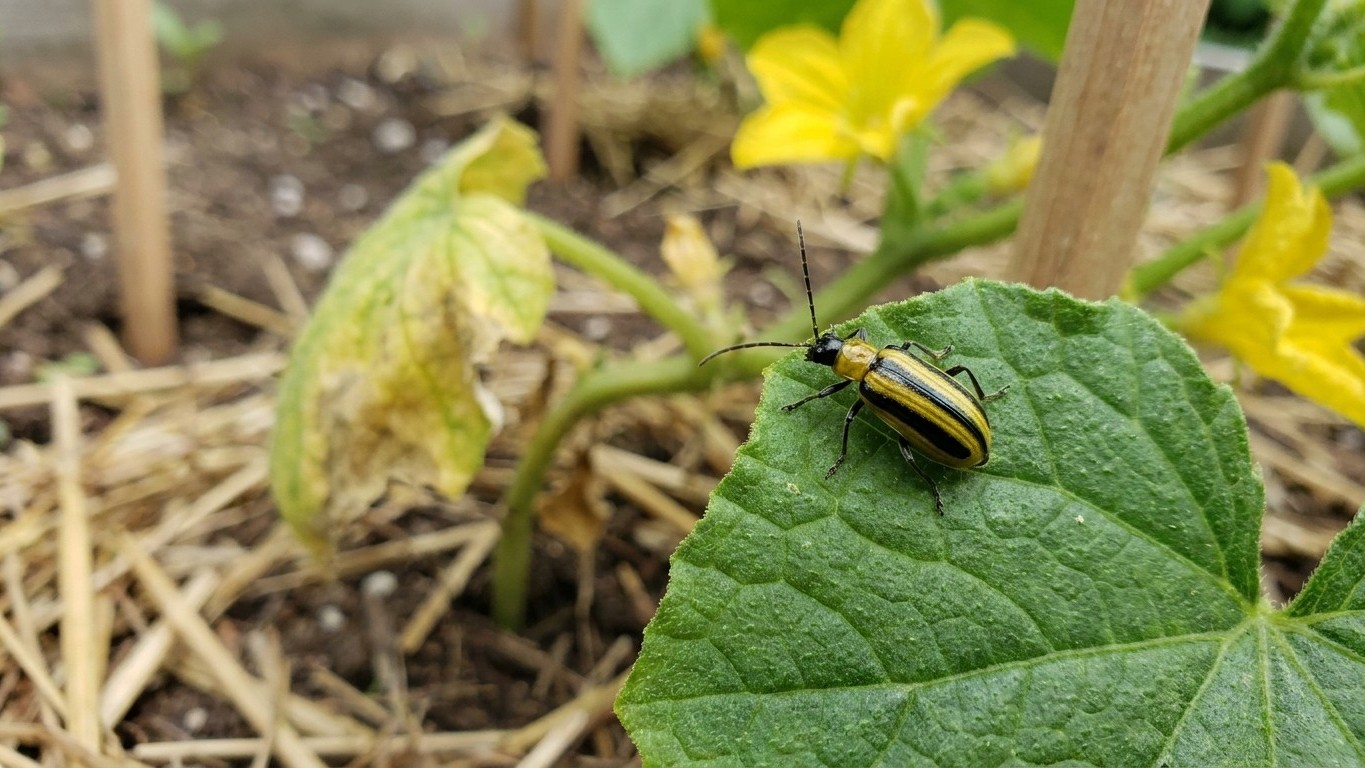
Adults are small, about a fifth of an inch, with a yellow-to-olive body marked by three bold black stripes running lengthwise down the wing covers. A black head and antennae finish the look. They’re easy to confuse with the spotted cucumber beetle, which has the same yellow base color but black spots instead of stripes. Both feed on cucurbits, but the striped species is the one New York growers need to watch closely because it’s the more efficient carrier of bacterial wilt.
The larvae live underground and never get seen by most gardeners. They’re thin, white, worm-like grubs that feed on cucurbit roots and the base of stems, weakening plants from below while the adults attack from above. A plant under pressure from both directions at once rarely recovers on its own.
When Striped Cucumber Beetles Show Up in New York
These beetles overwinter as adults, tucked into leaf litter, hedgerows, and the edges of woodlots near last year’s cucurbit patch. They don’t fly in from somewhere else each spring. They walk out of the ground right where you planted squash the year before, which is part of why they hit the same gardens hard year after year.
Timing tracks soil warmth more than the calendar. Once soil hits roughly 55°F to 60°F, adults become active and start searching for host plants. On Long Island and in the lower Hudson Valley, that often lands in the last week of May. In the Capital Region and Western New York around Buffalo and Rochester, expect activity to start in early to mid-June. Further north, in the Adirondacks and St. Lawrence Valley, beetles frequently don’t appear in force until mid-to-late June, and the growing season is short enough that only one generation completes before frost, compared to two generations in warmer parts of the state.
That second generation matters. Adults from the first wave lay eggs at the base of plants in June, larvae feed through July, and a fresh crop of adults emerges in August, right as squash and pumpkins are sizing up fruit. Gardeners who relax control efforts after the spring flush often get blindsided by this second round.
Why Timing Determines Damage Severity
Seedlings and young transplants are far more vulnerable than established plants. A cucumber with two true leaves can be defoliated by a handful of beetles in a single afternoon, while a mature vine with a dozen leaves shrugs off the same beetle population. That’s why the first two to three weeks after planting are the highest-risk window, and it’s also why staggering when you plant, or starting with larger transplants instead of direct-seeding, changes the outcome more than almost any spray program.
Bacterial Wilt: The Real Reason to Act Early
The beetle itself does cosmetic damage. The disease it spreads does the killing. Bacterial wilt, caused by the bacterium Erwinia tracheiphila, lives in the beetle’s digestive tract and gets deposited into feeding wounds through their frass. Once inside the plant’s vascular system, the bacteria multiply and clog the tissue that moves water, causing vines to wilt from the tip backward even when soil moisture is fine.
Cucumbers and muskmelons are highly susceptible. A single infected plant usually can’t be saved, and there’s no spray that cures it once symptoms appear. Squash and pumpkins are less prone to the disease overall, though certain varieties still get hit. This difference is the main reason cucumber growers in New York treat early-season beetle control as non-negotiable, while pumpkin growers sometimes tolerate light feeding without much fallout.
What Actually Stops Striped Cucumber Beetles
No single tactic wins on its own. Combining a few methods, timed to the beetle’s life cycle, gets the best results for New York conditions.
Row Covers, Used Correctly
Floating row covers placed over beds immediately after planting block adults from reaching seedlings during the most vulnerable stage. The catch is timing the removal. Cucurbits need pollinators, so covers have to come off once flowers open, typically three to five weeks after planting depending on the crop. Leave them on too long and you’ll get plenty of foliage but no fruit.
Trap Cropping
Blue Hubbard squash is intensely attractive to cucumber beetles, more so than most cucumbers or zucchini. Planting a border of Blue Hubbard around the perimeter of a cucurbit patch pulls beetles toward the trap crop, where growers can concentrate insecticide applications or hand-removal instead of treating the entire planting. Research trials at Cornell have shown this perimeter approach can cut insecticide use significantly while still protecting the main crop.
Delayed Planting and Transplants
Direct-seeded cucurbits spend their most fragile stage exposed right when beetles are emerging. Starting seeds indoors and setting out sturdier transplants shortens that vulnerable window. Pushing planting dates a week or two later, so seedlings emerge after the first beetle wave has already peaked and started declining, works particularly well in the Hudson Valley and Capital Region where the timing gap is predictable.
Mulch and Habitat Disruption
A layer of straw mulch around cucurbit plants seems to interfere with beetles’ ability to locate host plants, likely because it disrupts the visual and chemical cues they use to find cucurbit foliage against bare soil. It’s a low-cost addition to any control plan and helps with moisture retention besides.
Kaolin Clay and Organic Options
A fine kaolin clay spray coats leaves in a white film that irritates beetles and discourages feeding without harming the plant. It needs reapplication after rain but works well for gardeners avoiding synthetic insecticides. Spinosad-based products, applied in the evening after pollinators have left the flowers, offer another organic option with a shorter residual than clay treatments.
Targeted Insecticide Use
When beetle pressure is heavy enough to threaten seedling survival, a targeted application of a labeled insecticide such as permethrin or carbaryl can save a planting. The key is applying at dusk, once bees have stopped foraging, since these products are toxic to pollinators and cucurbit flowers depend heavily on bee visits for fruit set. Spot-treating trap crop borders instead of the whole planting reduces both cost and pollinator exposure.
Crop Rotation
Since adults overwinter near last year’s cucurbit bed, moving this year’s squash and cucumber plantings to a different part of the yard or garden, ideally at least several hundred feet away, forces emerging beetles to travel further to find host plants. Some never make it, and populations on the new site start noticeably lower.
Monitoring: Catching the First Wave
Yellow sticky traps placed at seedling height give an early warning before visible damage appears, since striped cucumber beetles are strongly drawn to yellow. Checking traps twice a week during the emergence window, late May through mid-June depending on region, lets gardeners time row cover removal, trap crop spraying, or protective treatments to the actual beetle population instead of guessing off the calendar. For New York gardeners dealing with repeat infestations, keeping a simple log of when beetles first appear each year builds a personal timeline that often predicts next year’s emergence within a week.
Related guides
- Striped cucumber beetle in Massachusetts: When It Shows Up and What Stops It
- Striped cucumber beetle in Connecticut: When It Shows Up and What Stops It
- Striped cucumber beetle in North Carolina: When It Shows Up and What Stops It
- Striped cucumber beetle in Nova Scotia: When It Shows Up and What Stops It
- Striped cucumber beetle in New Jersey: When It Shows Up and What Stops It
- Striped cucumber beetle in Kansas: When It Shows Up and What Stops It