
Striped cucumber beetles start showing up in North Carolina gardens as early as mid-April in the coastal plain and by late April to early May in the piedmont and mountains, right when cucumber and squash seedlings push their first true leaves. Row covers installed before emergence, kept sealed at the soil line until flowering begins, remain the single most reliable defense, backed up by prompt removal of crop debris each fall so adults have nowhere to overwinter.
That timing window matters more than most gardeners realize. A beetle that arrives two weeks after transplanting does modest cosmetic damage. The same beetle arriving the day seedlings emerge from soil can kill a stand outright, either through direct feeding or through a bacterial disease it carries in its gut. North Carolina’s long growing season, stretching from the Outer Banks to the Blue Ridge, means the pest’s schedule shifts by region, and gardeners who plant by the calendar instead of by soil temperature often get caught off guard.
When striped cucumber beetles emerge across North Carolina

Adult beetles overwinter in leaf litter, hedgerows, and wooded field edges, tucked in at temperatures below 50°F. They start moving once soil temperatures climb past roughly 65°F, a threshold that eastern North Carolina’s sandy coastal plain soils reach several weeks before the clay-heavy piedmont or the cooler mountain valleys around Asheville and Boone.
In practical terms, that breaks down into three rough windows:
- Coastal plain (Wilmington, Greenville, Fayetteville): mid-to-late April, sometimes earlier during a warm spring
- Piedmont (Charlotte, Raleigh, Greensboro): late April into early May
- Western mountains (Asheville, Boone, Sylva): mid-to-late May, occasionally pushed into June at higher elevations
A second generation typically follows in July and August statewide, feeding on later plantings and on volunteer cucurbits that sprout from compost piles or dropped fruit. Some years bring a partial third generation in the coastal plain if fall stays mild, which is one reason experienced growers in that region treat late-summer squash plantings with the same caution as spring ones.
Identifying the beetle and the damage it leaves behind
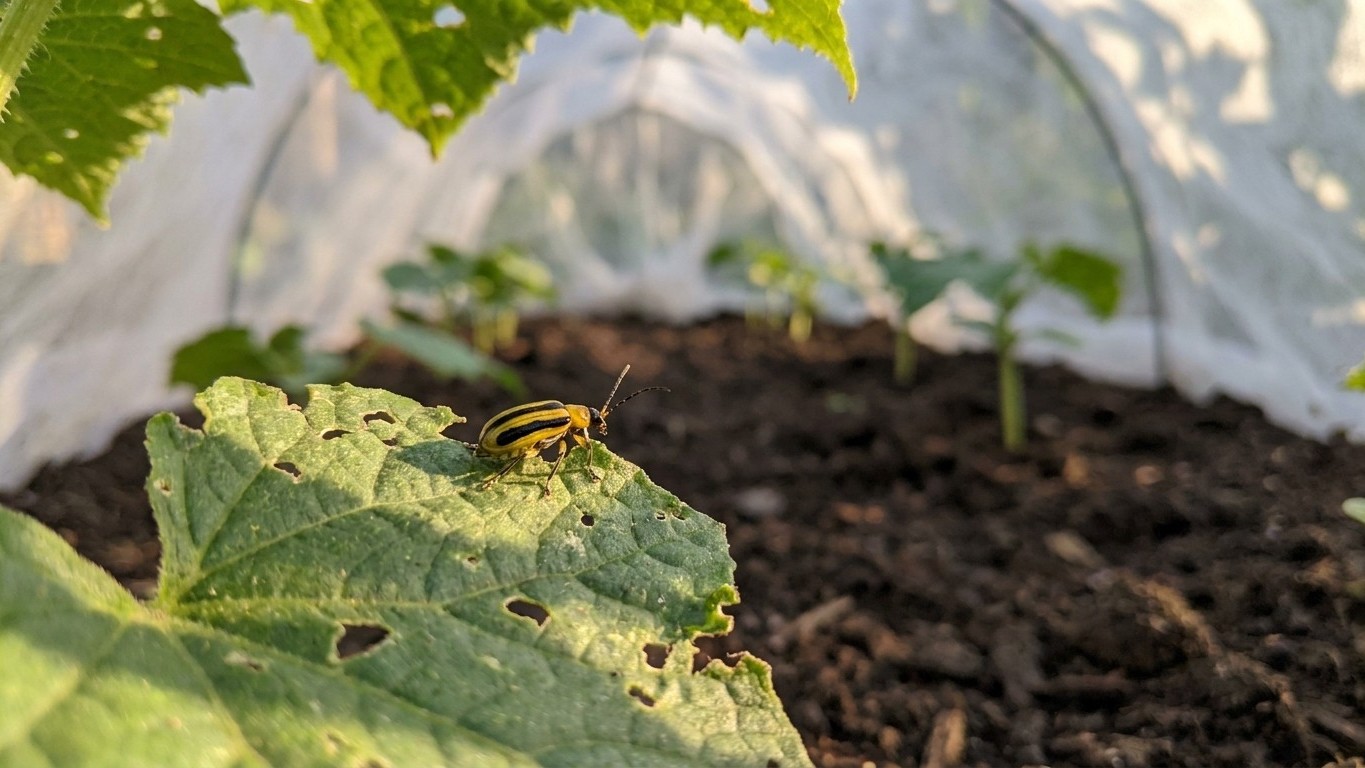
The striped cucumber beetle (Acalymma vittatum) measures about a quarter inch long, with a yellow-to-greenish-yellow body marked by three bold black stripes running lengthwise down the wing covers. Its head is black. It’s often confused with the spotted cucumber beetle, a close relative with black spots instead of stripes that also feeds on cucurbits but carries the bacterial wilt pathogen less efficiently.
Feeding damage shows up first on cotyledons and young leaves as small, ragged holes, sometimes so numerous the leaf looks like it’s been hit with buckshot. Beetles also chew on stems near the soil line, on flowers, and on the rind of young fruit, leaving scarring that reduces market quality even when the plant survives. Larvae, which most home gardeners never see, live in the soil and feed on roots, contributing to stunted growth that’s easy to misdiagnose as a fertility problem.
Why this beetle matters more than its size suggests
The real threat isn’t the chewing. It’s Erwinia tracheiphila, the bacterium that causes cucurbit bacterial wilt, which the beetle picks up while feeding on infected plants and then spreads to healthy ones through its saliva and frass. Once a plant is infected, there’s no cure. Vines wilt one leaf at a time, then collapse entirely, often within one to two weeks of the first symptoms appearing. Cucumbers and muskmelons are highly susceptible. Winter squash varieties bred from Cucurbita moschata, including butternut, show much stronger natural resistance to the wilt pathogen even though beetles still feed on them, which is a distinction worth knowing before you decide where to spend your row-cover budget.
A simple field test confirms wilt: cut a wilting stem near the base and slowly pull the two halves apart. If you see thin, sticky strands of bacterial ooze stretching between them, that plant is done, and pulling it out promptly limits the source of infection for beetles that might carry the bacteria to neighboring plants.
What actually stops striped cucumber beetles
No single tactic works in isolation for this pest, largely because the disease transmission happens fast, sometimes within the first few days after emergence. Layering several methods, timed to the beetle’s own schedule, gets better results than reaching for one product after damage is already visible.
Physical exclusion before bloom
Lightweight floating row cover, installed at planting or immediately after seedlings emerge, blocks beetles from ever reaching the plant. The edges need to be buried or weighted continuously, since gaps of even an inch give beetles an entry point. Covers must come off once flowers open, because cucurbits depend on bees for pollination and a sealed cover keeps pollinators out along with pests. That window, the few days between bloom and cover removal, is when scouting and backup tactics matter most.
Trap cropping and timing tricks
Blue Hubbard squash and other highly attractive cucurbit varieties planted around the perimeter of a main crop draw beetles away from the plants you actually want to harvest. Growers treat the trap crop border with an insecticide or simply accept heavier damage there, while the interior planting stays largely untouched. Delaying the main planting by even one to two weeks past the earliest safe date can also help in some seasons, since it shortens the overlap between vulnerable seedlings and the first beetle wave, though this trades off against a shorter harvest window.
Cultural steps that reduce next year’s population
Fall cleanup removes the leaf litter and crop debris where adults shelter for winter. Rotating cucurbits to a different part of the yard or garden each year, ideally at least 500 feet from the previous season’s planting site, cuts down on beetles finding host plants immediately upon emergence. Composting cucurbit debris in a hot, actively managed pile rather than leaving vines to overwinter in place removes another overwintering site.
Products that fit organic and conventional programs
Kaolin clay, sold under trade names as a particle film barrier, coats leaves and fruit in a fine white powder that beetles find irritating to walk and feed on; it needs reapplication after rain. Spinosad, an organic-approved insecticide derived from soil bacteria, controls beetles on contact and through ingestion but should be applied in early morning or evening to limit exposure to foraging bees. Pyrethrin-based sprays offer quick knockdown for conventional and organic growers alike, though they break down fast in sunlight and often need repeat applications during heavy pressure. For gardeners managing larger plantings, systemic neonicotinoid seed treatments or soil drenches applied at transplant provide season-long protection against both beetle feeding and the risk of wilt transmission, though these products carry pollinator-safety restrictions that home gardeners should read carefully before use, since blooming plants and neonicotinoid exposure don’t mix well.
Yellow sticky traps placed just above the plant canopy help with monitoring more than control, giving a rough sense of beetle pressure and timing so sprays or covers go on before populations spike rather than after. Checking traps twice a week during April and May in most of the state, or May and June in the mountains, gives enough lead time to act.
Putting it together for a North Carolina garden
A realistic program starts with row covers at planting, removed only when flowers open. Sticky traps go up at the same time to track arrival. Once covers come off, kaolin clay or spinosad handles beetles that show up during and after bloom, applied in the evening to protect pollinators. Fall sanitation and a rotation plan for next year close the loop. None of this eliminates the beetle entirely, since adults fly in from wooded areas well beyond any single yard’s control, but it consistently keeps damage below the threshold where bacterial wilt takes down an entire planting.
One detail that surprises a lot of gardeners: beetles feeding on resistant butternut squash can still pick up and carry the wilt bacterium to a nearby cucumber patch, even though the squash itself shows no symptoms. That’s a strong argument for keeping highly susceptible crops like cucumbers and muskmelons separated from squash plantings by as much distance as the garden layout allows, rather than assuming a resistant variety acts as a buffer.
Related guides
- Striped cucumber beetle in South Carolina: When It Shows Up and What Stops It
- Striped cucumber beetle in Nova Scotia: When It Shows Up and What Stops It
- Striped cucumber beetle in Ohio: When It Shows Up and What Stops It
- Striped cucumber beetle in New Mexico: When It Shows Up and What Stops It
- Striped cucumber beetle in Kentucky: When It Shows Up and What Stops It