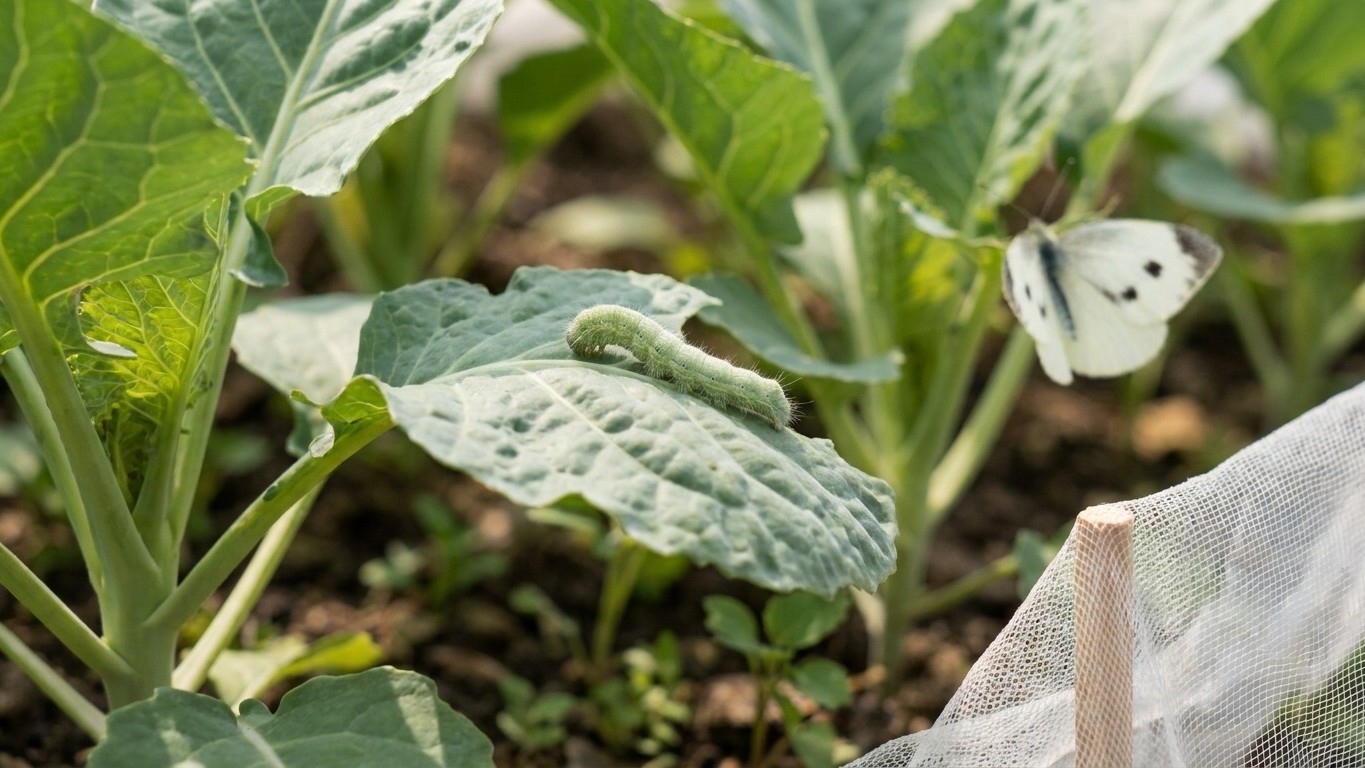

Imported cabbageworm larvae start chewing through Ontario brassica patches as early as mid-May in the south and stick around until the first hard frost, usually running through three or four overlapping generations. The fastest way to stop them is a physical barrier at planting time, row covers or fine mesh netting, combined with Bacillus thuringiensis (Bt) sprays once you spot the velvety green caterpillars on the undersides of leaves.
This isn’t a rare or occasional visitor. Pieris rapae, the species behind the name, has been established in eastern Canada since it arrived near Quebec City in the 1860s. It spread west along with cabbage farming and now shows up in nearly every home garden and commercial field growing cole crops across the province, from the Niagara Peninsula to the Ottawa Valley.
When Imported Cabbageworm Appears in Ontario

Adults overwinter as pupae, small brown or greenish chrysalises glued to fence posts, plant stakes, greenhouse walls, or leftover crop debris. Once daytime temperatures hold consistently above 50°F, those pupae break dormancy and the first white butterflies take flight. In southern Ontario, that means Windsor, the Niagara region, and the Golden Horseshoe typically see their first adults in late April or early May. Growers farther north and east, around Ottawa, Peterborough, or the Georgian Bay shoreline, usually see the same event two to three weeks later, sometime in mid-to-late May.
The butterfly itself is easy to recognize: white wings roughly 1.5 to 2 inches across, with one or two black spots per forewing. What confuses people is that the butterfly does no damage at all. It’s the offspring that cause trouble. A single female can lay several hundred eggs over her lifespan, depositing them one at a time (unlike some other pests that lay in clusters) on the underside of leaves. Each egg is pale yellow and shaped like a tiny bullet, easy to miss unless you’re checking leaves closely.
How Many Generations Show Up Each Season
Ontario typically sees three full generations per year, with a partial fourth in warmer years or in the mildest pockets of the southwest. Each generation takes roughly three to four weeks from egg to adult butterfly, depending on temperature. That timeline compresses in hot weather and stretches out in a cool, wet June. The practical result: pressure builds through the season, and the worst damage usually shows up in August and September, when populations from earlier generations have stacked on top of each other.
That late-summer spike catches a lot of home gardeners off guard. Early-season plantings often look fine through June, then take visible damage right as heads are forming on cabbage or when broccoli side shoots are trying to develop. Waiting until damage is obvious means you’re already behind two generations.
Spotting the Damage Before It Spreads
The caterpillar itself is velvety green with a faint yellow stripe running down its back, growing from a pinhead size up to about 1.25 inches over two to three weeks. It feeds constantly, and because its coloring matches cabbage and kale leaves so well, most people notice the damage before they notice the insect.
Look for irregular holes chewed between leaf veins, dark green frass (droppings) scattered across leaf surfaces, and damage concentrated on inner leaves or developing heads rather than just the outer canopy. On cabbage specifically, larvae will tunnel directly into the head, which ruins marketability fast for anyone growing for market or for canning.
Three brassica pests get confused with each other constantly in Ontario gardens, and telling them apart matters because the timing and controls differ slightly:
- Imported cabbageworm: velvety green, moves slowly, single yellow eggs, adult is a white butterfly active during the day
- Cabbage looper: pale green with faint white stripes, arches its back into a loop as it crawls (like a tiny inchworm), adult is a mottled brown night-flying moth
- Diamondback moth: much smaller, tapered at both ends, wriggles violently and often drops off the leaf on a silk thread when disturbed
Imported cabbageworm tends to arrive first in the season and is usually the most visible of the three across southern and central Ontario.
What Actually Stops It
Physical exclusion works better than almost anything else, and it’s the method most extension programs across Canada and the northern United States recommend as a first line of defense. Floating row covers or fine insect mesh, installed right at transplanting or seeding and sealed tightly at the soil edges, block adult females from ever reaching the leaves to lay eggs. The covers need to stay on until harvest for crops like broccoli or cabbage, since female butterflies will lay eggs the moment they find an opening.
Bacillus thuringiensis subspecies kurstaki, sold under several biological insecticide brands, remains one of the most effective and lowest-risk sprays available. Bt kurstaki targets caterpillars specifically and breaks down within a few days of sun exposure, which means it needs reapplication after rain or every seven to ten days during active feeding periods. It works best against young larvae in their first two molts, so early detection matters more than late-season heavy spraying.
Spinosad is a reasonable alternative for organic growers who want something with slightly longer residual activity, though it’s less selective than Bt and can affect some beneficial insects if applied when pollinators are actively foraging nearby flowers. Applying it in the evening, after bees have finished their daily foraging, cuts that risk down considerably.
For home gardens, hand-picking remains surprisingly practical. Checking the undersides of leaves every few days during peak season, from mid-July through September, and squishing eggs or dropping larvae into soapy water keeps small plots manageable without any spray at all. It’s tedious, but for a dozen cabbage plants it takes less time than most people expect.
Trap Crops and Natural Predators
Nasturtiums and certain mustard varieties act as decoys, drawing egg-laying females away from the main crop when planted along the border of a brassica bed. It’s not a complete solution, but it reduces pressure on the crop you actually want to protect.
Ontario also benefits from an established biological control that’s been quietly doing its job for decades: the parasitic wasp Cotesia glomerata. This tiny wasp lays its own eggs inside cabbageworm larvae, and the wasp larvae eventually emerge and spin small clusters of bright yellow cocoons on the caterpillar’s body, usually killing the host in the process. Finding these yellow cocoon clusters on a caterpillar is actually good news. It means natural control is already working, and spraying that particular caterpillar is pointless since it’s already doomed. Chickadees and other insectivorous birds also pick off larvae regularly in gardens that keep some shrub cover nearby for perching.
Building Longer-Term Resistance in the Garden
Crop rotation matters more for this pest than gardeners often assume. Because pupae overwinter on or near where the previous crop grew, planting brassicas in the same bed year after year gives the next generation a head start close to home. Moving cole crops to a different part of the yard or field each season, even a modest 10 to 15 feet away, disrupts that convenience.
Fall cleanup helps at the margins, though it’s not a complete fix since pupae also attach to fences, sheds, and other structures well away from the original planting bed. Removing spent brassica stems and leaves after harvest, rather than leaving them to overwinter in place, still reduces the local population available to emerge the following spring.
Diverse plantings beat monoculture blocks for this particular pest. A large solid planting of cabbage or kale gives female butterflies an easy, concentrated target. Interspersing brassicas with unrelated crops, herbs, or flowering plants makes it harder for adults to locate host plants efficiently and supports the predator and parasitoid populations that help keep numbers down naturally.
Watching for the first white butterflies of the season, rather than waiting for visible leaf damage, gives growers the lead time needed to act before eggs hatch into feeding larvae. That two-week window between first flight and first noticeable damage is really the whole game with this pest across Ontario’s growing regions.