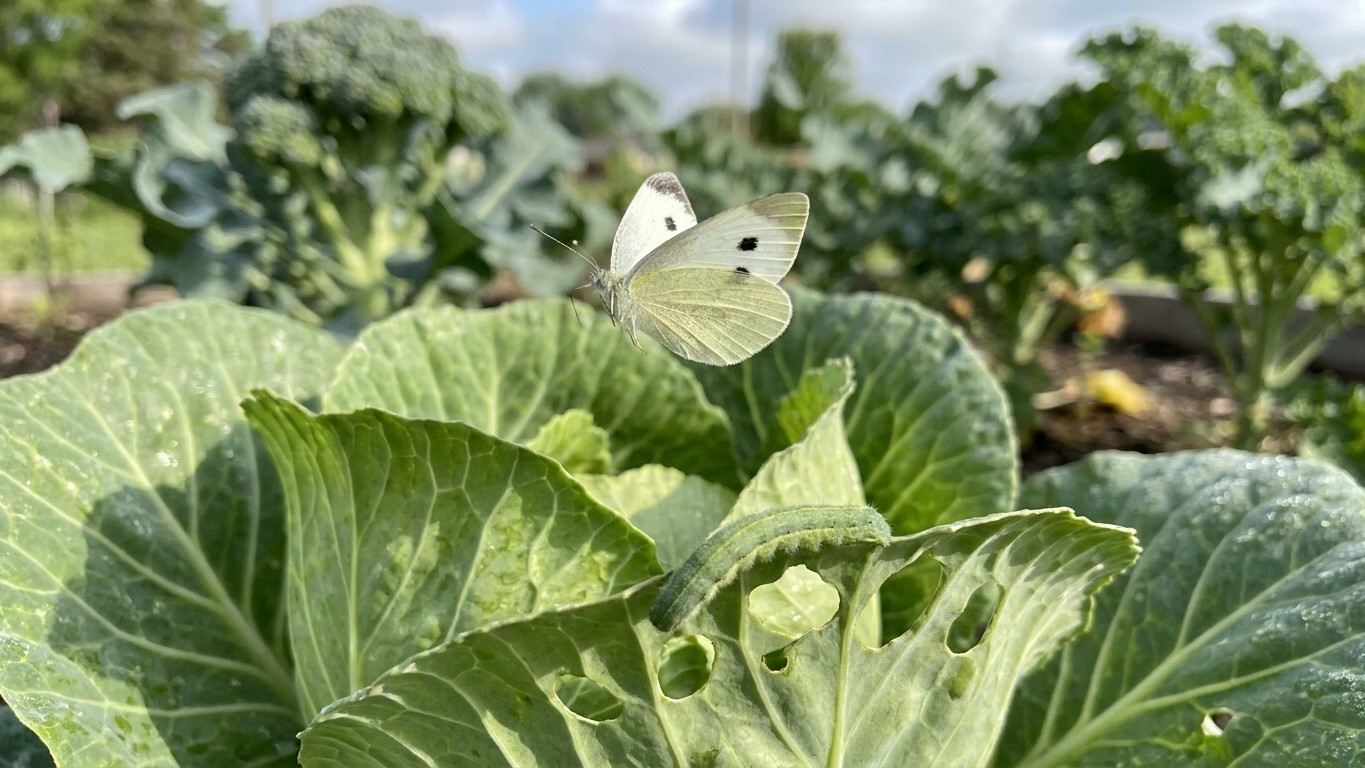

The imported cabbageworm (Pieris rapae) turns up in South Dakota gardens as soon as the small white butterflies start fluttering over brassica beds, usually in mid-to-late May in the eastern part of the state and a bit later west of the Missouri River. The velvety green caterpillars that follow do the real damage, chewing ragged holes in cabbage, broccoli, and kale through the growing season until the first hard frost knocks the population back. Row covers installed before those first butterflies appear, weekly scouting for eggs and small larvae, and a well-timed spray of Bacillus thuringiensis remain the most reliable ways to stop them without wrecking a vegetable patch.
Identifying the Imported Cabbageworm

Adults are the easy part. They’re small white butterflies, wingspan around 1.5 to 2 inches, with one or two black spots on each forewing (males have one, females two). They look almost delicate fluttering around a garden, which is exactly why so many home growers ignore them until the damage shows up two weeks later.
The larvae are the problem. They’re velvety green, blend almost perfectly with cabbage leaves, and grow to about an inch long. Look closely and you’ll spot a faint yellow stripe running down the back, which separates them from the similarly colored cabbage looper. That distinction matters for control: loopers move with a distinctive arching hump, like an inchworm, while imported cabbageworms crawl in a straight, steady line. Diamondback moth larvae, another crucifer pest sometimes found in the same beds, are smaller, thinner, and taper at both ends.
Eggs are the detail most gardeners never check, and that’s a mistake. They’re pale yellow, ribbed, spindle-shaped, and laid singly on the undersides of leaves, usually along the veins. Finding them before they hatch buys a grower a week or more of lead time on control.
When It Shows Up in South Dakota
South Dakota’s climate splits into distinct zones that shift the pest’s calendar by a few weeks. Sioux Falls and the eastern river valleys warm up faster in spring than the higher, drier plains around Rapid City, and that gap shows up directly in when the first butterflies take flight.
The insect overwinters as a pupa tucked into plant debris, old cabbage stalks, fence lines, or nearby weedy cover. It doesn’t survive as an adult through a Dakota winter, so every season starts fresh from those hidden pupal cases. Adults emerge once daytime temperatures hold consistently in the 60s, which typically lands in mid-to-late May east of the Missouri and early June farther west.
From there, the state usually sees two to three overlapping generations before the season ends, sometimes a partial fourth in a warm year with a late fall. Each generation takes roughly three to five weeks from egg to adult, faster in the hottest stretches of July and August. That overlap is what makes the pest feel constant rather than seasonal: by midsummer, a single garden bed can have eggs, small larvae, mature caterpillars, and fresh adults all present at once.
Activity winds down with the first hard frost, generally late September in the east and slightly earlier in the higher elevations of the west. A light frost slows the caterpillars but doesn’t necessarily kill them outright; it takes a real freeze to end the season’s damage for good.
What It Damages, and How to Spot It Early
Imported cabbageworm feeds almost exclusively on plants in the brassica family. In a typical South Dakota vegetable garden that means:
- Cabbage and Brussels sprouts, where larvae bore into the developing head and leave behind frass that’s hard to wash out
- Broccoli and cauliflower, where feeding damage on the florets can ruin a harvest cosmetically even when the plant survives fine
- Kale, collards, and mustard greens, which show ragged, irregular holes across the leaf surface
- Radish and turnip tops, less commonly attacked but still vulnerable when populations are high
The giveaway isn’t the caterpillar itself, since it camouflages well. It’s the frass, small dark green or black pellets scattered on leaves and down in the crown of a cabbage head. Combine that with irregular chew marks (as opposed to the smooth, uniform holes flea beetles leave) and it’s almost certainly cabbageworm.
Damage compounds fast on head-forming crops like cabbage and broccoli because larvae often tunnel toward the center, contaminating the part of the plant a grower actually wants to eat. On loose-leaf crops like kale, the plant usually outgrows moderate feeding, which is one reason extension entomologists generally treat action thresholds differently for head crops versus leafy greens.
What Actually Stops It
Physical and Cultural Controls
Floating row cover, put down before the first adult flight in May, blocks egg-laying entirely and is the single most effective tool available to a home gardener. It has to go on early and stay sealed at the edges; a single gap is enough for a female butterfly to find her way in.
Crop rotation and fall cleanup matter more than most gardeners assume. Because the insect overwinters as a pupa in old plant debris, clearing cabbage family residue out of the bed each fall removes a chunk of next year’s starting population before it ever gets going. Rotating brassicas to a different part of the garden each year also cuts down on the concentration of pupae sitting right next to next spring’s crop.
Hand-picking works, especially on a small home plot, but only if it’s done weekly and thoroughly, checking leaf undersides for both eggs and larvae. Skip a week during peak generation overlap in July and the population can double.
Biological Controls
Bacillus thuringiensis subspecies kurstaki (Btk) is the standard organic recommendation, and for good reason: it targets caterpillars specifically, breaks down within days in sunlight, and spares pollinators and most beneficial insects. It works best applied when larvae are small, since older, larger caterpillars need to eat more of the treated leaf tissue to get a lethal dose. According to the EPA’s registered pesticide fact sheets, Bt products have one of the narrowest toxicity profiles of any insecticide approved for home garden use, which is why extension programs across the northern Plains lean on it as a first-line option.
Spinosad is a reasonable second option for growers who want something slightly faster-acting, though it’s less selective than Bt and can affect some beneficial insects if applied while they’re active on the plant.
Natural enemies do a surprising amount of unpaid work in South Dakota gardens. The parasitic wasp Cotesia glomerata lays its eggs inside cabbageworm larvae, and a heavily parasitized caterpillar stops feeding well before it dies, a small but real dent in seasonal damage. Trichogramma wasps target the eggs directly. Broad-spectrum insecticides wipe these allies out along with the pest, which is part of why chemical-heavy spray programs sometimes make the cabbageworm problem worse the following year, not better.
When Chemical Options Make Sense
For a market garden or larger planting where hand-picking and row covers aren’t practical, a targeted insecticide labeled for cabbageworm on brassicas can be justified, particularly if scouting shows more than a couple of larvae per plant on young transplants. Rotating the active ingredient and spraying in the evening, when pollinators are less active on the flowering weeds nearby, cuts down on collateral damage. Reading and following the label’s pre-harvest interval matters here more than with Bt, since some conventional options carry a wait time of a week or more before the crop is safe to pick.
A Detail Most Gardeners Miss
Cabbageworm pressure in South Dakota tracks weed cover as much as it tracks the vegetable garden itself. Wild mustard and other roadside brassica relatives common along fence lines and ditches throughout the state serve as a reservoir host, letting populations build up even in years when a garden’s own brassica bed is small or newly planted. Mowing or clearing wild mustard patches within a few hundred feet of a vegetable garden won’t eliminate the pest, but it removes one more place for the population to quietly overwinter and rebuild before spring transplants ever go in the ground.
Related guides
- Imported cabbageworm in Nebraska: When It Shows Up and What Stops It
- Imported cabbageworm in Tennessee: When It Shows Up and What Stops It
- Imported cabbageworm in Utah: When It Shows Up and What Stops It
- Imported cabbageworm in Idaho: When It Shows Up and What Stops It
- Imported cabbageworm in Delaware: When It Shows Up and What Stops It