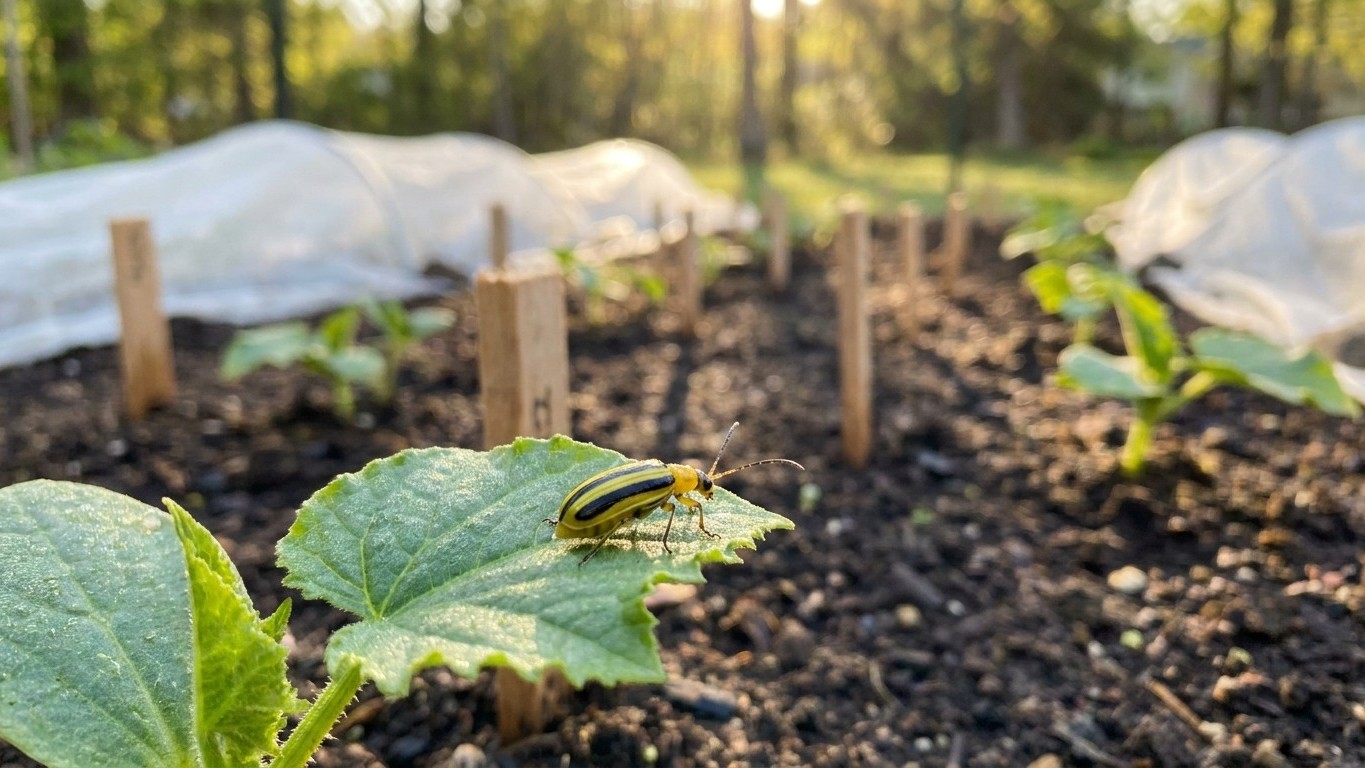

Cucumber beetles start showing up in Virginia gardens in late April to early May, right around the time soil temperatures climb past 55°F and the first cucurbit seedlings break ground. The striped cucumber beetle is the one to worry about first because it carries bacterial wilt, a disease that can kill a healthy squash or cucumber vine within two weeks. Row covers installed before beetles arrive, removed only for pollination, remain the single most reliable defense home growers have.
Virginia’s mix of climates complicates the picture. A garden in Virginia Beach might see beetles a full three weeks before one in the Shenandoah Valley. Knowing which beetle you’re dealing with, and when your particular corner of the state warms up, changes how you fight back.
Two Beetles, One Name, Different Threats

Gardeners across Virginia lump two distinct insects under “cucumber beetle,” and that mix-up matters. The striped cucumber beetle (Acalymma vittatum) is yellow with three black stripes running lengthwise down its back, about a quarter-inch long. The spotted cucumber beetle (Diabrotica undecimpunctata), sometimes called the southern corn rootworm in its larval stage, wears twelve black spots on a similar yellow-green body.
Striped beetles are the bigger problem for cucurbit crops specifically. They overwinter as adults in leaf litter and field edges, then emerge hungry and head straight for cucumber, squash, melon, and pumpkin seedlings. Spotted beetles have a broader diet, they’ll feed on corn, beans, and dozens of other plants, which makes them less devastating to any single crop but harder to manage with crop rotation alone.
The stripe pattern is the giveaway in the field. Flip a beetle over or catch it in bright light, and the distinction takes about two seconds to spot once you know what you’re looking for.
Timing Across Virginia’s Regions
Emergence tracks soil temperature, not the calendar, which is why the same species shows up at different times depending on where in Virginia you garden.
In Tidewater and Hampton Roads, where sandy soils warm fast and winters run mild, overwintering adults can be active by mid-April. Central Virginia and the Piedmont, including the Richmond area, typically see the first wave in early to mid-May. Gardeners in the Shenandoah Valley and the mountainous southwest corner of the state, think Blacksburg or Abingdon, often don’t see significant beetle pressure until late May or even early June, since clay soils and higher elevations hold onto cool temperatures longer.
A second generation follows in most of the state by mid-to-late summer, usually July into August, as beetles that survived spring feeding lay eggs at the base of cucurbit plants. Those eggs hatch into root-feeding larvae that most gardeners never see, only the adults that emerge weeks later to start the cycle over. This means a garden that looked clean in June can suddenly show fresh beetle damage in late July, and it’s not a new infestation, it’s the next generation clocking in.
Why Bacterial Wilt Is the Real Danger
Chewed leaves look bad but rarely kill a plant outright. The bigger threat riding along with striped cucumber beetles is Erwinia tracheiphila, the bacterium that causes cucurbit bacterial wilt.
The beetle picks up the bacteria while feeding on an infected plant, then carries it in its gut and deposits it in the wounds it creates on the next plant it chews. Cucumbers and muskmelons are highly susceptible; squash and pumpkins less so, though certain squash varieties still get hit hard. Once a vine is infected, there’s no cure. Leaves wilt during the heat of the day, seem to recover overnight, then wilt again the next afternoon, a pattern that repeats for about a week before the whole vine collapses.
The Virginia Cooperative Extension notes that a simple test confirms bacterial wilt at home: cut a wilted stem near the base and slowly pull the two halves apart. If sticky, white bacterial ooze stretches between them in thin strings, the diagnosis is confirmed, and the plant should be removed rather than left to serve as a source for beetles to keep spreading the disease.
What Actually Stops Cucumber Beetles
Prevention beats reaction with this pest, largely because once bacterial wilt takes hold, there’s nothing left to spray.
Row Covers and Timing
Floating row covers, installed at planting and sealed at the edges with soil or landscape staples, physically block beetles from reaching seedlings during the vulnerable first few weeks. The catch is pollination. Cucurbits need bees to set fruit, so covers have to come off once flowering starts, typically three to four weeks after transplanting or direct seeding. Some growers split the difference by removing covers only during morning hours when bees are active, then replacing them in the afternoon, though that’s more labor than most home gardeners want to sign up for.
Delayed planting can help in regions with a long enough season. Pushing cucumber and squash planting back by two to three weeks lets the first wave of overwintered beetles run out of food sources and die off before seedlings emerge, though this trades some yield potential for reduced pest pressure.
Trap Crops and Physical Barriers
Blue Hubbard squash draws striped and spotted cucumber beetles more strongly than almost any other cucurbit. Planting a small border of it around the main garden, then treating just those trap plants with an approved insecticide or hand-picking beetles off them, concentrates the pest problem in a spot that’s easy to manage.
Kaolin clay, a fine white mineral powder sold under various garden product names, coats leaves in a film that beetles find irritating to walk on and difficult to feed through. It needs reapplication after rain but causes no harm to pollinators and works as a low-toxicity option for gardeners trying to avoid broad-spectrum insecticides.
Encouraging Natural Predators
Soldier beetles, braconid wasps, and certain ground beetles all feed on cucumber beetle eggs or larvae. Reducing insecticide use, especially broad-spectrum products that kill beneficial insects along with pests, gives these natural controls a chance to establish. Planting flowering herbs like dill, fennel, and yarrow near the vegetable garden provides nectar sources that keep beneficial insect populations active through the season.
None of these methods work in isolation as well as they do stacked together. A garden with row covers during early growth, a trap crop border, and a hands-off approach to broad insecticides typically sees far less beetle damage than one relying on a single tactic.
When Chemical Control Makes Sense
For gardeners facing heavy beetle pressure, particularly a second-generation surge in July, targeted insecticide application sometimes becomes necessary to save a crop already flowering and setting fruit. Products containing spinosad offer a lower-impact option that’s less harmful to bees than older broad-spectrum chemicals, though even spinosad should be applied in the evening after flowers close for the day to minimize pollinator exposure.
Pyrethrin-based products work faster but carry more risk to beneficial insects if applied carelessly. Whatever product is used, timing the application for dusk, after bees have finished foraging for the day, cuts down significantly on collateral damage to the pollinators the garden depends on.
Virginia’s extension offices, run through Virginia Tech and Virginia State University, maintain local offices in nearly every county and can identify beetle species or confirm a bacterial wilt diagnosis from a sample, a free resource many home gardeners never think to use until a season’s crop is already lost. For more detail on identification and life cycle specifics, the Virginia Cooperative Extension publications library keeps region-specific guidance updated as growing conditions shift year to year.
One detail that surprises a lot of gardeners: beetle populations tend to run heavier in gardens planted in the same spot as the previous year’s cucurbits, since overwintering adults often emerge within a few yards of where they fed as larvae. Rotating cucumbers and squash to a different section of the yard each season, even a modest twenty-foot shift, measurably reduces the number of beetles that find the plants come spring.
Related guides
- Cucumber beetles in West Virginia: When It Shows Up and What Stops It
- Cucumber beetles in Wisconsin: When It Shows Up and What Stops It
- Cucumber beetles in California: When It Shows Up and What Stops It
- Cucumber beetles in Oklahoma: When It Shows Up and What Stops It
- Cucumber beetles in Missouri: When It Shows Up and What Stops It