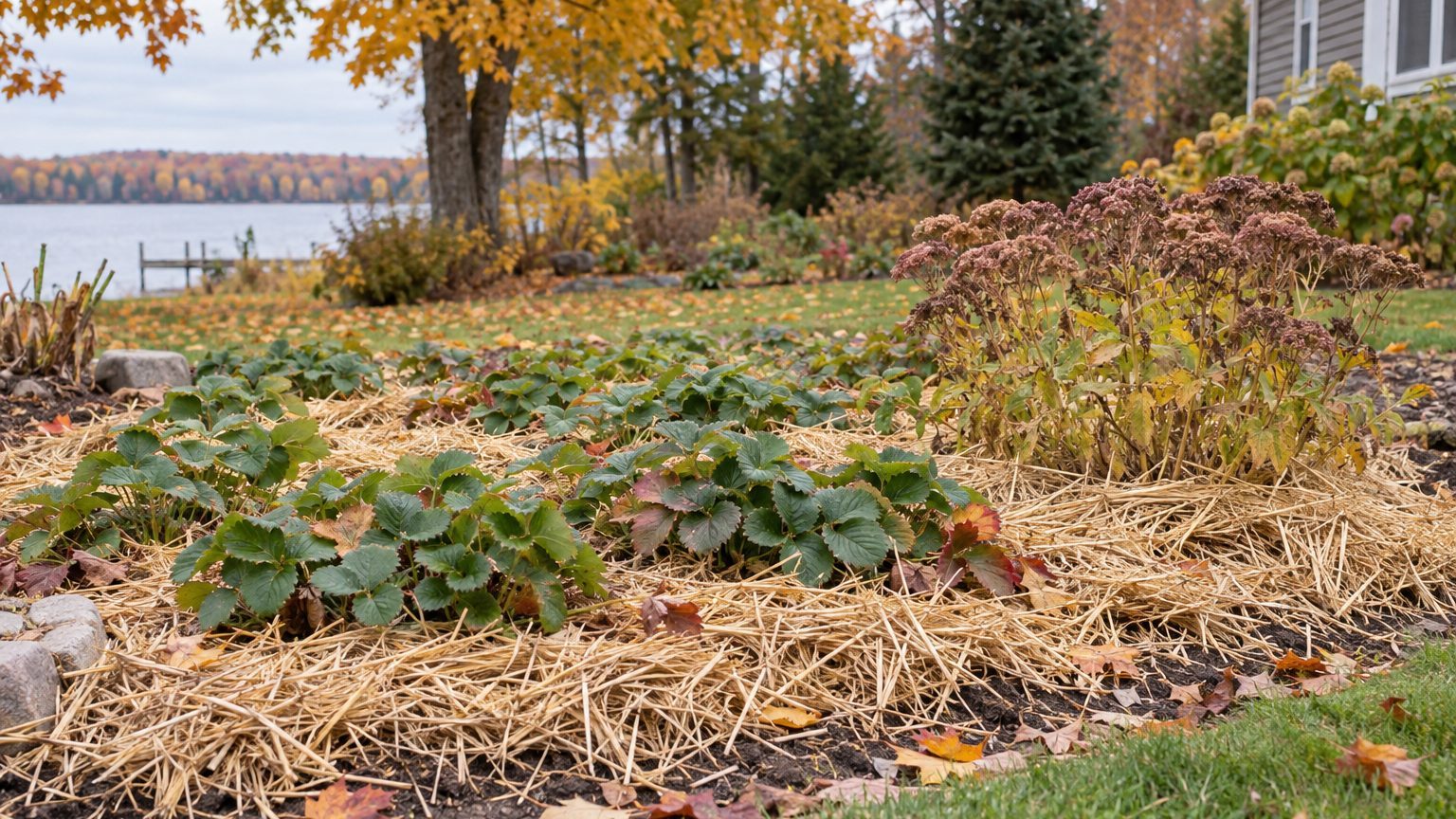

Wait until the ground starts to freeze. In Iowa, that puts winter mulch well after the first fall frost, which NOAA’s 1991-2020 normals for Des Moines place at October 14 to October 25, not on the night the basil blackens. Straw over strawberry crowns and a thin ring around borderline perennials work best when they keep frozen soil frozen. Spread too early, the same layer turns into a warm, damp nest for rot and rodents.
When to put winter mulch down in Iowa
Most gardeners assume mulch is a blanket, something to tuck plants in before the cold arrives. It is closer to a cooler lid. What hurts strawberry crowns and shallow-rooted perennials is not a single cold night but the cycle of freezing, thawing and freezing again, which expands and contracts the soil and pushes roots upward. Mulch slows the thaw. That only works if the soil is already cold when the layer goes on.
Des Moines is the reference here because its climate records are the most complete. NOAA’s 1991-2020 Climate Normals give a mean daily minimum of 13.8°F for the coldest month, so the ground freezes hard and stays that way for stretches. That is the condition the mulching rule is built around.
The first 32°F freeze arrives in a band, not on a single day. The same NOAA normals put the 30 to 70 percent probability band for that first freeze at October 14 to October 25 at the Des Moines airport station. Hold the mulch until the ground has begun to freeze, which comes well after the October 14 to October 25 first-frost range, not inside it. A frost that kills the squash vines is a signal to get the straw bales, not to spread them.
How to read the ground
Forget the calendar for a moment and go outside on a cold morning. If the top of the soil is crusty or stiff and stays that way after a run of hard freezes, you are in the window. If the soil is still soft, dark and workable by midday, wait. A trowel tells you more than a thermometer here.
Once the soil is stiff, there is no rush, but do not let the window slide into a snowstorm. Spreading straw over an ice crust or a foot of wet snow is miserable work. Pick a dry, cool afternoon shortly after the ground firms up and finish in one session.
Adjusting for your part of Iowa
The USDA Plant Hardiness Zone Map (2023) puts Iowa in a range from 4b to 6a, built on the average annual extreme minimum temperature. Des Moines sits in the middle of that spread, and the northern counties are colder and the southern ones milder. In the colder north the first freeze comes earlier, so the mulching window opens earlier there too. Southern Iowa runs later.
One more caution. Iowa State Extension county figures (1950-2021) run about 10 days earlier in fall than the airport numbers. Treat the October 14 to October 25 range as the optimistic end, and watch the ground rather than the date. The First and Last Frost Dates in Iowa page breaks the pattern down by area if you want to see where your county falls.
Strawberries
The crown is the part of a strawberry plant that has to survive the winter. It is a short, woody stem at the soil line where every leaf, runner and flower cluster originates. Roots are shallow, and when soil heaves the roots lift and the crown ends up sitting on the surface, exposed to drying winds and bare cold. Plants that look fine in November can be dead by April for this reason alone.
Iowa’s winters give heaving plenty to work with. With a coldest-month mean minimum of 13.8°F at Des Moines (NOAA 1991-2020 normals), the soil freezes deeply, and the swings in late winter and early spring, when sun warms the surface by day and it refreezes at night, do the most damage.
Use clean straw. Not hay, which carries seed heads and will seed your bed with grass and weeds, and not whole leaves, which mat into a soggy sheet. Straw is hollow, so it holds air and drains water. Fluff it loosely over the plants until the leaves are covered, then let it settle. Because straw compresses, it is easy to apply too much or too little, so check the layer after a few days. For depth, work toward the 2-inch to 3-inch range that NC State Extension gives for general mulching, then check that the crowns are hidden and the leaves are lightly covered. Deeper is not better.
Spread the straw after the ground begins to freeze in fall, and pull it off the crowns as soon as new growth greens up in spring. That second half of the rule gets skipped more often than the first. Under mulch, new leaves come up pale yellow because they have not seen light. That is your cue. Choose a mild, overcast day, rake the straw off the plants and into the aisles between rows, and leave it there. It keeps berries clean and weeds down through the season, and it is on hand for a frost-night cover when the plants flower. Keep watching the forecast, since a late frost on open blossoms costs you fruit. The last frost date for your county is on the frost dates page, and the fuller picture of bed care is in Growing Strawberries.
June-bearing beds and everbearing ones follow the same rule. The plants may differ in how they fruit, but the crown is built the same way.
Perennials and borderline plants
Perennials that are well established and rated for Iowa rarely need winter mulch. Their roots are deep, their crowns are tolerant, and they have gone through the cycle for years. The plants that benefit are the newcomers and the borderline ones.
Anything planted this fall or last spring has not yet anchored itself, and the soil will lift it out of the ground like a cork. Shallow-rooted perennials, coral bells among them, are prone to the same thing even after several seasons. Then there are the plants sold as hardy but sitting near the cold edge of what they can take: some hardy chrysanthemums, lavender, and certain roses, along with woody perennial herbs like sage and thyme. If you live toward the colder end of USDA’s 4b to 6a range, the north of the state, treat those as candidates. If you are in the milder south, you can be more relaxed. Herb beds are worth their own look: Getting Perennial Herbs Through the Winter covers how they differ from ornamentals.
Depth is where people go wrong. NC State Extension Gardener Handbook (chapter 11, Woody Ornamentals) says: “A 2-inch to 3-inch layer of mulch suppresses most annual weed seeds and makes it easy to hand-pull any that do germinate.” On trees it adds: “Provide a 3-inch layer of mulch to reduce water loss and maintain uniform soil moisture and temperature around roots.” Those two sentences serve different purposes and land in the same range. That is the ceiling. A winter layer that is much deeper is how a ring turns into a volcano, and how a crown ends up rotting.
Shape matters as much as depth. Make a ring around the plant, not a pile on top of it. Leave a gap of bare soil right at the crown or stem so air can reach it and moisture does not sit against the bark. Straw, shredded leaves and chopped stalks all work, as long as they are loose and dry when you apply them. Our note on Mulching Without Killing the Plant goes deeper on the ring and why it matters.
Mulch new and borderline perennials only after the soil has started to freeze, in a ring with an open gap at the crown, and stay within the 2-inch to 3-inch range. Roses often get extra soil mounded over the base, which is a separate technique from mulching, and it goes on at the same point in the calendar: after the ground has begun to freeze.
What goes wrong
Winter mulching fails in a handful of predictable ways, and nearly all of them come down to timing or thickness. The table sums up what each one looks like and how to head it off.
| Problem | What it looks like | What prevents it |
|---|---|---|
| Mulching too early | Soft, damp soil under the layer; crowns that turn mushy or grow lush, tender leaves late in the fall | Wait until the ground has begun to freeze, well after the first frost |
| Matting and rot | A wet, slick sheet of leaves or compacted straw; a sour smell; blackened crowns | Use loose, dry straw or shredded leaves; keep the layer within the 2-inch to 3-inch range |
| Voles and mice nesting | Runways and small holes in the mulch; chewed crowns, stems or bark in spring | Delay mulching, keep the layer thin, and hold it back from woody stems |
| Forgetting to uncover | Pale, stretched, yellow growth in spring; slow flowering; rot in cool, wet weather | Pull mulch off crowns when new growth appears |
Early mulching is the root of the other problems. A layer spread while the soil is still warm holds heat and moisture near the crown, which is what rot fungi and rodents like best. Voles in particular need only a warm, dry, covered space to move in. Waiting until the ground has begun to freeze gives them less time to settle, and keeping the layer loose and pulled back from woody stems reduces what they can chew.
Matting is a leaf problem more than a straw one. Whole oak or maple leaves lay flat, hold water and freeze into a solid crust. Shredded leaves are much better, since they stay loose and drain. If you can only get whole leaves, mix them with straw.
Put a spring reminder on your calendar for the first mild stretch after winter loosens its grip, and uncover the crowns then. Mulch left on too long in Iowa’s cool, damp April is as harmful as mulch left off in January. Uncover gradually if you are unsure: pull the straw back, leave it nearby, and put it back on if a hard freeze threatens.
Common questions
Can I mulch strawberries right after the first frost?
No. The first frost, which NOAA’s 1991-2020 normals put at October 14 to October 25 for the Des Moines airport station, only tells you fall has arrived. Wait until the soil surface has started to freeze and stays stiff. Mulch spread right after that first frost holds warmth in the soil and invites rot and rodents.
Is it too late if I wait for the ground to freeze?
Rarely. Iowa winters are cold enough that the ground freezes reliably, since the mean daily minimum in the coldest month at Des Moines is 13.8°F (NOAA 1991-2020). The bigger risk is waiting until the ground is buried under snow and ice. Watch the weather, and spread the mulch on the first dry, cold afternoon after the soil firms up.
Is shredded leaf mulch okay for perennials?
Yes, provided the leaves are shredded and dry. Whole leaves mat into a soggy layer that smothers crowns. Keep the ring to the 2-inch to 3-inch range from NC State Extension, and leave a gap of open soil around the stems.
Does northern Iowa mulch earlier than the south?
Yes. The colder north has an earlier first fall frost and a colder winter, so the ground freezes sooner and the window opens sooner. The USDA Plant Hardiness Zone Map (2023) covers Iowa from 4b to 6a, so where you fall matters. Iowa State Extension county figures also run about 10 days earlier in fall than the airport numbers, which is another reason to trust the soil over the date. More local timing is collected in the Iowa guides.