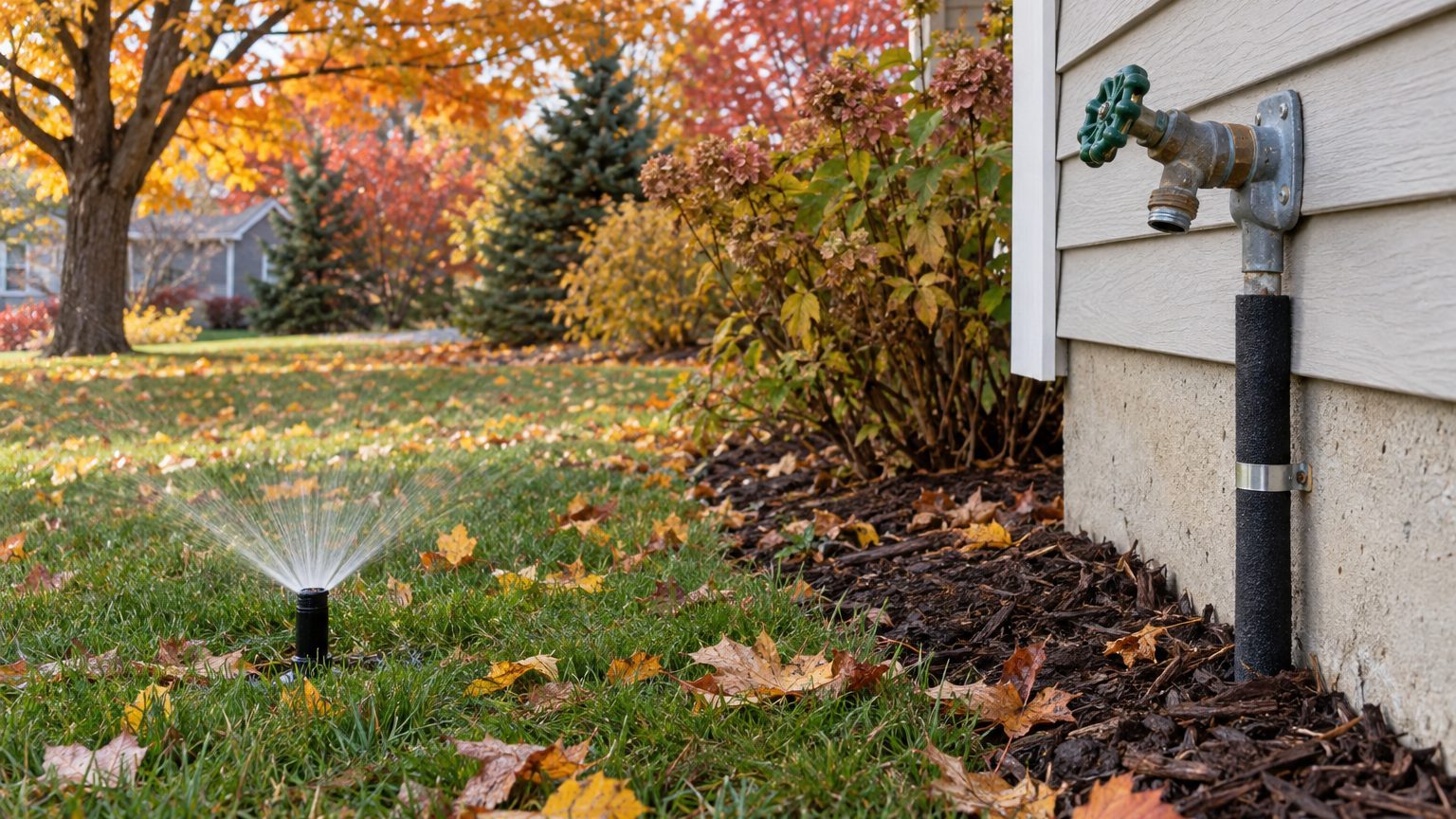

Drain sprinkler lines and outdoor taps in the weeks before the first hard freeze, which at St. John’s averages out to mid-October. Farther north and higher up, that freeze arrives sooner, so the work moves earlier too. Do it late and the damage stays hidden until spring, when a split pipe or cracked valve announces itself the moment the water comes back on. Timing comes first below, then the lines, the faucets and the failures this province makes likely.
When to do it in Newfoundland and Labrador
Aim for early October through the days just before the average first fall frost of October 17, and always before the first hard freeze, not after the first light one. That date comes from Environment and Climate Change Canada’s Canadian Climate Normals for 1981-2010 at the St. John’s airport station (ST JOHN’S A), and it is a mean, not a deadline.
Why the average is a midpoint, not a safe date
A mean date splits the years in half. In one year out of two, the first fall frost falls later than October 17, and in the other it falls earlier. Waiting for the 17th to start means losing that coin toss about half the time. Treat the date as the middle of a window that opens in early October, and finish while the forecast still shows nights above freezing. One more caution: the Canadian normals cover 1981-2010, while US stations are measured on 1991-2020, so don’t line the two up to the day.
The difference between a light frost and a hard freeze matters because of what each one does. A light frost burns tomato leaves and basil but barely touches water sitting in a buried line. A hard freeze holds temperatures below freezing through the night and into the morning, which gives water in a pipe time to turn solid. Plenty of people read the first white lawn as the starting gun. For plumbing, it means the clock has already run down.
Winter here is cold enough to justify the whole job
The mean daily minimum of the coldest month at St. John’s is -8.7 °C (16.4 °F) in those same normals. That is an average of the nightly lows, so individual nights run colder. Advice from mild-winter regions, where skipping the blowout is a reasonable gamble because pipes rarely see sustained freezing, does not transfer. Here, every line holding water and every hose left on a wall faucet is a candidate for damage. So the job is a full one: drain the sprinkler system, empty and store the hoses, shut off and drain the exterior taps, and check the valve boxes.
Natural Resources Canada places St. John’s in Canadian plant hardiness zone 6a (1991-2020 normals). That is a Canadian system, built on seven climate variables, and it does not convert to a USDA zone. Use it to understand the climate, not to compare against American numbers.
Where you live shifts the window
St. John’s is one station, and a province is not one climate. Labrador and higher, more inland ground on the island run weeks behind the airport in warmth. The direction is simple: the colder the district, the earlier the first fall frost, so the shutdown moves toward the start of October or sooner. If you live in one of those places, don’t borrow the St. John’s calendar. Borrow its logic instead, and finish ahead of your own first hard freeze. Other seasonal jobs across the province are collected in the Newfoundland and Labrador guides.
Sprinkler lines: drain or blow out
Water behaves badly in a closed pipe. As it turns to ice it expands, and a sealed line has nowhere to send that extra volume. Pressure builds between the ice and the nearest closed point, and the weakest part of the system gives way. That might be a threaded fitting, a valve body, a poly pipe joint, a riser under a sprinkler head, or the backflow preventer, which sits above ground and takes the cold first.
The split rarely shows itself in winter. Ice plugs the crack and holds. The leak appears in spring, when the ice melts and pressure returns, as a geyser in the lawn, a soggy patch that never dries or a zone that won’t hold pressure. Sprinkler systems are full of low spots where water collects: valves sit lower than the lines they feed, heads hang off the ends of risers, and pipe sags where soil has settled. Gravity alone does not clear all of that.
Three ways to empty the system
Irrigation systems are emptied in three ways, and they leave different amounts of water behind.
| Method | How it works | Where water can stay behind | Fit for this climate |
|---|---|---|---|
| Manual drain | You open drain valves at the low points and let gravity empty the lines. | Valve bodies, heads, and any section that does not slope toward a drain. | Reasonable first step, rarely enough alone. |
| Automatic drain | Valves open on their own when line pressure drops and release water. | Pockets behind a valve stuck shut with grit, and flat or sagging stretches of pipe. | Depends on perfect slope and clean valves. |
| Compressed-air blowout | Air pushed through each zone forces water out through the heads. | Very little when done zone by zone, though the backflow preventer needs separate attention. | The safest choice here. |
With a coldest-month nightly minimum of -8.7 °C, a system that is merely mostly empty is a gamble. Automatic drains are designed around the assumption that every line slopes toward a drain valve, and one stuck valve or one sagging stretch leaves a pocket that can freeze. Blow out each zone with compressed air in early to mid October, ahead of the first hard freeze, even if the system has manual or automatic drains. Open those drains first, then let the air clear what they missed.
Doing a blowout safely
Shut off the water supply to the system and relieve the pressure first. Connect the compressor at the blowout port, open one zone at a time, and run the air until the heads sputter out a fine mist instead of a stream. Then move to the next zone and cycle through all of them, since air that runs too long through one zone can heat and damage its heads. Keep the air pressure within the rating of your pipe and fittings. A compressor that is too large can burst a system that water never would have. Wear eye protection, and keep your face and body away from heads and the backflow preventer while air is moving. Drain the backflow preventer, then set the controller to its off or rain setting so it doesn’t try to run zones all winter.
Once the system is down, the lawn’s own fall routine takes over, and the steps in Winterizing a Lawn fit naturally into the same October weekend.
When a professional is the sensible choice
Hire out the blowout if you don’t own a compressor rated for irrigation work, if you don’t know where the zones, valves and drains are, or if it’s the first winter in a house you didn’t build. The same goes for older systems with brittle pipe, where an overpressure mistake costs more than the service call. Book early enough that the visit falls before the freeze, not after it.
Outdoor faucets and hoses
Outdoor taps are the cheapest part of the plumbing system to protect and one of the costliest to ignore. The job is mostly turning valves and coiling hoses, with no tools beyond your hands.
The shutdown sequence
Do the steps in this order, in early to mid October, before the first hard freeze:
- Disconnect every hose, splitter, timer and nozzle from the faucet.
- Drain each hose end to end and store it indoors or in a shed.
- Find the interior shutoff valve that feeds the outside tap and close it fully.
- Open the outside faucet and leave it open so trapped water can run out.
- Put a foam cover over the faucet if you like, knowing it supplements draining and never replaces it.
Leaving the outside tap open all winter feels backwards, but an open tap lets any leftover water drain or expand without pressure behind it. If your house has no interior shutoff for the outside faucet, or you can’t tell which valve controls it, stop there. Adding a valve or tracing the line is plumbing work, and it belongs to a plumber. A longer walkthrough is in Winterizing Outdoor Faucets Before the First Freeze.
Why a frost-free faucet still fails with a hose attached
A frost-free faucet puts its valve seat deep inside the heated part of the wall, at the inner end of a long barrel. When you shut it off, the water behind the seat stays in the warm zone, and the water left in the barrel is meant to drain out through the spout. That draining is the whole design. It depends on the barrel tilting slightly downward and on the spout being open to the air.
Attach a hose, even a drained one with the nozzle closed, and you break that design. Water stays trapped in the barrel, in the cold section outside the wall’s warmth, and it freezes there. A full hose gives the faucet a further reservoir of ice to push back against the barrel. The faucet then splits, usually well inside the wall where you can’t see it. The first sign comes in spring when the tap is turned on, or in a damp patch on the interior wall or basement ceiling. The design and its limits are covered in Frost-Free Outdoor Taps. If your faucet tilts upward or drips after shutoff, the fix is a plumber’s work, not a weekend project.
What goes wrong here
The failures that matter most in this climate are predictable. Each one comes down to timing or to one overlooked item.
The early cold snap
Because October 17 is only the middle of the range, half of all years bring the first frost earlier, and a hard freeze can follow close behind. Homeowners who plan to drain “sometime this month” get caught with full lines on the first cold night, and Labrador and upland districts get caught sooner than anyone. In spring this looks like zones that won’t build pressure, leaks at fittings and valves, or a cracked backflow preventer. Prevention is a firm date set in early October, with the air compressor or the service call arranged ahead of it.
The forgotten hose
One hose left on a wall faucet is enough. The faucet barrel freezes, splits inside the wall, and nobody knows until the first spring hose-down, when water sprays into a basement or crawl space. The signs are a drip or running water inside once the tap opens, stained drywall and wet insulation. If it happens, see Frozen Pipes for what to do next, and call a plumber for any repair. Prevention is a walk around the whole house, including the back wall and the garage, before the first freeze.
The valve box that floods
Sprinkler valves usually sit in a below-grade box that collects rain, snowmelt and groundwater. A blowout clears the pipes but not the water standing around the valves. If the box is full when the weather turns hard, the water around the valves freezes and cracks them. In spring you find a valve that weeps, a zone that won’t shut off, or a pool of water around the box. Lift each lid before the first hard freeze and check the water level. If it’s wet, the box needs better drainage, and a landscaper or irrigation contractor can sort that out.
Common questions
Can I wait until I see frost on the lawn?
No. A light frost on the grass tells you the season has turned, but it says little about whether buried or exposed water has had time to freeze. By the time a hard freeze arrives, the window to drain has closed. Finish in early October, before the October 17 average first fall frost at St. John’s.
Is October 17 a safe deadline for all of Newfoundland and Labrador?
It is not. The date is a mean from the St. John’s airport station, so in one year out of two the first frost comes later and in the other it comes earlier. Labrador and higher inland districts have an earlier first fall frost, so their shutdown belongs earlier, too.
If my system has automatic drain valves, do I still need a blowout?
A blowout is the safer choice. Automatic drains leave water wherever a line doesn’t slope toward a valve or a valve sticks closed. With a coldest-month nightly minimum of -8.7 °C, one pocket of trapped water is enough to split a fitting.
Should I leave the outside faucet open all winter?
Yes, once the interior shutoff is fully closed and the hose is off. The open tap lets leftover water drain and gives any remaining water room to expand. If you can’t find an interior shutoff for that tap, have a plumber handle it.