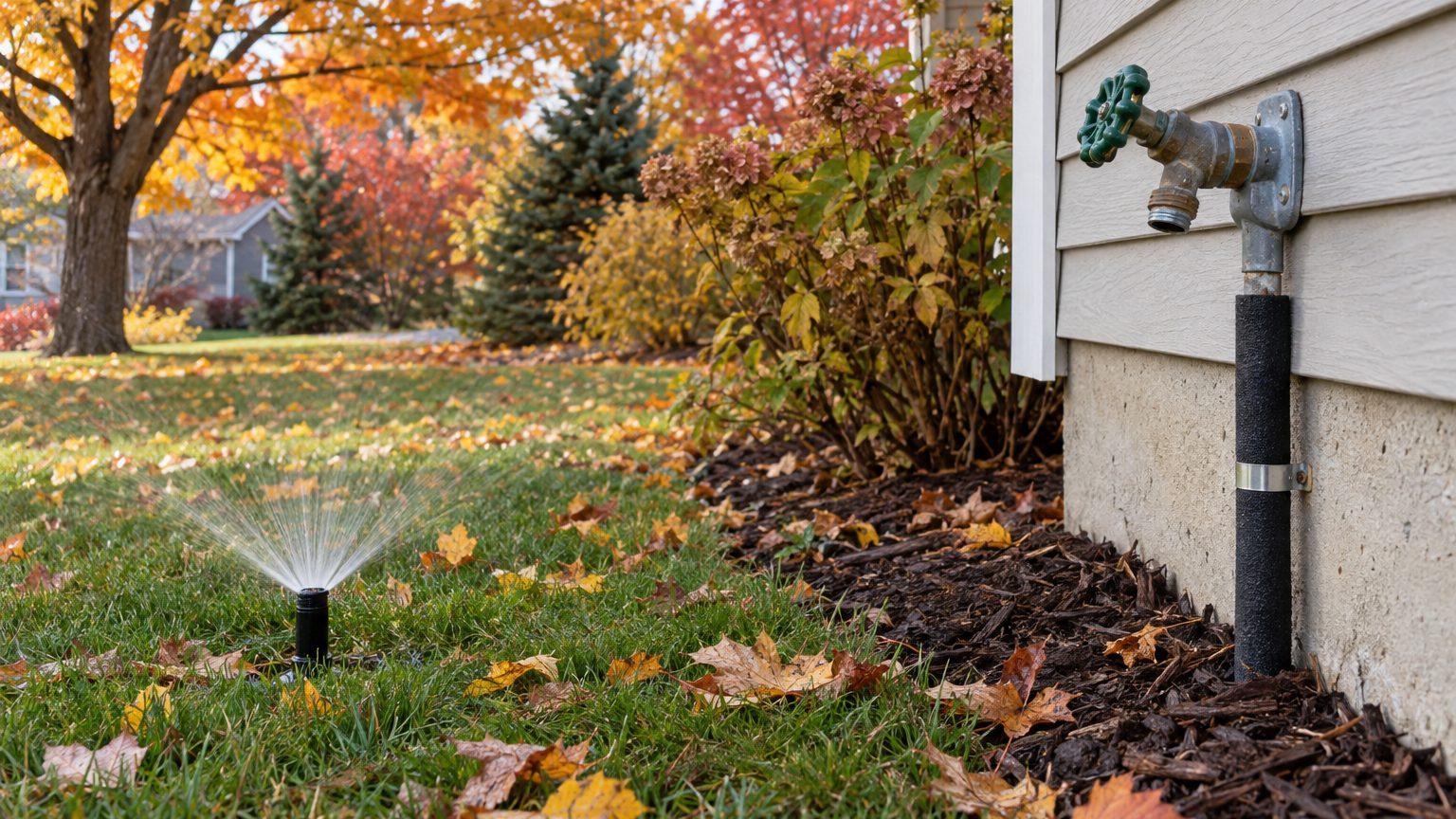

Drain everything outdoors in late summer, and don’t wait for a frost to tell you the time has come. Nunavut’s coldest month has a mean daily minimum of -34.3 °C, so any water left in a sprinkler line, valve or outdoor tap will freeze solid and split whatever holds it. Aim to have lines drained and taps shut off between late August and early September, ahead of the average first fall frost of September 13. Hoses come off first.
When to do it in Nunavut
The window for winterizing is late August to early September, set by the first fall frost. The rule is before the first hard freeze, not after the first light one. A light frost is a warning; a hard freeze is the night the damage happens.
Environment and Climate Change Canada’s 1981-2010 climate normals for the Rankin Inlet A station (official data here) put the average first fall frost on September 13. Treat that as the middle of a window, never as a safe date. It is a mean, so in roughly half of years the frost comes later, and in the other half it comes earlier, sometimes well before you have picked a weekend for the job.
Why the average date is only a midpoint
One station does not describe a territory this large. The figure comes from Rankin Inlet A, and communities farther north, or on higher ground, see the first frost earlier. For them the fall chores move earlier too: drain sooner, not later. The Canadian normals also cover 1981-2010, an older reference period than the 1991-2020 normals US stations now use, so the real recent pattern may sit a little differently. Local conditions vary across the territory, and the Nunavut guides cover other seasonal timing in more detail.
Practical translation: start in the last days of August, finish before the weather has a chance to surprise you, and do not make September 13 your deadline. By that date half the years have already had their frost.
A full drain is not optional here
In a mild-winter state, a full blowout is sometimes overkill, because the pipes rarely see a hard freeze. Nunavut is the opposite case. The mean daily minimum of the coldest month at the reference station is -34.3 °C (that is -29.8 °F, if you are comparing with US figures), according to the same ECCC 1981-2010 normals. There is no mild-winter shortcut and no safe pocket of water.
Natural Resources Canada’s plant hardiness site places Rankin Inlet in zone 0a. That is a Canadian system built on seven climate variables, not a USDA zone, and it does not convert to one. It is mentioned here only because it points the same way as the temperature data.
What is worth doing: remove every hose, empty every line and valve you own, close the supply, and leave outdoor taps open. Half measures fail at this latitude.
Sprinkler lines: drain or blow out
Ice takes up more room than the water it came from. Water trapped in a closed length of pipe has nowhere to expand, so the pipe gives way, usually at a fitting, a valve body or a low spot where water pooled. You rarely see it happen. The line looks fine in October and sprays from a crack in spring.
Valves are the weak points. Zone valves and any above-ground backflow device hold water in their bodies, and a cracked valve body means a replacement part, not a patch. Sprinkler heads can split too, though they are the cheapest piece to lose.
Three ways to clear the lines
| Method | How it works | Fit for Nunavut |
|---|---|---|
| Manual drain | You open low-point drain valves and let gravity empty the lines | Workable on small, well-sloped systems; leaves pockets of water if the lines sag |
| Automatic drain | Valves open on their own when line pressure drops and release water | Convenient, but depends on slope and on the valves working; pockets can remain |
| Compressed-air blowout | An air compressor pushes the water out through the heads, zone by zone | The most thorough option for a climate with no forgiving winter |
Each method has a place. Manual and automatic drains rely on gravity, which only works if every pipe slopes toward a drain point. Anyone who has dug up a line knows how often that is not quite true. Air does not care about slope.
Which one this climate calls for
With a coldest-month mean minimum of -34.3 °C, any water left behind will freeze. Plan a compressed-air blowout in the late August to early September window, and treat gravity drains as a first step rather than the whole job. Shut the water supply, open the drain valves, then blow out each zone in turn.
Technique matters more than force. Work one zone at a time and in short bursts, because running air continuously can heat the pipe and damage it. Stay clear of the heads while they are firing, and wear eye protection. Stay within the pressure rating of your pipe, valves and heads, and remember that air volume does the clearing, not high pressure.
Hire a professional if you do not own a compressor of suitable capacity, if the system has several zones, or if you are unsure of the pressure limits of what is buried. A pro also makes sense with an above-ground backflow device you have never serviced. Ask well ahead of the frost window, not during it. With the lines clear, the turf comes next, and Winterizing a Lawn picks up from there.
Outdoor faucets and hoses
This job is mostly turning things, and nothing more. Anything past turning valves, such as cutting, soldering or replacing a tap, belongs to a plumber.
The sequence
Start with the hose, because a hose left on is the most common reason an outdoor tap freezes. The steps are short:
- Disconnect every hose, splitter and sprayer from the outdoor tap.
- Drain each hose fully and store it indoors or in a shed.
- Close the interior shutoff valve that feeds the outdoor tap.
- Open the outdoor tap and leave it open so the remaining water runs out.
That is the whole routine. Do it before the first frost, in the late August to early September window, not on the day the forecast turns. A fuller walkthrough sits in Winterizing Outdoor Faucets Before the First Freeze.
If the interior valve will not close fully, or drips after you shut it, stop there. A valve that does not seal leaves the tap fed with water all winter, and fixing it is a plumber’s job.
Why a frost-free faucet still fails with a hose attached
A frost-free tap places the actual shutoff well inside the heated side of the wall. The long stem behind it is angled to drain, so water empties after you close it. That design only works if the water can run out. A hose left on, even a short one, holds water in the spout and in the stem, so the tap cannot drain, and the water freezes in the barrel or behind the wall, where you cannot see it.
The failure is quiet. Nothing leaks in fall because the ice acts like a plug. The trouble starts when it thaws, with water running inside the wall wherever the barrel split. At -34.3 °C mean winter minimum, there is no ambiguity: a frost-free tap with a hose attached will freeze. For how these taps work and what to check, see Frost-Free Outdoor Taps.
What goes wrong here
The common failures are predictable, which also makes them preventable. Each one traces back to timing or a missed step.
The early cold snap
The September 13 average is a midpoint, so the frost can arrive before anyone has started. The first hard freeze rarely announces itself, and one clear, calm night is enough. In spring the result looks like a spray from a cracked pipe or a fitting that weeps as soon as the water comes on. The fix is to treat late August as the start of the job, not the end of a to-do list, so the work is done before an early freeze can test it.
The forgotten hose
One hose left on one tap is the classic miss: the garden hose behind the shed, the short length on the back tap. Spring evidence is a tap that drips from the stem, or water that shows up inside the wall or on the basement ceiling below it. A walk around the house with a checklist works better than memory. Count the outdoor taps first, then count the hoses you have removed. For related pipe damage inside the house, Frozen Pipes explains the warning signs and what to do.
The valve box that floods
Valve boxes sit in the ground and collect meltwater and runoff. If a box holds standing water and the valves inside have not been drained, the water freezes and cracks them. In spring you find a box full of water, or a zone that will not shut off. In fall, check each box for pooled water, clear it, and make sure the lid is secure. Blowing out the zones clears the valves, but the box itself still needs a look.
In spring, turn the water on slowly and inspect every outdoor point before you walk away. A hairline crack shows up fast under pressure, and a minute of watching saves a flooded yard.
Common questions
Is September 13 a safe deadline?
No. It is the average first fall frost at the Rankin Inlet A station, from the 1981-2010 ECCC normals. In about half of years the frost arrives later, and in the other half it arrives earlier. Finish in late August to early September, and treat the average as the middle of the window.
Can I skip the blowout if I drained the valves by hand?
On a small, well-sloped system you might get away with a manual drain, but there is no margin for error at a mean coldest-month minimum of -34.3 °C. Water trapped in a low spot or a valve body will freeze. A blowout is the thorough option, and a professional can do it if you do not have the equipment.
Does a frost-free faucet still need winterizing?
Yes, though the job is shorter. Take off every hose and drain it, close the interior valve, and leave the outdoor tap open. A hose left on traps water in the stem, and that water can split the barrel behind the wall.
Do these dates apply across the whole territory?
Not exactly. The frost figure comes from a single station, Rankin Inlet A, and colder districts farther north or on higher ground see the first frost earlier, so they should drain earlier too. The Canadian normals cover 1981-2010, whereas US stations now use 1991-2020, so compare them with care.