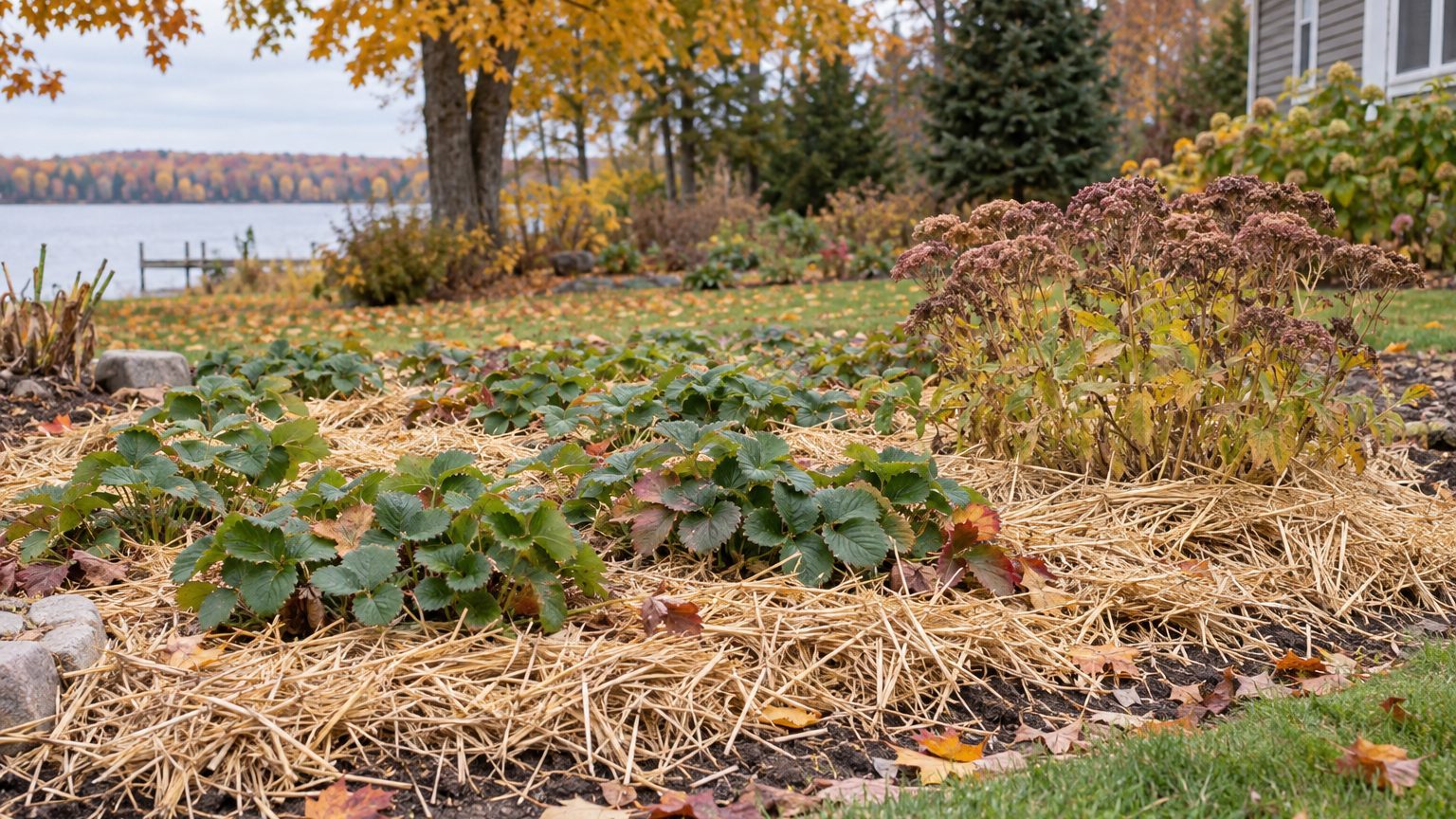

In Utah, winter mulch for strawberries and perennials goes down late, after the soil has started to freeze, not when the first frost hits the tomatoes. At Salt Lake City, the first fall frost arrives between October 18 and October 29, according to NOAA’s 1991-2020 Climate Normals. The mulch follows that window rather than leading it. Colder, higher ground runs earlier, and warmer southern Utah runs later. Buy the straw now. Spread it in late fall.
When to put winter mulch down in Utah
Winter mulch does not work like a blanket on a bed. Its job is to keep the soil frozen once it has frozen, so that a sunny January afternoon can’t thaw the top inch and a cold night can’t refreeze it. That freeze-thaw cycle is what pushes shallow crowns and roots up out of the ground. Mulch spread in early October, while the soil is still warm, does the opposite of what you want. It holds heat and moisture against the plant, and it gives mice and voles a cozy place to settle before the cold arrives.
The NOAA figures show why the ground does freeze here. At the Salt Lake City reference station, the mean daily minimum of the coldest month is 24.2°F (NOAA NCEI Climate Normals, 1991-2020). That is an average of the lows, not the record low, but it sits well under 32°F. The northern logic applies: soil freezes, thaws on sunny days, and freezes again.
Reading the window
NOAA’s freeze-probability data for the Salt Lake station puts the first 32°F freeze between October 18 and October 29, the band where the odds of a freeze run from 30 to 70 percent. A first frost is only the starting gun. Plants are still alive, and the soil beneath them is still warm. Wait until after the October 18 to October 29 first-frost range has passed, then mulch once the soil surface is freezing at night and staying stiff into the morning. In a typical year, that means the weeks after the first frost range, not the first week of it. Your own frost dates and the First and Last Frost Dates in Utah help you place the start .
Early October is the time for the prep work: pull weeds, finish watering, and get the straw or shredded leaves bagged and waiting. Don’t spread any of it yet.
Colder and warmer parts of the state
The Salt Lake valley is a mild spot by Utah standards. Most of the state sits higher and colder, and southern Utah is warmer. The USDA Plant Hardiness Zone Map (2023, built on 1991-2020 data) lists Utah as 4a to 9a, which tells you how much the state varies from place to place. That is a statewide range, so use the city nearest you, not the whole span, to place your own date.
| Where you garden | First fall frost | What it does to mulch timing |
|---|---|---|
| Salt Lake City valley (NOAA reference station) | October 18 to October 29 | Mulch after that range, once the soil surface starts freezing |
| Higher, colder ground | Earlier than that range | Mulch earlier, since the soil freezes earlier |
| Warmer southern Utah | Later than that range | Mulch later, and expect a lighter job or a frost-night cover instead |
The direction is the thing to remember. Colder means earlier frost, so fall tasks move earlier. Warmer means they slide later.
Strawberries
Strawberry plants carry everything they need for next summer in the crown, the short stem at soil level where leaves and flower buds form. It sits right at the surface, with no insulation. Two things hurt it over a Utah winter: bare cold, and the freeze-thaw cycles that heave it upward. I won’t hand you a kill temperature, because NOAA’s normals and the other facts here don’t supply one and plant tolerance varies by variety. Heaving needs no number to explain. Roots shear, crowns sit half out of the ground, and the survivors flower poorly.
What to use and how deep
Clean straw is the standard choice. Look for straw, not hay. Hay is full of seed heads and will plant a weed crop in your berry bed come spring. Pine needles and shredded leaves also work, though leaves can mat into a wet sheet if they are not shredded. Straw stays loose, sheds water, and lets air through.
For depth, the best figure available comes from NC State Extension, which says: “A 2-inch to 3-inch layer of mulch suppresses most annual weed seeds and makes it easy to hand-pull any that do germinate” (NC State Extension Gardener Handbook, chapter 11). That sentence is about weeds in general, not strawberries, so treat it as an order of magnitude. I would keep strawberry straw in that same range, loosely laid, and not go deeper. Straw fluffs when fresh and packs down with the first snow. More is not better. A thick, soggy pile traps moisture against the crowns, which is how you swap cold damage for rot.
Cover the whole bed, plants and all, so the crowns are buried under a thin loose layer. Our Growing Strawberries page covers variety choice and bed care if you are still planning next year’s patch.
Pulling it back in spring
Uncovering matters as much as covering. When the plants begin to grow again, leaves turning from pale yellow-green under the straw is the signal, so rake the straw off the crowns and tuck it between the rows. Don’t haul it away. Late frosts in Utah can arrive after growth starts, and straw kept nearby can go back over the plants on a freezing night. Pull the straw off the crowns as soon as new growth shows, and keep it between the rows to re-cover on frost nights. Check the last-frost range for your area on the frost dates page linked above before you put it away for good.
Perennials and borderline plants
Most established perennials adapted to your zone do not need winter mulch to survive. They are rated for the climate, and their crowns sit deep enough to ride it out. The ones that benefit are plants that live near the cold limit of what your location offers: new transplants set out in fall, shallow-rooted plants, and borderline plants that you are stretching one hardiness band past where they are comfortable. Roses, lavender, and similar semi-woody plants fall into that group for many Utah gardeners. For herbs in particular, Getting Perennial Herbs Through the Winter goes plant by plant.
The USDA Plant Hardiness Zone Map (2023) is built on one variable, the average annual extreme minimum temperature, and it lists Utah as 4a to 9a. That is a very wide range, so check the zone for your own town before deciding which plants are borderline. A plant that is borderline in the high country can be perfectly comfortable in a lower valley.
A ring, not a pile
Mulch the area around the plant, but keep it off the crown itself. Make a ring or doughnut, with a small gap of bare soil closest to the stem or crown. Piling mulch against the crown holds moisture against the bark and buds, invites rot, and gives rodents a hidden entry point. For depth, NC State Extension says: “Provide a 3-inch layer of mulch to reduce water loss and maintain uniform soil moisture and temperature around roots.” That line is written about trees, but the logic carries over. Mulch moderates the swings in soil moisture and temperature, which is the whole point in a Utah winter. The same source’s 2-inch to 3-inch range for weed suppression gives you the other end. Stay in that band. Deep mulch is how a ring becomes a volcano.
Mulch borderline perennials after the soil has begun to freeze, which at Salt Lake means after the October 18 to October 29 frost range has passed, using a ring of 2 to 3 inches with bare soil right at the crown. The timing rule is the same as for strawberries: later in warmer places, earlier in colder ones. The general technique for avoiding mulch damage is in Mulching Without Killing the Plant.
What goes wrong
Mulching too early is the most common mistake. The warning signs show up by midwinter: crowns that are soft or discolored, and a damp, sour smell under the layer. Prevention is simply patience. Wait until the soil surface has started to freeze, which at Salt Lake is after the October 18 to October 29 first-frost range, and sooner in colder places.
Matted mulch does similar harm. Whole leaves, wet grass clippings, and straw that was baled damp can all fuse into a slick layer that holds water against plants. You’ll see gray mold or a crust on the surface. Shred leaves, use dry straw, and keep the layer in the 2-inch to 3-inch range NC State Extension gives for mulch.
Voles and mice are the third problem. A deep, undisturbed layer sitting on bare soil is an ideal winter home, and the damage appears in spring as chewed crowns, bark stripped off low stems, and surface tunnels. Keeping mulch off the crown, laying it late, and keeping the ring shallow all help, because a thin loose layer is a poor nest.
The last mistake comes in spring. Mulch left on too long smothers new growth, keeps the soil cold, and holds moisture on crowns just as they wake up. Start uncovering as soon as new growth shows, and keep the pulled mulch nearby for frost nights. A soft pale shoot under straw is a plant asking to be let out.
Common questions
Should I mulch strawberries right after the first frost in Utah?
Not right away. The first frost, October 18 to October 29 at Salt Lake according to NOAA’s 1991-2020 normals, is only the signal that the season is turning. Strawberries are better off waiting until the soil surface is freezing at night, since early mulch holds warmth, moisture, and rodents against the crowns. Colder, higher locations reach that point earlier than Salt Lake, and warmer southern Utah reaches it later.
How thick should winter mulch be?
NC State Extension’s handbook says: “A 2-inch to 3-inch layer of mulch suppresses most annual weed seeds and makes it easy to hand-pull any that do germinate.” It also says: “Provide a 3-inch layer of mulch to reduce water loss and maintain uniform soil moisture and temperature around roots.” Both statements point to the same range. Going deeper does not add protection and raises the risk of rot and rodents.
Do I need to mulch every perennial?
No. Established perennials suited to your area generally don’t need it. Save the effort for new fall transplants, shallow-rooted plants, and borderline plants near the cold limit of what your location offers. The USDA’s 2023 map lists Utah as 4a to 9a, so what counts as borderline depends heavily on where you live in the state.
Does the ground freeze everywhere in Utah?
At the Salt Lake City reference station, the mean daily minimum of the coldest month is 24.2°F (NOAA NCEI Climate Normals, 1991-2020), so the ground does freeze there, and the higher, colder parts of the state are colder still. Southern Utah is warmer, and in the mildest pockets mulch is more about holding moisture, suppressing weeds, and covering plants on a frost night than about keeping soil frozen. The Utah guides cover timing by region in more detail.