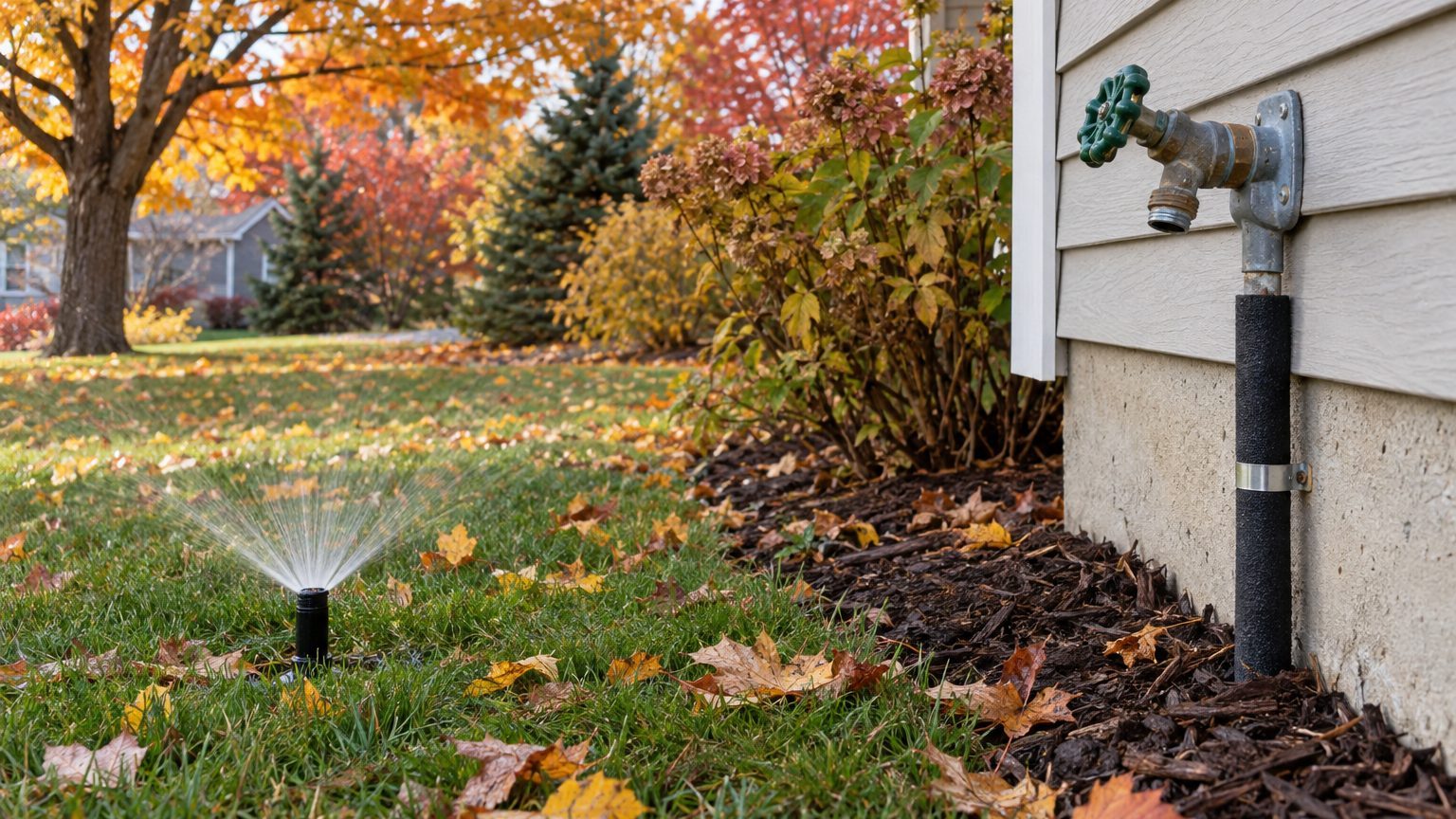

The calendar matters less than the thermometer. In Yukon, sprinkler lines and outdoor taps need draining before the air and soil settle into real cold, and the trigger is the first fall frost, not a holiday weekend. At Whitehorse that frost arrives, on average, around August 25. That is earlier than most people start thinking about winter. Below: the timing, the method for each part of the system, and the failures that show up in spring.
When to do it in Yukon
Winterize sprinklers and outdoor faucets in a window running from late August to mid-September, which means before the first hard freeze, not after the first light one. The anchor is the first fall frost: at the Whitehorse A station, Environment and Climate Change Canada’s Canadian Climate Normals for 1981-2010 put it on average at August 25.
That date is a midpoint, not a safe harbor. In one year out of two the first frost lands later than August 25, and that also means it can come sooner. Treat the average as the center of a window and start inside it, not at the far edge. A light frost is the kind that blackens tender garden plants and frosts the windshield for a morning. Buried pipe and valve bodies shrug it off. A hard freeze is different: air temperatures well below zero that hold through the night and into the next day, long enough to turn standing water in a line to ice. The first one is a warning. The second is the deadline you want to be well ahead of.
Why a full shutdown isn’t optional here
In a territory where winter lows stay above freezing, a full blowout is often unnecessary. A quick drain and a cover can be enough, and the real work is simply not leaving a hose attached. Yukon is the opposite case. The mean daily minimum of the coldest month at the Whitehorse reference station is -19.2 °C (about -2.6 °F, for readers comparing with US figures), according to the same ECCC normals. Any water left in a line, a valve or a faucet barrel will freeze solid and stay frozen for months. So everything gets done: the supply shut off, the lines emptied, the hoses stored, the outdoor taps left open.
Colder and higher districts run earlier
The August 25 figure belongs to one station, and the territory is not one climate. Northern and upland districts get their first frost earlier than Whitehorse does, which pushes the whole window earlier there, never later. If you live farther north or at elevation, finish at the front of the window and treat the average as a ceiling, not a target. The Yukon guides cover more local timing.
One note on sources. Canadian normals run 1981-2010, while US figures commonly use 1991-2020, so a Yukon frost date and a US frost date are not measured over the same years. Don’t line them up in a table and read them as equals.
Sprinkler lines: drain or blow out
What freezing does to lines and valves
Water expands as it turns to ice, and a closed pipe has nowhere to put the extra volume. The pipe or fitting gives way. Splits often run along the length of a poly or PVC line, and valve bodies and fittings can crack. Sprinkler heads and the backflow preventer, which usually sits above ground and is the most exposed piece of the system, are especially vulnerable. The damage stays hidden all winter. You find it in spring when the system is pressurized and a geyser appears in the lawn.
Low points are where trouble collects. Irrigation pipe is laid with only a slight slope, and plenty of water stays behind in flat runs, in the valve manifold and inside each head. That leftover water is what breaks things, not the water you can see running out when you open a drain.
Three methods compared
| Method | How it clears water | What it can leave behind | Fit for Yukon |
|---|---|---|---|
| Manual drain | You open drain valves at the low points of each zone and let gravity empty the lines | Water in flat runs, heads and valve bodies | A first step, rarely enough alone |
| Automatic drain | Valves at low points open by themselves when line pressure drops | The same residual water, plus valves that can stick or leak | Helpful backup, not a full answer |
| Compressed-air blowout | Air pushed through each zone forces out nearly all remaining water | Very little, if every zone is done | The standard choice |
Manual and automatic drains both depend on gravity, and gravity only gets water to the lowest point on a given run. They work well in places where a stray bit of ice is a minor problem. With a coldest-month average minimum of -19.2 °C, a stray bit of ice is a split pipe by spring.
Which one this climate calls for
For an in-ground system in Yukon, the sound routine is shut off the water supply, drain the main line, then blow out every zone with compressed air before the first hard freeze. Do the zones one at a time, and run each until the heads stop spitting water and only air or a light mist comes out. Wear eye protection and keep your face clear of the heads. Too much air pressure or too long a run with no water cooling the lines can damage fittings, so use the equipment ratings for your pipe and heads, not a guess. Once the zones are done, fall lawn work is a separate job; see Winterizing a Lawn.
When a professional is the sensible choice
Hire it out when the system has many zones, because a small compressor can’t keep up. Hire it out too if you don’t know the pressure rating of your pipe and heads, the backflow preventer needs servicing, or the system has no drain valves at all. A pro also brings a compressor sized to the job, which matters more than it sounds. Book early. Because the frost can arrive before the average date, a technician’s calendar fills fast once the first cold nights show up in the forecast.
Outdoor faucets and hoses
The shutdown sequence
An outdoor faucet needs only valve-turning, and the order matters. In the same window as the sprinklers, work through these steps:
- Disconnect every hose, splitter, timer and sprayer from the faucet.
- Find the interior shutoff valve for that faucet, usually in a basement, crawl space or utility area, and close it.
- Open the outdoor faucet fully so the water between the interior valve and the spout can drain out.
- Drain each hose, coil it, and store it indoors or under cover.
- Leave the outdoor faucet open all winter.
The last step surprises people. A faucet left open lets any water that leaks past the interior valve go somewhere other than into a pipe that freezes. Closing the faucet again too soon traps water you were trying to release.
Why a frost-free faucet fails with a hose attached
A frost-free faucet is built so the valve seat sits deep inside the heated part of the house, at the end of a long stem. When you shut it off, the barrel behind the spout is supposed to drain out through the opening, sloped slightly downward. That design only works if the spout is open to air. A hose, even a short or empty one, holds water in the barrel. A hose also traps water in its own coils and under the spray head, and that water cannot back out of the faucet. The trapped water freezes outside the wall’s warm zone, splits the barrel and often goes unnoticed until the faucet is turned on in spring. Frost-free tap design is covered in Frost-Free Outdoor Taps. For a broader checklist, see Winterizing Outdoor Faucets Before the First Freeze.
Where your job ends
If you see a drip after closing the interior valve, a leaking handle, a wall that stays cold and damp, or you want to replace a faucet, that’s a plumber’s job. So is adding insulation inside the wall or fixing a stuck interior valve. The home routine is valves and hoses only, so close the interior shutoff, open the outdoor faucet, and leave it open until spring.
What goes wrong here
The early cold snap before anyone has drained
The most likely failure is also the simplest: the hard freeze arrives before the work is done. With a mean first frost of August 25 at Whitehorse and earlier frost in colder districts, a cold night can come while the sprinkler controller is still set for summer. In spring this looks like a split in a lateral line, a soggy patch that wasn’t there last year, or a head that cracks and sprays sideways. Prevention is mostly timing. Don’t treat the average as permission to wait, and set a reminder for the second half of August so the job lands inside the window.
The forgotten hose
One hose left on a faucet can undo the rest of the shutdown. The failure doesn’t show in fall. It appears when you turn the water back on and see a spray inside the wall, drips from a basement ceiling, or a stain spreading below the faucet. Prevention takes a minute: walk the property before the first cold nights and check every faucet, including the one behind the shed or around the back of the house. A split pipe that lets water into a wall cavity is a bigger repair; see Frozen Pipes for how those problems develop.
The valve box that floods
Zone valves often live in a buried box with a lid. If groundwater, snowmelt or irrigation runoff collects in the box, water sits around the valves and freezes. Signs in spring are a valve that won’t close fully, a steady weep at the manifold, or a box full of water with fittings stained or cracked. Prevention starts in fall. Check the box for standing water, clear it, keep the lid on, and make sure the valves themselves are drained and blown out. When you pressurize the system in spring, open the supply slowly and watch each zone and faucet before you trust them.
Common questions
What if frost already hit before I drained everything?
A light frost usually doesn’t damage buried lines, so drain promptly and carry on. If a hard freeze has already come through, don’t turn the water back on to run the system. Let everything thaw, then drain and blow out as planned. Check in spring for damage you can’t see in fall.
Can I wait until October?
You can, but you’re betting. The August 25 average at the Whitehorse A station means the first frost falls later than that in one year out of two, not that it always does. Colder and higher districts get their first frost earlier than Whitehorse does, so waiting there is a bigger gamble. The window in this article runs late August to mid-September for a reason.
Does a frost-free faucet still need winter prep?
Yes. Take the hose off, shut the interior valve, and leave the outdoor faucet open. A frost-free faucet is protected only if it can drain, and a hose or a closed spout stops that. Anything beyond turning those valves is work for a plumber.
Does my hardiness zone tell me when to winterize?
No. Natural Resources Canada’s Plant Hardiness Site lists Whitehorse as Canadian zone 1b, based on 1991-2020 normals. That is a Canadian measure built from several climate variables, not a USDA zone, and it can’t be converted to one. It describes what plants survive, not when pipes freeze. For plumbing, the first fall frost is the better guide, and it comes from a different set of years (1981-2010), so treat the two numbers as separate tools.