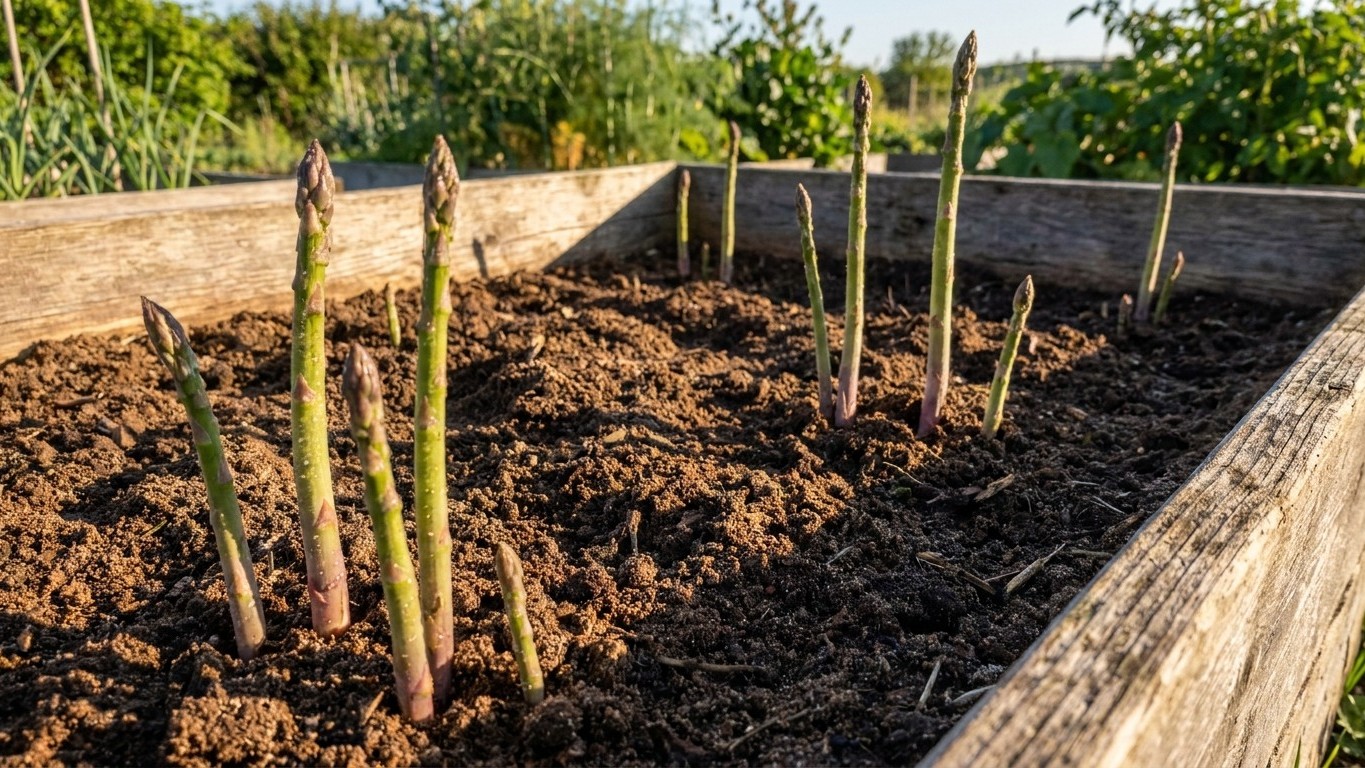

The sources behind this page publish no pest list for Newfoundland and Labrador, and no calendar saying when anything feeds on a bed. Guessing at insects or animals and attaching dates to them would be invention, so this page doesn’t. What the sources do carry are hard numbers on the ground, the rain and the frost, which are the conditions that set up a 10 to 15 year bed. Start with the Growing Asparagus in Newfoundland and Labrador overview if you want the full picture.
The short answer
A bed gets planted once. Crowns go into 8-inch furrows in early spring, nothing is harvested until year 3, and then the bed produces for 10 to 15 years. Utah State University Extension sets one soil requirement: most soils will do, provided they are well drained. Nothing there addresses chilling or soil pH, so neither appears here as a rule. Drainage is the whole test.
So does the ground here pass? The dominant soil in the province’s agricultural survey is a Podzol, the acid, leached soil that forms under conifers, where rain has washed the bases out of the surface. It covers 59 percent of the mapped surface, with organic soils next. The median surface horizon reads about 4.3 for pH (strongly acid), 56 percent sand, 9 percent clay and 35 percent silt, with organic matter near 3.3 percent. That is a loam to silt texture with little clay, which sounds forgiving. The drainage class is the catch: imperfectly drained. That falls short of the “well drained” the source asks for.
My plain reading is that the typical ground here does not reliably clear the bar. It is not hopeless, because the texture is open. But “imperfect” means water lingers after wet spells, and a furrow is a trench. Dug 8 inches into imperfectly drained ground, it can act as a sump for the crowns sitting at the bottom. In most gardens a soggy patch is a seasonal nuisance you amend and live with. With asparagus it is a decision you live with for fifteen years.
That median is a starting point, not a diagnosis. The survey covers the agricultural regions only, so the far north of Labrador isn’t represented. River bottoms, muskeg and any lot a builder has scraped or filled can behave nothing like the median. A strongly acid median is also not your pH. Get your own number from a soil test before you commit.
If your spot holds water, you have three moves. Walk the property after a heavy rain and plant where water leaves first, such as the high corner or the slope’s shoulder, not the low spot. Build the bed up above the surrounding grade instead of digging down into it. Or pick a different location altogether. Digging deeper into wet ground only makes the sump deeper. The Will Newfoundland and Labrador Soil Hold an Asparagus Bed for Fifteen Years? page walks through the drainage question in more depth.
The furrow is also filled in gradually, not all at once: 2 inches every other month across the first year, so the crowns end up buried over time while the shoots keep reaching daylight. Then comes the wait. Harvest runs 4 weeks in year 3, then 6 weeks, then 8. The stopping rule is an object, not a date: quit cutting when most spears are thinner than a pencil.
Will the summer here water it for you?
The bed wants 1 to 2 inches every other week for the first two years, then every three weeks. St. John’s A, the reference station for these numbers, normally collects about 290 mm (11.4 inches) of rain across June, July and August, out of 1534 mm (60.4 inches) for the whole year. July is the driest of the three at 92 mm (3.61 inches), and both June and August run a little wetter. Spread over roughly thirteen weeks, that works out to a bit under an inch a week, or somewhere near 1.75 inches per fortnight. On paper, the summer covers the schedule almost by itself.
Paper and garden differ. Those are normals for one airport station, from an older reference period than the one behind the US figures elsewhere on this site, so they’re not directly comparable. They show what you can usually expect, not what this July will do. A slope, a rain shadow or a town changes the picture. Soil matters too: the median profile is imperfectly drained, so rain tends to hang around instead of vanishing, which helps in a dry week and hurts in a wet one. Rain that comes as a single hard downpour also runs off more than it soaks in, and hot days at or above 90°F pull water out of the ground fast.
Here is how to work it out for your own plot:
- Set a rain gauge in the open, near the bed, as soon as you start preparing the ground. It beats any regional average.
- Add up each two-week stretch in years one and two. The target is 1 to 2 inches.
- Where a fortnight comes in under 1 inch, make up the gap with a slow, deep soaking on the bed, not a daily sprinkle.
- Where a fortnight comes in over 2 inches, add nothing, and check that the furrow is draining.
- From the third year, stretch the interval to every three weeks and run the same count.
In an average summer here, the gardener adds little. The work shows up in the stretch of dry weeks that the average hides, and the gauge is what tells you which weeks those are.
When to put the crowns in
Early spring is the planting window in the source, with no calendar date attached. The one frost marker published for this province is the average last spring frost at St. John’s A: around May 30. It is a mean, which means that in one year out of two the last frost lands later than that. It is the middle of a window, not a safe date, so don’t wait for it to pass before you start preparing the ground.
In practice, the work of digging 8-inch furrows and setting crowns sits in the weeks leading up to that date and around it. Prepare the bed once the ground can be worked, and check your own weather instead of the calendar. How well crowns in the ground handle a late frost is not published in these sources, so I’m not going to promise anything on that point. The When to Plant Asparagus Crowns in Newfoundland and Labrador page looks at the timing in more detail.
The date is also tied to one station. Northern and upland districts run weeks behind St. John’s, and Labrador is a different climate from the Avalon. Treat May 30 as a reference point, then shift it for your own location. If you don’t have a local frost record, ask neighbors who garden what they’ve seen.
The seed route
Seed is the alternative to crowns. The facts behind this page do not carry sowing dates or a seed-to-harvest timeline, so use the seed packet and don’t assume the crown schedule of harvest in year 3 carries over. Four varieties are named in the source, with only their sex given: Jersey Giant and Jersey Knight are all-male, while UC 157 F1 and Purple Passion are male and female. The source publishes nothing on flavor, yield or any reason to prefer one, so there is no basis here for ranking them.
Common questions
What eats asparagus in Newfoundland and Labrador?
The sources used for this page do not publish a pest list or a feeding calendar for the province, so neither appears here. For a reliable answer, ask your provincial agriculture office or a local gardening group what turns up in your area.
Can I cut spears in the second year?
No. Nothing is harvested until year 3. After that the harvest runs 4 weeks, then 6, then 8. Stop cutting when most spears are thinner than a pencil.
Does one of the named varieties do better in this province?
The source does not say. It names Jersey Giant and Jersey Knight (all-male) and UC 157 F1 and Purple Passion (male and female), and publishes only their sex.
How do I store spears after cutting?
The target is 0 to 2°C (32 to 35.6°F) with air at 95 to 100 percent humidity. Both edges of that window cause damage. Above 10°C (50°F), spears toughen quickly. At -0.6°C (30.9°F) or lower they freeze and go soft. Standing the cut ends in water is the practical way to get the humidity at home, because spears lose water fastest through the cut end.