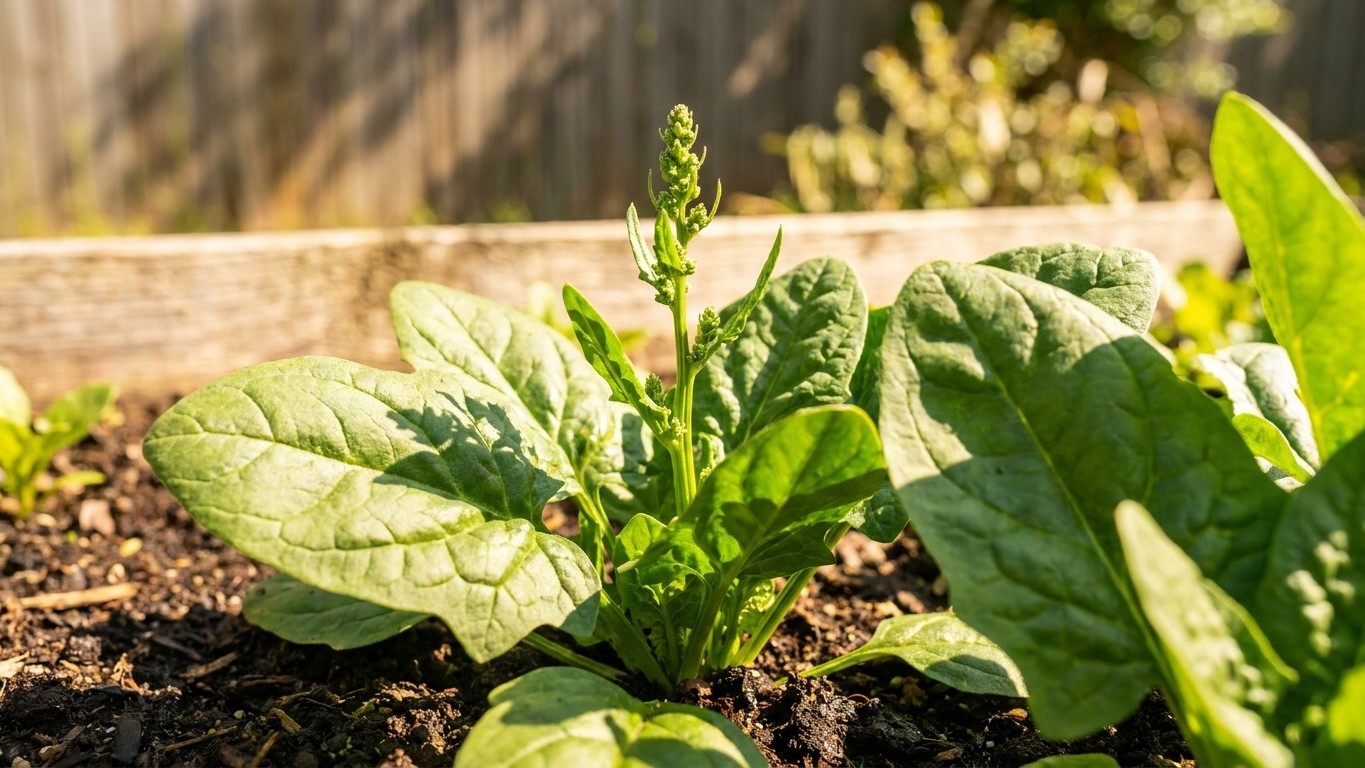

Cut spinach as soon as the leaves are big enough to eat, and don’t wait for them to get bigger. In South Dakota the clock runs out fast. Spring plants get a few weeks before heat and long days send up a seed stalk, and a fall crop has to be sown in the back half of summer to finish before frost. Once cut, the leaves hold quality for 10 to 14 days at best, and only at 32°F. The limits behind those numbers are below.
The short answer
Fifteen hours and 15 minutes. That is the daylight on the longest day of the year at the Sioux Falls reference station, and it matters more than any thermometer reading. Spinach flowers in response to long days as well as warm temperatures, and 15 h 15 is long by any standard. Once a plant flowers, it throws up a seed stalk, the leaves turn small and bitter, and the harvest is over.
Day length and heat, both at once
So what limits spinach here? Both. Heat sets the ceiling: Utah State University Extension says spinach grows best where temperatures do not exceed 75 F. Day length sets the trigger: long days alone can start flowering. A cool summer does not buy extra weeks. If June comes in with highs in the upper 60s, the days are still near their longest and the plant still gets the signal. Gardeners from cloudier, shorter-day regions often assume a mild season will stretch a spinach bed. At this latitude it won’t.
The heat count looks gentle at first glance. The reference station averages 13.8 days a year at 90 F or higher. But spinach quits long before 90. The 75 F line is the growth ceiling and also the point where flavor turns bitter, one number with two consequences. Every day at or above 90 is also a day above 75, so the number of days that stop spinach is larger than 13.8, and the spring crop runs out of road well ahead of any heat wave. For a closer look at the flowering mechanism, see Will Spinach Bolt Early in South Dakota?
How long it keeps once cut
Harvesting is only half the clock. The UC Davis Postharvest Technology Center calls spinach highly perishable. Its optimum is 32°F at 95 to 98 percent relative humidity, and it “will not maintain good quality for more than 2 weeks.” Wilting, yellowing and decay increase after 10 to 14 days. At 41 to 50°F, the range common in distribution and not far from what a crowded refrigerator door holds, the decline is faster.
Two weeks is a ceiling, not a plan. A home fridge is rarely at 32°F, so put the bag on the back of the bottom shelf, where it runs coldest, not in the door, where every opening lets warm air in. Cut in the cool of the morning, keep the leaves dry, and plan to eat them in the first several days.
How long the spring window really is
The spring window is bracketed by two events: the soil becoming workable around the last frost, and the first stretch of days above 75 F. Spinach goes in 2 to 3 weeks before the last frost. The reference-city frost date is April 29 to May 9, from the NOAA NCEI 1991-2020 Climate Normals for the Sioux Falls airport station. Working it through:
- Find your frost date. The reference figure is April 29 to May 9, a 30 to 70 percent probability band at an airport station. Suburban and rural gardens usually see the last spring frost one to two weeks later, and more at elevation, so check your own county rather than treating this as a state-wide guarantee.
- Count back 2 to 3 weeks. At the reference city that puts sowing at roughly April 8 to April 25. In a garden where frost lingers into mid-May, shift the dates later by the same margin, and sow only when the soil can be worked.
- Find where 75 F begins. This is the step no table can do for you. The date when growth stops being good is not published here, and 75 F is a temperature, never a calendar date. Watch the daily highs. When they start holding in the 70s, the plants are living on borrowed time, and the leaves are heading toward bitter.
- Count the weeks in between. Subtract your sowing date from the date the highs settle in the 70s. In a state where the last frost is in early May, sowing cannot start until mid-April or later, so what is left is a matter of a few weeks, not a season.
Notice what is missing from that list: a days-to-harvest figure. The source this page rests on publishes none for spinach, so any number would be borrowed from somewhere else. Cut by leaf size instead. Take the outer leaves when they are large enough to use, and if the center begins to lengthen into a stalk, cut the whole plant and stop waiting.
The short window argues for sowing early and sowing small batches rather than one big row. Pests also shape how much of that window you keep, which is covered in What Eats Spinach in South Dakota, and When.
The autumn crop, and when the soil lets you sow
Autumn gives spinach what spring cannot: days that shorten and temperatures that fall. The catch is the calendar, because the obstacles sit at both ends of it.
Warm soil closes the early end
The August problem isn’t cold. It is warm soil. Utah State University Extension notes that seed germination is reduced when the soil is above 80 F. A seed pushed into a hot bed in July may sit there, sprout poorly, or not come up at all. In a region with summer soil like this, the window opens when the soil falls below that mark, and the soil, not the date on the seed packet, makes the call.
Probing the soil in the morning gives a more honest reading than the air temperature. Watering the bed before sowing and shading it for the first days are common ways to cool the surface, though the only measured threshold the sources give is the 80 F one.
Frost closes the late end
The guidance for a fall crop is to plant 50 to 75 days before the date you want to harvest. At the reference city, first fall frost falls between September 24 and October 4 (NOAA NCEI 1991-2020 Climate Normals, same airport station). Using that as the realistic end of the harvest, the arithmetic goes like this:
- Harvest ending September 24: sow between July 11 and August 5.
- Harvest ending October 4: sow between July 21 and August 15.
The front half of those ranges lands in the weeks when soil is likely still too warm, so the usable sowing dates cluster toward the later end of each range, as soon as the soil cools. Rural and suburban gardens usually get frost one to two weeks earlier than the airport, which pulls the whole count earlier by the same margin. Someone with a garden that frosts in mid-September should be counting back from a mid-September date, not the reference figure.
Varieties are one more lever, but the data is thin. The source names four, Bloomsdale, Melody, Teton and Olympia, and publishes nothing about any of them: no maturity, no bolt resistance, no flavor. Any ranking of them for South Dakota would be guesswork, so this page makes none.
Common questions
How do I know when it is time to cut spinach?
Go by the leaves. When the outer ones are big enough to eat, start cutting. No days-to-maturity figure for spinach is published in the source used here, so a count from sowing would be a guess. If the center of the plant starts to stretch upward, it is bolting, and that plant should be cut whole.
How long does cut spinach keep in the fridge?
UC Davis says it will not keep good quality for more than 2 weeks, and that only at 32°F with 95 to 98 percent humidity. Quality drops after 10 to 14 days, and faster at 41 to 50°F. Use the back of the bottom shelf, not the door, and eat it early.
Does a cool summer let me keep cutting spring spinach longer?
No. Spinach bolts in response to long days and warm temperatures, and the longest day here has 15 h 15 of daylight. Cool weather can ease the heat side, but the day length is still there.
Are the frost dates on this page right for my garden?
They are reference-city figures: April 29 to May 9 for the last spring frost and September 24 to October 4 for the first fall frost, from the Sioux Falls airport station. Gardens outside town often see frost later in spring and earlier in fall, by a week or two, so check your county before committing seed. The overview in Growing Spinach in South Dakota covers the rest of the season.