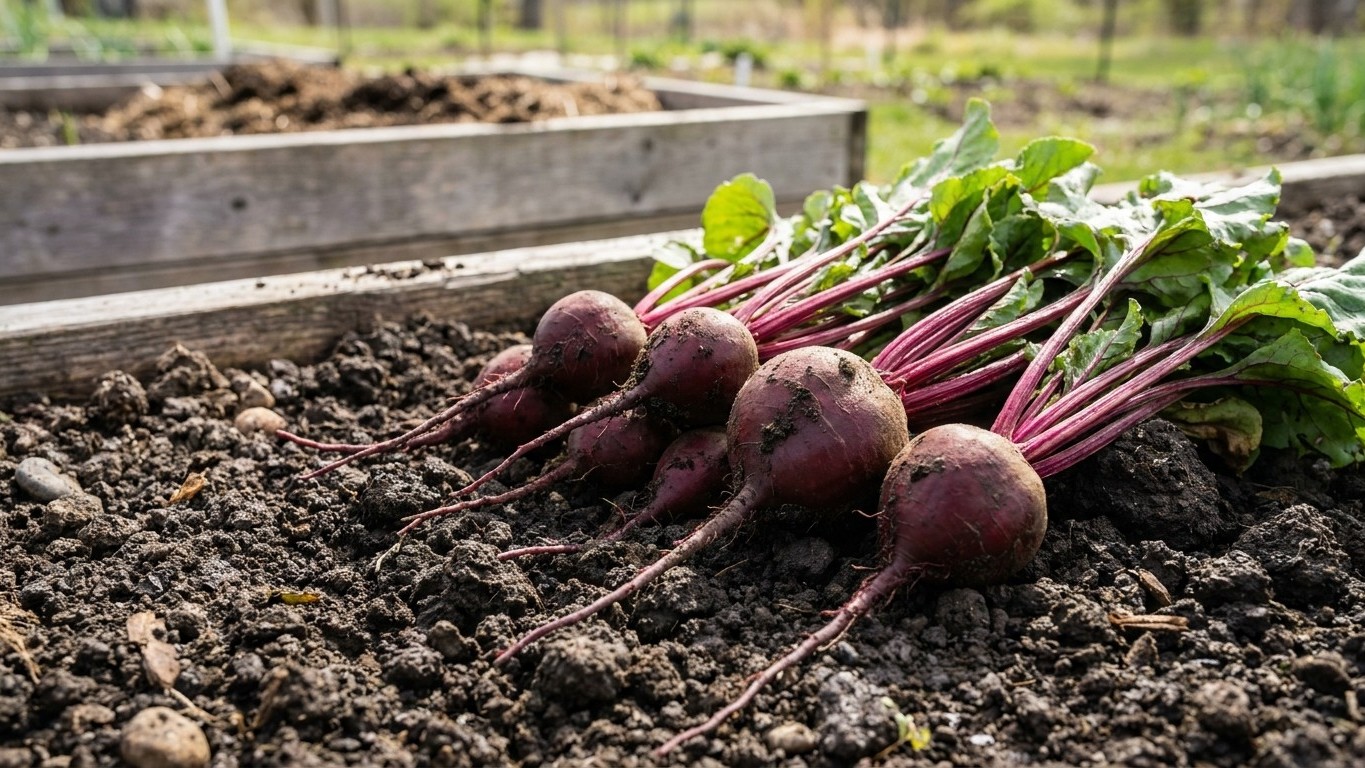

Pull beets 60 to 80 days after seeding, and decide at that moment which roots you will eat now and which you will store. The surprise comes after harvest. Topped beets keep best at 33 to 36 F, and the USDA says storage at 32 to 34 F produces more black spot and rot than slightly warmer conditions. Every other root crop rewards a colder cellar. Beets don’t.
The short answer
Start with the ground. Alaska’s state soil is the Tanana series, a Gelisol, which means permafrost sits within reach of the profile. USDA’s representative surface values are 30 percent sand, 7 percent clay and 63 percent silt, with a surface pH of about 4.7 (strongly acid), organic matter near 90.0 percent, and poor drainage. For a beet, that is nearly the reverse of the order. Utah State University Extension describes the crop as wanting deep, sandy, well-drained soil rich in organic matter. Tanana is silty, holds water, and has a frozen layer below that caps how far a root can go. The 90 percent organic matter figure describes a natural mat of forest litter and peat, not a garden bed. Nobody’s cultivated plot looks like that.
A caution applies to all of this. Alaska spans hundreds of soil series, and your garden may have river silt, glacial gravel, or fill a builder spread last decade. The Tanana numbers are a starting point for what the state’s ground tends to do (hold cold water, run acid). They are not your pH and not a diagnosis. A soil test gives you your own number, and Beet Soil in Alaska: What the Root Will Meet walks through what to do with it.
Heat is the other half of the question, and the number is not published here. NOAA NCEI’s normals for Anchorage (station USW00026451) carry the frost dates, not a count of days above 90 F, so I won’t offer one. What Utah State does give is the threshold that matters: heat above 85 F combined with water stress makes the root woody. Anchorage is one of the mildest inhabited parts of Alaska, and the Interior and the north are far shorter on season, so check your own local weather before assuming either way. Woodiness is a late-season problem, a thirsty root in a hot spell. It is a separate failure from bolting, which happens early and which the next section covers.
On the calendar, Anchorage’s last spring frost falls between May 3 and May 12, with about 143 frost-free days. Beets are sown in place, so the 60 to 80 days count from seeding, never from a transplant. Sow two to three weeks before the last frost, and the count lands in roughly mid-June at the earliest and mid-July at the latest, if the ground is workable that early. Pull some small roots when they are ready to eat. Leave the biggest for later, because the USDA’s storage chapter says large roots keep much better than small ones, which lose water and shrivel faster. The full growing picture is in Growing Beets in Alaska.
The six weeks that decide it here
Utah State’s guidance is blunt: water stress in the first six weeks causes premature flowering. The rule of sowing two to three weeks before the last frost means those six weeks have a known place on the Anchorage calendar. With a May 3 to May 12 frost window, seeding falls between about April 12 and April 28. Six weeks later takes you to roughly May 24 at the early end and June 9 at the late end. So the bolting window runs from late May into early June.
That stretch tends to be dry in Southcentral Alaska. The wetter weather usually arrives late in summer, and spring moisture depends more on snowmelt and the odd shower than on steady rain. This page doesn’t carry a precipitation figure, so treat that as a general pattern, not a forecast. The practical point is that the first six weeks of a beet’s life often coincide with the thirstiest part of the Alaskan growing season. That is where bolting risk sits here.
Why poor drainage does not rescue you
You might expect Tanana’s wet, silty ground to buffer the dry spell. In its mapped natural state it may, but most gardeners do not grow in it. A raised bed with imported mix drains freely, which is what beets want, and it can also dry out fast in May wind. Meanwhile, the cold, sodden native ground can delay thaw so long that the soil stays unworkable well past mid-April. The formula is a guide, not an order. If the ground is still frozen or soggy at the sowing date, wait. Seeding into standing cold water to hit a date helps no one.
Long summer daylight partly offsets the short season. Anchorage gets so much light in June and July that roots can catch up on lost weeks. That is the reason to be patient at the front end and diligent about watering through early June. Even moisture across those six weeks is the single most useful thing you can give a beet here. Hot-weather thirst comes later, and it needs its own attention once the roots are filling out.
What goes wrong here
- Bolting in early summer. Water stress in the first six weeks sends plants to flower instead of building a root. Remedy: keep the bed evenly moist from seeding through early June, mulch lightly, and check the soil a few inches down instead of trusting the surface.
- Woody roots in a hot spell. Heat above 85 F with water stress toughens the root. This is a different failure from bolting and it shows up later. Remedy: water deeply during any heat wave once roots are sizing up, and pull roots that are already ready rather than leaving them to sit.
- Cold, waterlogged ground. Poorly drained, permafrost-underlain soil keeps roots wet and limits depth. Remedy: grow in raised beds or well-drained ground with a loose, deep mix, and test before you plant.
- Over-amending. More compost feels like generosity, but Utah State caps it at no more than 1 inch of composted organic matter per 100 sq ft. Remedy: stay under that, particularly if your ground already runs organic.
- Storing too cold. At 32 to 34 F the USDA records more black spot and rot than at slightly warmer settings. Remedy: aim for 33 to 36 F for topped roots at 98 percent humidity. An unheated garage that drops below 31 F, or a pit or cellar above 41 F, is outside the safe range.
- Storing with the leaves on. Bunched beets, tops attached, last only 10 to 14 days at 32 F. Remedy: top them first and store the roots alone.
- Storing the small ones. Small roots shrivel faster than large ones. Remedy: eat the small roots first and set the biggest aside for storage.
Pests are a separate list, and in a short season they time themselves differently than you might expect. What Eats Beet in Alaska, and When covers that.
Common questions
How many days until I can pull beets in Alaska?
Count 60 to 80 days from seeding. Because beets are sown in place, there is no transplant date to count from. With an April sowing near Anchorage, that puts first harvests between mid-June and mid-July, assuming the ground thawed in time to plant.
Can I leave beets in the ground and let a hard cold set in?
This page doesn’t carry a field-freeze tolerance for beets, so I won’t invent one. The firm number is in storage: roots should sit between 31 F and 41 F in a pit or cellar, ideally 33 to 36 F for topped beets. Cold alone does not make beets keep better, and the USDA data points the other way near 32 F.
Should I cut the tops off before storing?
Yes. The USDA says bunched beets, leaves attached, keep for about 10 to 14 days at 32 F and above 98 percent relative humidity. Topped beets are the ones with a long storage plan, at 33 to 36 F and 98 percent humidity.
Do I need a soil test before planting?
Yes. The Tanana figures (pH about 4.7, 63 percent silt, poor drainage) describe the state’s representative soil, not your plot. Alaska has hundreds of soil series, and a raised bed, a river bottom and a scraped lot will each differ. A test gives you your own pH and organic matter, and those decide how much you should amend, if at all.