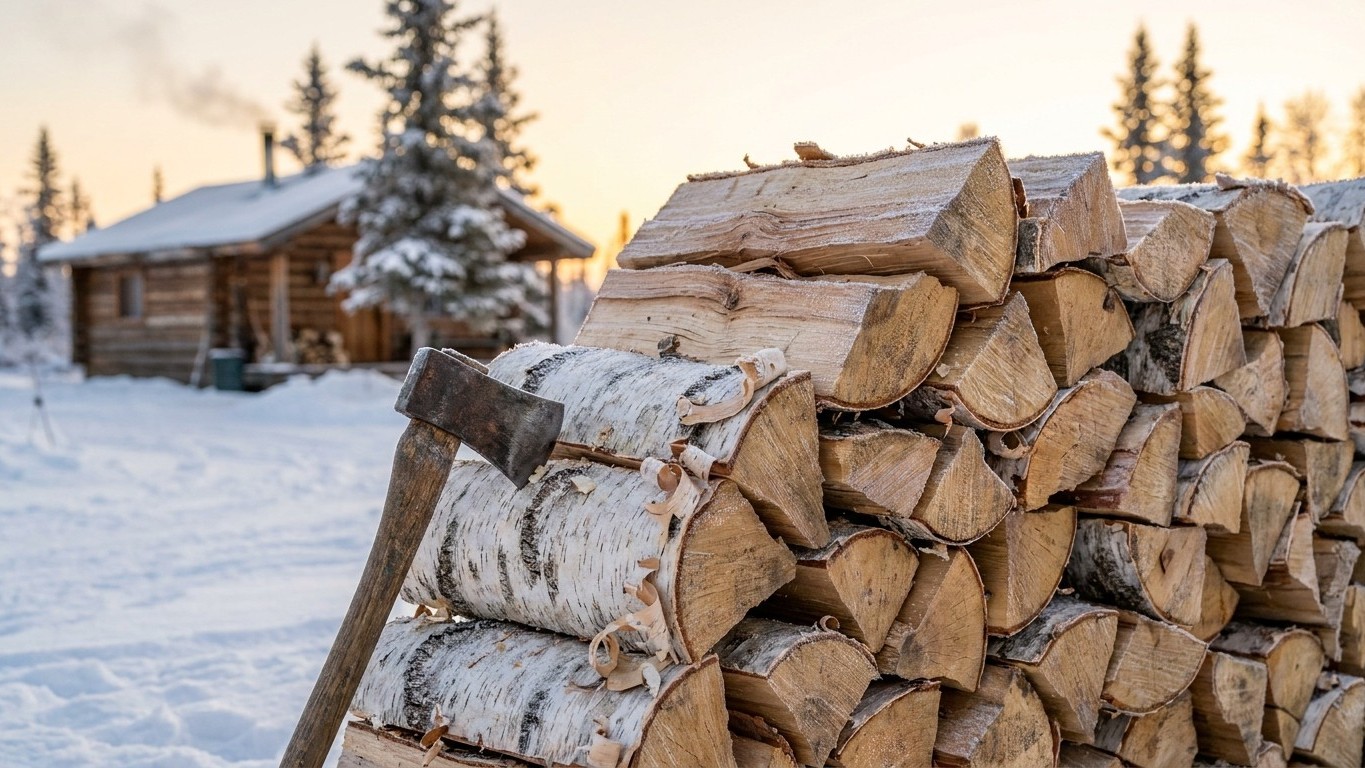

Birch wins in most of Alaska, hands down. But the state’s geography splits into three distinct firewood realities: the deep-freeze interior around Fairbanks, the mixed forests of Southcentral near Anchorage, and the soggy temperate rainforest of Southeast Alaska. Each region hands you a different set of trees, a different drying window, and a different set of headaches to solve before that wood ever hits your stove.
The Interior Standard: Why Birch Rules Fairbanks and the Interior

Ask anyone who’s heated a cabin through a Fairbanks winter what they burn, and the answer comes back almost every time: birch. Paper birch (also called white birch) grows thick across the interior boreal forest, and it’s the closest thing Alaska has to a firewood gold standard. Dense, clean-burning, and generally rated in the 20 to 26 million BTU per cord range when properly seasoned, it throws real heat during the stretches when temperatures drop to 30 or 40 below zero for days at a time.
Birch bark peels in thin, papery sheets that make it one of the easiest woods on the continent to get started, even with damp hands and numb fingers at 6 a.m. That’s not a small thing when your stove is the only thing standing between you and a frozen water line. The wood also splits fairly straight, which matters when you’re working outside in single-digit temperatures and don’t want to fight a knotty round for twenty minutes.
The catch is availability pressure. Birch near populated areas around Fairbanks and North Pole gets harvested hard every year, and prices for a cord have climbed noticeably over the past decade as easy-access stands thin out. Many households now supplement with black spruce or aspen rather than relying on birch alone, especially for daytime burns when peak heat output matters less than just keeping coals alive.
Spruce: Useful, But Handle the Resin Right
White spruce and black spruce are everywhere in the interior, and they’re often the first wood people cut simply because it’s what stands closest to the road or the cabin. Spruce burns hot enough to start a fire and holds a bed of coals decently, but its BTU output sits meaningfully below birch, generally in the mid-teens per cord. The bigger issue is resin. Spruce pitch builds creosote in a chimney faster than birch does, and interior residents who burn spruce as their primary wood need to plan on more frequent chimney inspections, not just an annual check.
Standing dead spruce, killed off in patches by spruce bark beetle outbreaks that have hit parts of Southcentral and the interior over recent decades, actually makes decent firewood once it’s down and dry, since a lot of the sap has already dried out of the wood. Green spruce cut fresh is a different story: it hisses, smokes, and does almost nothing for heat until it’s had a full season to dry.
Southcentral Alaska: Mixing Birch, Spruce, and What’s Local
Around Anchorage, the Kenai Peninsula, and the Matanuska-Susitna Valley, the wood mix looks similar to the interior but the climate math changes. Winters here are colder than most of the Lower 48 but noticeably milder than Fairbanks, so the demand for maximum BTU output per log is a little less brutal. That opens the door to burning more aspen and cottonwood as a supplement rather than relying on birch for every single load.
Aspen dries fast and lights easily, which makes it a solid shoulder-season wood for the cool stretches in September and again in April and May when you want heat without cranking the stove to its limit. Its BTU rating runs lower than birch, typically in the 12 to 14 million range per cord, so it burns down to ash quicker and needs more frequent reloading through a long cold night.
Cottonwood shows up in river bottoms throughout Southcentral and gets cut mostly because it’s abundant and easy to buck, not because it’s a great firewood. It produces a lot of ash, burns fast, and leaves behind more mess in the stove than birch or spruce. Most people treat it as a filler wood rather than a primary heat source, useful for stretching a wood pile during a mild week but not something to count on during a cold snap.
Southeast Alaska’s Rainforest Problem: Seasoning Wood in the Wettest State
Juneau, Ketchikan, Sitka, and the rest of the Panhandle sit inside one of the wettest climates in North America, part of the Tongass National Forest’s temperate rainforest belt. That changes the entire firewood equation. The trees available skew toward western hemlock, Sitka spruce, and red alder, with much less birch than the interior or Southcentral. But the bigger challenge isn’t which tree you cut. It’s drying it out before mold and rot set in.
Hemlock burns reasonably well once seasoned, producing moderate heat output, but Southeast’s annual rainfall (Ketchikan averages well over 100 inches a year) means wood left uncovered for even a few weeks can reabsorb moisture faster than it dried in the first place. Anyone burning wood in the Panhandle needs covered, elevated storage from day one, not as an afterthought once the wood’s already stacked. A simple woodshed with open sides for airflow but a solid roof does more good here than almost anywhere else in the state.
Red alder, common along Southeast waterways, dries faster than hemlock and burns clean, making it a decent secondary wood, though its BTU output sits on the lower end. Because the region’s growing season and humidity work against fast seasoning, many Southeast households buy wood already split and partially dried rather than cutting and seasoning it themselves, since the six-month window that works fine in the interior often isn’t enough here.
What to Avoid and Why
Green wood, no matter the species, is the single biggest mistake burned in Alaska stoves every winter. Freshly cut birch or spruce can carry 40 to 50 percent moisture content, and burning it wastes a huge share of the wood’s potential heat just boiling off water, while coating the chimney with creosote in the process. Interior burners get one real advantage here: nearly 24 hours of summer daylight accelerates drying dramatically compared to almost anywhere else in the country, so wood split and stacked by early June can be genuinely ready by September if it’s stacked loosely with good airflow and covered on top only.
Cottonwood and willow, both common along river systems statewide, rank at the bottom of the list for anyone with a choice. They’re fine as an emergency fill-in wood, but neither holds a candle to birch or even spruce for sustained heat through a cold night.
A few practical points worth keeping in mind across every region:
- Split rounds within days of felling, not weeks, since bark seals in moisture and slows drying dramatically once it dries and hardens.
- Stack wood off the ground on pallets or rails; ground contact invites rot fast in both interior permafrost-adjacent soil and Southeast’s wet ground.
- Check chimney creosote buildup more often if spruce or hemlock makes up a large share of your burn pile, ideally at least once mid-season in addition to the standard annual sweep.
- Cutting on state or federal land requires a permit in most cases. The Alaska Department of Natural Resources and the Tongass National Forest both issue personal-use firewood permits, and requirements differ by district and by year, so check current rules before loading the chainsaw.
Matching Wood to How You Actually Heat
The right wood depends less on abstract BTU charts and more on how your household actually uses heat. A cabin relying on wood as the sole heat source through an interior winter needs birch as its backbone, full stop, with spruce as a supplement for daytime burns when overnight cold snaps aren’t the concern. A Southcentral home with wood heat as backup to an oil or gas furnace has more flexibility to mix in aspen and cottonwood without much downside, since the wood isn’t fighting 40-below temperatures on its own.
In Southeast, the calculation shifts toward whatever’s actually dry rather than whatever’s theoretically best. A well-seasoned load of hemlock beats a green cord of birch shipped in from elsewhere every time, since moisture content, not species, decides how much usable heat you’re getting on a given night. That’s the one rule that holds true no matter which corner of the state you’re heating.