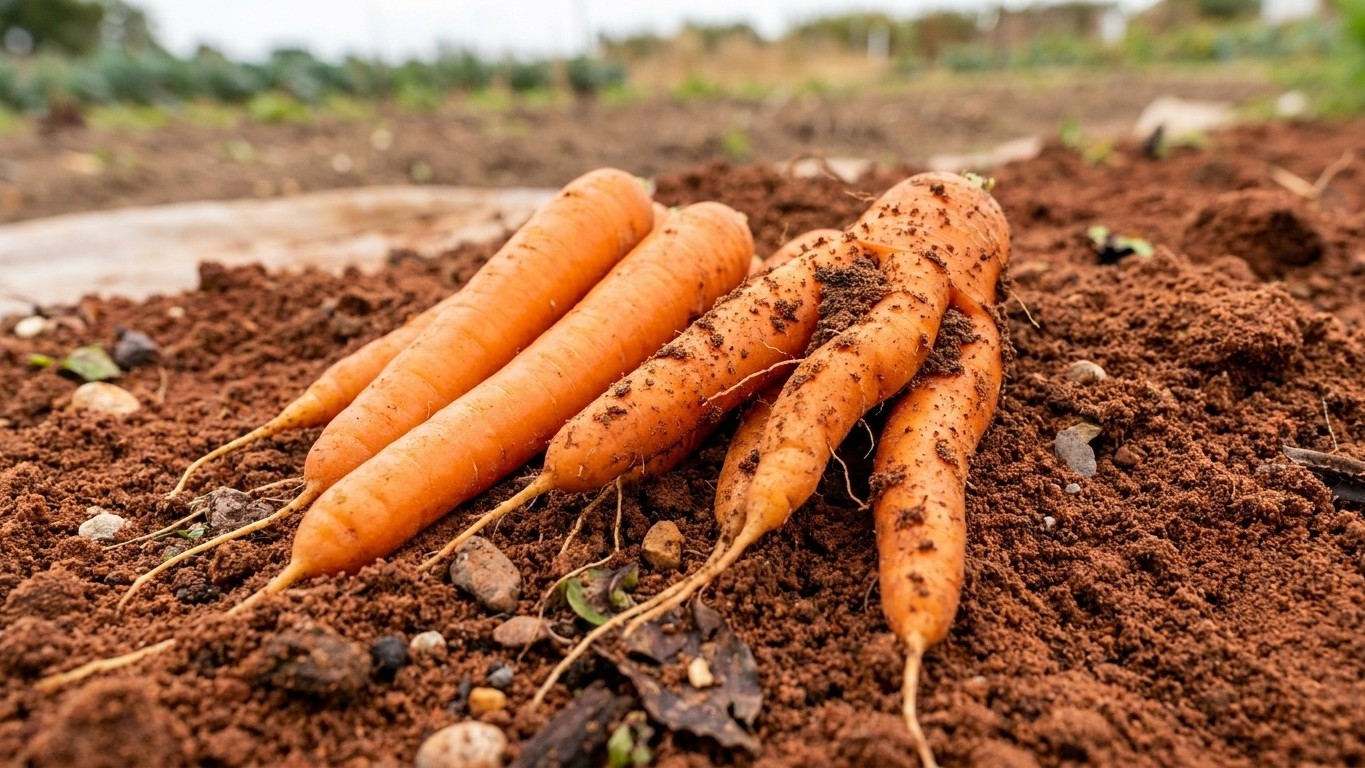

Pull carrots about 65 to 75 days after planting, says Clemson Cooperative Extension. Many varieties run longer, up to 70 to 100 days, and every one of those days is counted from seeding, because carrots are sown in place and never transplanted. Cut the tops off the moment they come out of the ground, then chill the roots at 33 °F with high humidity. For the full season, see Growing Carrots in Arkansas. Below is what the ground does to the crop.
The short answer
Arkansas has an official state soil, the Stuttgart series, and it makes a useful first reference. It is an Alfisol, a forest soil of moderate fertility that holds nutrients reasonably well. USDA’s representative values for its surface horizon, drawn from the major components of the series in the NRCS Soil Data Access database (seven components), read like this: 30 percent sand, 16 percent clay and 54 percent silt, which makes it a loam to silt. Organic matter sits at about 1.8 percent. Surface pH is about 5.6, slightly acid. Drainage is somewhat poorly drained.
Those numbers describe the soil that represents the state, not the soil in your yard. Arkansas spans hundreds of soil series, so treat this as a starting point, not a diagnosis. River bottoms, hill country and any lot a builder has scraped or filled can be nothing like it. The pH above is the mapped surface of a natural soil, not your bed’s pH.
Will a carrot fork in it?
Utah State University Extension says carrots want deep, sandy, well-drained soil rich in organic matter, and that heavy or rocky soil makes the root fork. Set that against the Stuttgart figures and the mismatches are easy to see.
| What carrots want | Stuttgart surface horizon |
|---|---|
| Sandy texture | Loam to silt: 30 percent sand, 16 percent clay, 54 percent silt |
| Well-drained | Somewhat poorly drained |
| Rich in organic matter | About 1.8 percent |
Plainly, then: left as it is, ground like this tends to fork carrots. The clay share is modest, so the trouble is less a brick-hard clay than a silty soil that holds water, packs down and has little organic matter to keep it open. A root that meets a dense or soggy layer splits around it.
The answer from Utah State is to add plenty of compost and double dig, loosening the layer below the topsoil as well. Where water lingers after rain, a raised bed is the cleaner fix. A different variety will not solve it, since the source names none and the problem lives in the ground. The longer version of this question is in Will Carrots Fork in Arkansas Soil?
When to pull, and how to keep them
Clemson’s advice is to harvest about 65 to 75 days after planting. With carrots, “planting” means sowing, so count from the day the seed went in. Your seed packet gives days to maturity for the variety you chose, and a calendar date for Arkansas is not published here. Brush the soil from a root’s shoulder and judge the size before you pull the whole row.
Storage is where a good harvest gets lost. Clemson’s figure is 33 °F with high humidity, which is just above freezing and nowhere near a cellar temperature. A carrot kept at 50 °F sprouts and softens in a fraction of the time. That means a refrigerator, not a garage in an Arkansas autumn.
The tops are the catch. The leaves keep drawing moisture out of the root, so a carrot left with its greens on goes limp fast. Bunched carrots, with tops on, keep about 10 to 14 days. Trimmed roots keep for months. Twist or cut the tops off at harvest, leave a stub of stem, and bag the roots to hold humidity. Clemson’s full guidance is in its carrot, beet, radish and parsnip factsheet.
The test that settles it in your own garden
The state soil tells you what a region’s ground tends to do. Your bed has its own history, and a spade and an afternoon will tell you more than any map. Run these steps before you sow, in this order.
- Dig a hole and read the wall. Take a spade, or better a digging fork, and open a hole as deep as you can comfortably go. Look for layers, a color change, a hard band where the spade stops dead. A carrot’s tip will meet whatever your spade meets.
- Count the stones. Sift a few spadefuls through your hands. Stones and clods in the path of a growing root are what make it fork, so pull out what you find and note how many keep turning up.
- Feel the texture. Squeeze a moist handful and rub it between your fingers. Gritty means sand. Smooth and slippery, like flour, means silt. Sticky, and it rolls into a long ribbon, means clay. Silt-heavy ground, like the state soil, feels smooth and packs when wet.
- Watch the drainage. Fill the hole with water, let it empty, then fill it again and watch the second round. If it drains slowly, or puddles linger in that spot after a heavy rain, you are working with poor drainage.
- Send a sample for a soil test. Your county Extension office can tell you how to submit one. The lab reports your own pH and organic matter, the numbers this article cannot give you.
- Choose the fix. Loose, deep and fast-draining ground can be sown as it is. Dense or stony ground needs compost worked in and double digging, where you loosen the lower layer with a fork without flipping it. If water stands, build a raised bed.
Do the work before seeding. Carrots are sown in place and are not transplanted, so the bed you prepare is the bed the roots grow in.
What goes wrong here
Arkansas gives carrots a mix of slow-draining silty ground, heat in the growing season and swings between dry spells and downpours. The usual failures trace back to those three.
- Forked, stubby or twisted roots. Heavy, compacted or stony ground makes the root split around whatever blocks it. Remedy: work in plenty of compost, double dig, and take out stones. In a bed that stays wet, switch to a raised bed.
- Poor germination in a hot spell. Silty surfaces crust as they dry, and carrot seed sits in that top layer waiting to sprout. Remedy: keep the seedbed evenly moist, and lay a board or burlap over the row until sprouts show, checking it often so you can remove it as they appear. Resow gaps rather than letting a thin row stand.
- Roots that split or crack. A long dry stretch followed by a heavy rain or a deep soaking swells the root faster than the skin can stretch. Remedy: water on a steady schedule, and mulch to even out moisture. Cracked carrots are still edible, but they do not store well, so eat those first.
- Rot where water stands. A somewhat poorly drained soil holds water around the roots after storms. Remedy: raise the bed, add organic matter, and do not sow in the low spot of the yard.
- Chewed or tunneled roots. Something below or above ground is eating the crop. Remedy: identify the culprit before you treat anything, starting with What Eats Carrot in Arkansas, and When.
- Limp, sprouting or soft carrots in storage. Tops left on pull moisture from the root, and storage warmer than 33 °F lets the roots sprout and soften. Remedy: cut the tops at harvest, bag the roots, and keep them cold and humid.
Common questions
How many days until I can pull carrots in Arkansas?
Clemson Extension says to harvest about 65 to 75 days after planting. Many varieties take 70 to 100 days, counted from seeding, so your seed packet’s days-to-maturity figure is the number to trust. A statewide calendar date is not published here, because it shifts with when you sow and with your local weather.
Can I move carrot seedlings to a better spot?
No. Carrots are sown in place, and there is no transplant date to count from. If the bed is wrong, fix it before you seed: add compost, double dig, or build a raised bed.
How long do harvested carrots keep?
With tops on, bunched carrots keep about 10 to 14 days. Trimmed roots kept at 33 °F with high humidity keep for months. Cut the tops first, because the leaves keep pulling moisture from the root.
Is the Stuttgart soil what I have in my yard?
Probably not exactly. It is the official state soil by Arkansas law, but the state has hundreds of soil series, and a filled or scraped lot may match none of them. The digging and drainage test above, plus a lab soil test, will give you your own numbers, including the pH the state soil figure cannot supply.