
Stop cutting when most of the spears coming up are thinner than a pencil. That is the signal, not a calendar date, and it holds in Kentucky as it does anywhere. The bed gets no harvest at all until year 3, then about four weeks of cutting, then six, then eight. Spears you do cut keep best at 32 to 35°F with the cut ends standing in water. Kentucky’s state soil drains well, which helps, but your own patch of ground decides the rest.
The short answer
Kentucky’s official state soil is the Crider series, an Alfisol: a forest soil of moderate fertility that holds nutrients reasonably well. USDA’s representative values for its surface layer read 5 percent sand, 19 percent clay and 76 percent silt, with organic matter around 3.0 percent and a surface pH of about 6.2, slightly acid. It is classed as well drained. That matters more for asparagus than for almost anything else in the vegetable patch. A bed lasts 10 to 15 years, and the only soil requirement Utah State University Extension names is drainage: most soils will do, provided they are well drained.
So the ground that represents the state passes the one test that counts. But it represents the state, and it is not a diagnosis of your garden. Kentucky spans hundreds of soil series, and river bottoms, hill country and any lot a builder has scraped or filled can behave nothing like Crider. Those USDA figures describe the mapped surface layer, not a worked bed, and that pH is not yours. The extension source says nothing about soil pH for asparagus, so there is no number to chase. A soil test through your county Cooperative Extension office gives you your own.
If your ground does not drain
With tomatoes, heavy soil is a yearly nuisance you amend and move past. With asparagus it is a decision you cannot undo, because the crowns stay put for the life of the bed. Before you dig, make a test hole where the bed would go, fill it with water, and look at it the next day. Standing water means the spot is wrong. Your options are to move to a slope or a better-drained corner, or to build the bed up with loose soil so the crowns sit in ground that sheds water. Silt-heavy ground can also seal over when worked wet, so wait until a handful crumbles instead of smearing. The long-game version of this question has its own page: Will Kentucky Soil Hold an Asparagus Bed for Fifteen Years?
The cutting calendar, and keeping what you cut
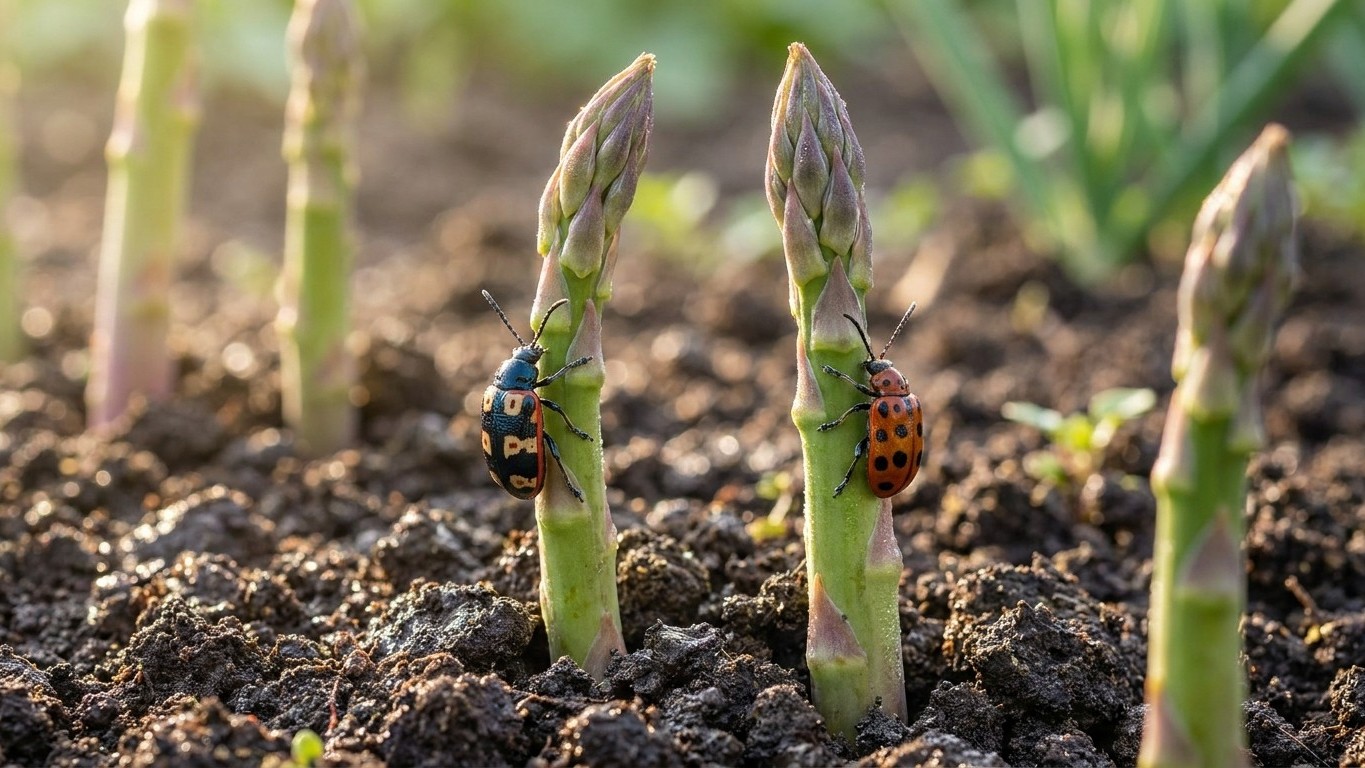
Nothing is cut in year 1 or year 2. Not “a few spears,” nothing. The first harvest comes in year 3 and runs about four weeks, the next season about six, then eight. Within any season, thin spears are the bed telling you it is done, so leave them to grow into ferns. Spears left standing also draw other diners, a story told in What Eats Asparagus in Kentucky, and When.
Once cut, spears have a narrow window. UC Davis Postharvest puts the optimum at 32 to 35.6°F (0 to 2°C) with relative humidity of 95 to 100 percent. Both edges bite. Above 50°F the spears toughen within hours, and at about 31°F or below they freeze, turn water-soaked and collapse to mush on thawing. In a home kitchen, the practical way to reach that humidity is to stand the butts in a little water, since the cut end loses moisture faster than anything else.
Will the summer here water it for you?
The bed wants 1 to 2 inches of water every other week for its first two years, then every three weeks. Louisville’s 30-year climate normals from NOAA NCEI put summer rain at about 12.0 inches across June, July and August: 4.27 in June, 4.05 in July and 3.71 in August, the driest of the three. Spread across 13 weeks, that is a little under an inch a week, set against 48.3 inches for the whole year. By simple arithmetic, a typical two-week stretch in summer delivers around 1.8 inches, which lands in the middle of what the bed asks for.
On paper, though. Rain arrives in storms, and a single summer thunderstorm mostly runs off rather than soaking in. Days at or above 90°F pull water back out of the ground. A loam-to-silt soil like Crider sits between sand, which lets an inch of rain through within the day, and clay, which holds it for a week, so the water stays in reach of the roots longer than it would on sand. These are normals for one reference station, not a forecast and not your garden. A slope, a rain shadow or a city changes them.
Filling the gap
Your share is whatever the rain leaves unfilled. Here is how to work it out:
- Set a straight-sided rain gauge at the edge of the bed, where it catches what the bed catches.
- Add up the rain over each two-week stretch (three weeks once the bed is past its second year).
- Compare the total with the 1 to 2 inches the bed wants.
- If the gauge falls short, water to make up the difference. A fortnight with half an inch of rain needs roughly another half inch to an inch and a half from you.
- Water slowly and in one session, so it soaks in rather than running off the surface.
August, at 3.71 inches, is the month most likely to leave a gap, though 3.71 inches is still a lot of rain. In a normal Kentucky summer you may add little. The gauge, not the normals, tells you when a dry spell has turned into a real shortfall.
When to put the crowns in
Crowns go in during early spring. For Louisville, NOAA NCEI’s 30-year normals put the last spring freeze at 32°F around March 24 to April 4 (the 30 to 70 percent probability band). Treat those as “around” dates. A mean frost date is an average, so some springs freeze later and some earlier. The National Weather Service in Louisville also warns that this urban station runs later in spring and earlier in fall than the surrounding rural parts of Jefferson County, and rural gardens should expect a tighter window. Other parts of Kentucky have their own dates, and they are not published here.
Utah State University Extension has you plant the crowns in 8-inch furrows. The furrow is not filled in at planting. You backfill it gradually across the year, 2 inches every other month, which makes four rounds to bring an 8-inch furrow level. Planting with the wait in mind helps too. The clock to year 3 starts at planting, so a crown set in early spring is the one that reaches its first four-week harvest soonest. For the full picture of the bed from planting day onward, see Growing Asparagus in Kentucky.
The seed route
Starting from seed is the alternative to buying crowns. The source behind this page is built around crowns, and it gives no sowing dates or timeline for seed, so none are offered here. The no-harvest-until-year-3 rule is stated for crowns, so do not assume a seed-grown bed runs on the same clock. If you go that way, ask your county extension office what the timing looks like for your area.
Common questions
Can I cut a few spears before year 3?
No. Asparagus is not harvested until year 3. A “few spears” in year 2 is still a harvest, and the bed is spending reserves it has not finished building. The first cutting season runs about four weeks.
Is there a calendar date to stop cutting in Kentucky?
No date is published here, and a date would be the wrong tool anyway. The stopping rule is an object: quit when most spears are thinner than a pencil. The weeks cap (four, then six, then eight as the bed matures) tells you how long a season can run, not where it must end.
Why do my stored spears turn tough or mushy?
Both failures come from temperature. Above 50°F, spears toughen within hours. At about 31°F or below they freeze, and freezing injury shows as a water-soaked look that leads to extreme softening. Aim for 32 to 35°F with near-saturated air, and stand the cut ends in water.
Which variety should I plant?
Utah State University Extension names four, and only by sex. Jersey Giant and Jersey Knight are all-male. UC 157 F1 and Purple Passion are male and female. No flavor, no yield and no reason to prefer one is published there, so any ranking you read elsewhere is not backed by this page’s source. No nursery is named either.