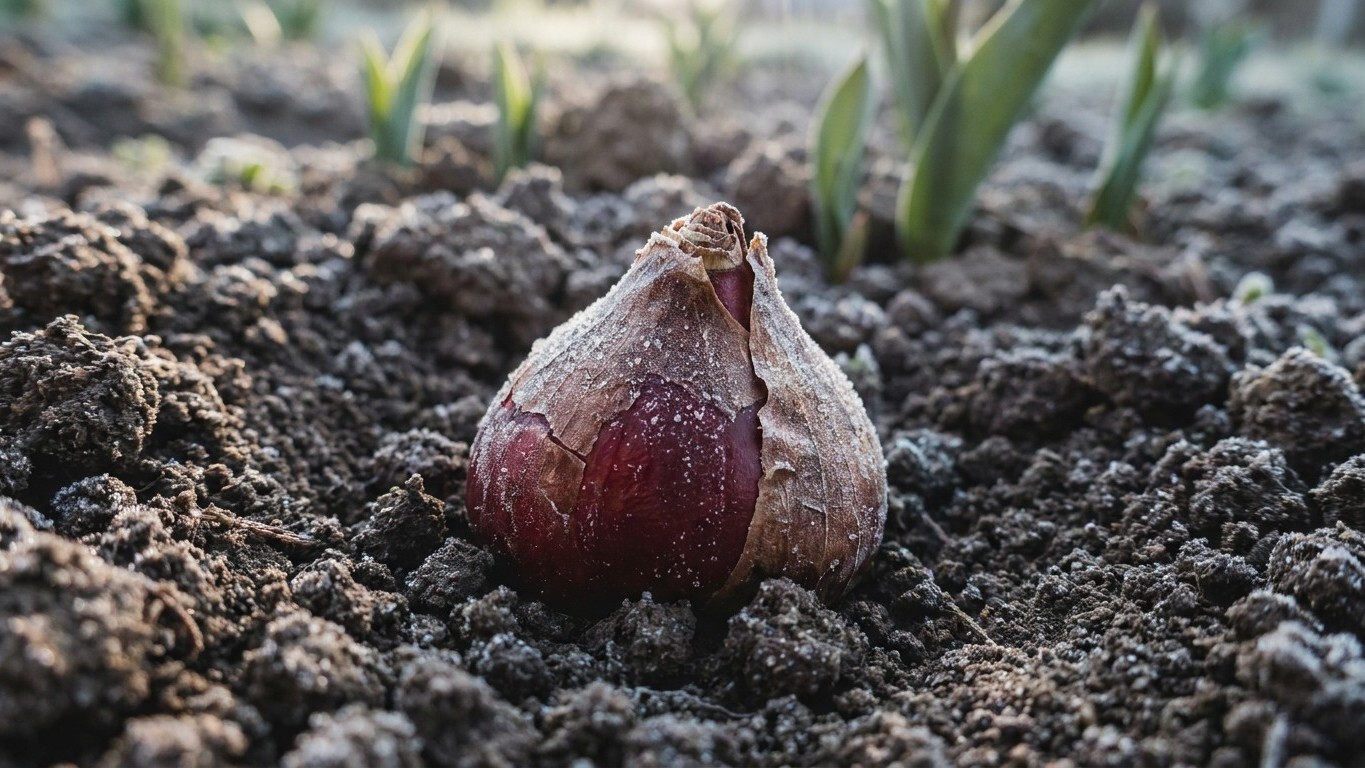

Garlic in Utah gets eaten in two shifts. Underground, wireworms, voles and pocket gophers go after cloves and bulbs from planting through winter. Above ground, onion thrips feed on leaves in the warm, dry months, and mites and microscopic nematodes ride in on infested seed garlic. Garlic goes in during autumn and comes out the following summer, so it sits in the soil through every one of those windows.
The short answer for Utah
The calendar starts with the first fall freeze. At the Salt Lake City station (USW00024127), NOAA NCEI’s 1991-2020 Climate Normals put the 32°F freeze probability in a 30-70% band from October 18 to October 29. That band is where you start counting, because the planting date hangs on it, and the planting date decides which pests meet your garlic at its weakest.
A frost date is a midpoint, never a safe date. In one year out of two, the first freeze lands later than the date you read off a chart. A garden that plants “right after frost” will sometimes be planting into soil that has not cooled yet, and warm soil keeps wireworms feeding and tempts cloves into leafy growth before winter. That growth is tender and easy to damage.
Salt Lake sits in a mild valley, which matters for how you read the figure. Most of Utah is higher and colder, so the freeze arrives sooner there. Southern Utah is warmer, so it arrives later. The Salt Lake band is a reference point, not a statewide answer.
The year then runs in a fixed order. Autumn planting brings the soil pests and rodents. Winter and early spring bring voles working under snow cover, and in cool, wet springs onion maggots can appear. Summer brings thrips, and by the time bulbs are lifted and curing, mites become the concern. Each pest has a window, and the frost date tells you where the first one opens. For the planting side of that count, see When to Plant Garlic in Utah: Counting Back From the First Frost.
Working it out for your own garden
A state is not one climate. Elevation, a large lake and the lay of your valley can move these dates by about two weeks either way. So the useful move is to take the Salt Lake band and adjust it, not to adopt it.
Start with the band, then shift it
Take the Salt Lake figures: October 18 to October 29. If your garden runs two weeks colder (a bench above the valley floor, say, or a high mountain town), subtract 14 days. That gives roughly October 4 to October 15. If you run two weeks warmer, add 14 days and you land near November 1 to November 12. Those are illustrations of the arithmetic, not published normals for any particular town. For a real number in your district, use a nearby station’s normals.
Then remember the midpoint rule. Whatever band you land on, half of all years bring the first freeze later. Treat the early end of the band as “frost might come now” and the late end as “frost probably has come, but not always.”
Lay the pest calendar over it
Once you have your band, the pest calendar falls into place around it. Before planting, look at the bed itself. A plot cut out of old sod is classic wireworm ground, and so is a bed that grew potatoes or grain. Wireworms live in the soil for years and chew into cloves, so dig a few test spots and look before you commit seed.
At planting, the danger is the seed. Garlic curl mites and stem and bulb nematodes travel on infested cloves, and neither is easy to see. Buy clean seed garlic from a grower who sells it as seed, and avoid grocery-store bulbs, which are not screened for these problems and are often a poor match for local winters anyway. Varieties matter too, and Garlic Varieties That Suit Utah Winters covers which types hold up.
After the ground cools, voles and gophers become the story. A thick mulch is useful for insulating cloves, but it is also cover for rodents. Many gardeners wait until the soil has chilled before mulching, and some lay hardware cloth under the bed in gopher country.
In spring and summer, scout weekly. Thrips show up as silvery streaks on the leaves, usually heaviest in hot, dry weather, which Utah supplies in abundance. Maggots show up as wilting plants with rotting bulbs, more often in cool, wet springs. If you want a broader introduction to the crop in this state, Growing Garlic in Utah is the parent guide.
What changes across Utah
Utah’s geography splits the pest calendar into several different ones. The reference point is the Salt Lake Valley, where the first freeze falls between October 18 and October 29 at the airport station. Everything else runs ahead or behind it.
| Area | Frost timing vs. Salt Lake | What causes it | Pest consequence |
|---|---|---|---|
| Salt Lake Valley floor | Reference band | Lower elevation, the large lake nearby | Soil stays warm longer, so wireworms and rodents have a longer fall |
| Cache Valley and other cold northern basins | Earlier | Cold air pools in enclosed valleys | Short rooting window, plus heavy snow cover that suits voles |
| Park City, Heber and high Wasatch valleys | Earlier | Elevation | Late spring emergence, so thrips arrive on young plants |
| Uintah Basin and eastern Utah | Earlier or near | Elevation and continental winters | Hard winters, so shallow cloves heave out of the soil |
| St. George and the far southwest | Later | Low desert elevation | Long warm season, so thrips and mites run longer |
Gardens along the Wasatch Front benches deserve a separate note. Cold air drains downhill on clear nights, so the foot of a slope can freeze before the middle of the slope does. That is a reminder that your own lot may not match the station reading, even in the same county.
Gardeners in other cold-winter states run the same count with a different anchor. Vermont’s version, in When to Plant Garlic in Vermont: Counting Back From the First Frost, starts from a much earlier freeze, and Garlic Varieties That Suit Vermont Winters shows how the variety choice shifts with it. Utah’s warmer southwest has no real equivalent there.
The mistakes this climate punishes
Utah’s winters split into two camps, and the errors differ in each. In the cold camp (most of the state), the penalties are too-late planting and too-shallow planting. Cloves that go in after the soil is nearly frozen may not root before the ground locks up, and a clove with no roots is easy prey. A shallow clove can heave out of the soil during freeze-thaw cycles, leaving it exposed to rodents and cold. Follow the depth on your seed supplier’s instructions, and err toward deeper in cold basins.
In the warm camp, around St. George, the mistake is planting a hardneck. Hardnecks want a real cold period, and a mild winter leaves them with small, poorly formed bulbs, which also hold less vigor against pests. Softnecks tolerate mild winters better.
Several other errors cost Utah gardeners crops:
- Planting too early because the calendar says “fall.” Warm soil produces top growth before winter, and half of all years the freeze comes later than the chart suggests.
- Saving cloves from a bed that showed stunted, twisted or yellowing plants. Mites and nematodes travel in your own seed stock.
- Mulching heavily while the soil is still warm, which gives voles shelter and a reason to move in.
- Replanting garlic, onions or leeks in the same bed year after year, which builds up nematodes and maggots.
- Letting plants go drought-stressed in summer. Thrips do their worst damage on stressed leaves, and Utah’s dry heat makes stress easy.
One more habit is worth breaking: waiting for damage to appear before looking. By the time leaf tips yellow from thrips or a plant wilts from maggots, the damage is already done. A weekly walk down the row in spring is cheaper than any spray.
Checking this against your county
County-level conditions vary more than a single station can show. Utah State University Extension has local offices and publications that cover insect pests in vegetable gardens, and staff can help identify what is chewing your plants if you bring a sample. Ask your county office about the local frost window and any soil pest problems known in your area before you buy seed.
Common questions
What is the most common garlic pest in Utah?
Onion thrips are the one most gardeners meet, because they thrive in hot, dry weather and feed on the leaves through summer. Wireworms and rodents come close for damage to cloves and bulbs, especially in new beds cut from sod.
When should I start watching for pests?
Start before planting by checking the soil for wireworms and buying clean seed. Then watch again after the ground cools for voles and gophers, and scout weekly from spring emergence through summer.
Does the first frost date mean I am safe to plant?
No. It is a midpoint, so in one year out of two the first freeze comes later. For Salt Lake City, NOAA NCEI’s 1991-2020 normals put it between October 18 and October 29, and your own district may sit two weeks earlier or later.
Can I use garlic from the grocery store as seed?
It is a risk. Grocery bulbs are not screened for mites or nematodes, and they may be varieties poorly suited to Utah winters. Seed garlic from a grower who sells it for planting is the safer route.