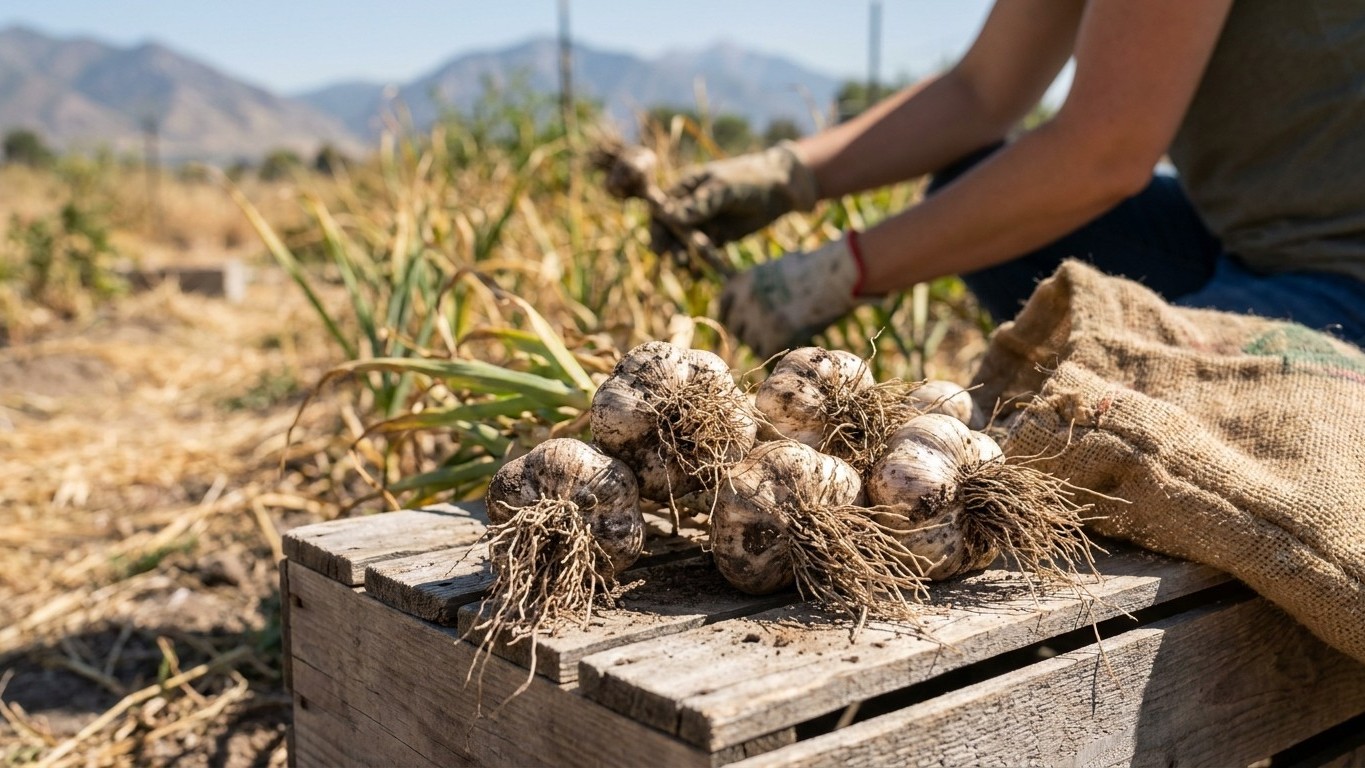

One undivided round is what a garlic clove becomes if Utah’s winter doesn’t chill it long enough — no cloves, just a single smooth bulb. That outcome sounds like a real risk until you look at how much cold this state actually hands over each winter. Salt Lake City’s valley floor alone spends most of six months below 40°F, far past what the clove needs to split apart. Head north, or climb in elevation, and the margin only widens further.
Will garlic get the cold it needs in Utah

Garlic is planted as a single whole clove, and that clove only becomes a head of individual cloves if it passes through a real stretch of cold weather first. Skip that stretch, or cut it short, and the grower digs up one smooth, undivided round instead of a bulb wrapped in cloves. That is the failure mode every fall garlic planting guide is really trying to prevent, and it is the first thing worth checking before choosing among the Garlic Varieties That Suit Utah Winters growers can plant.
The six-to-eight-week test
The reference station near Salt Lake City spends 26.1 weeks a year with mean air temperatures below 40°F, according to the NOAA climate record. University of Georgia Extension bulletin C854 puts garlic’s actual requirement at six to eight weeks of that kind of cold after planting. Twenty-six weeks against an eight-week minimum is not a close call. Salt Lake City sits in a comparatively mild valley by Utah standards, and higher benches, mountain valleys in Cache Valley and central Utah, and the northern half of the state generally run colder still, so the margin only grows outside the valley floor. Southern Utah, around St. George and the lower Colorado Plateau, runs warmer, but even there the shortfall would have to be dramatic to threaten the eight-week floor.
That surplus means growers here skip a step that gardeners in mild-winter states have to plan around. Where winters fall short of the six-to-eight-week minimum, the two working fixes are refrigerating cloves for several weeks before planting to fake the missing cold, or switching to softneck varieties, which tolerate a shorter chill far better than hardnecks do. Utah growers do not need either trick under a normal winter. The same calculation, run with a colder or milder start, decides the answer everywhere garlic gets planted, from short-chill states along the Gulf Coast to places with genuinely severe winters like Vermont, where the cold season runs even longer than Utah’s and hardneck garlic performs at its best.
When to put the cloves in
Fall garlic planting is a balance. Cloves need enough time in the ground to grow roots before the soil locks up cold, but not so much time that they push a lot of leaf growth a hard freeze can then burn back. The anchor for that timing is the first fall frost, not a fixed month on the calendar, which is why it helps to check When to Plant Garlic in Utah.
Reading the frost window backward
NOAA’s 1991-2020 climate normals put the first fall freeze (32°F) at Salt Lake City, station USW00024127, somewhere between October 18 and October 29, a range with its midpoint around the fourth week of October. Garlic generally wants three to four weeks of root growth before that freeze locks up the ground, which lands the planting window in late September to early October for the Salt Lake area, the same window every variety listed in this guide calls for.
Two things move that window elsewhere in the state. Elevation is the big one: a mountain valley or a high bench sees its first freeze weeks earlier than the Salt Lake floor, which pulls the planting window earlier to match. A large body of water, or a low desert basin, works the other way, holding heat longer into fall and pushing both the freeze and the planting date later. Southern Utah’s warmer valleys, around St. George, typically freeze later than the Wasatch Front and can plant correspondingly later.
If autumn runs unusually warm in a given year, it is fine to lean toward the later end of the window and wait for soil temperature to actually drop rather than planting strictly by date. What garlic is responding to underground is soil temperature, not the calendar, and a mild fall simply delays the signal by a week or two.
Which types suit Utah
Garlic splits into two groups, and the choice between them is not really about taste. Hardneck garlic sends up a rigid central stalk (a scape), forms a single ring of large, easy-to-peel cloves, and performs best where winters are genuinely cold. Softneck garlic skips the scape, packs in more, smaller cloves, tolerates milder winters, and keeps in storage far longer than hardneck, often through most of a year rather than a few months.
Hardneck vs softneck by variety
Given the cold surplus described above, Utah’s climate leans toward hardneck garlic performing at its best, while softneck still does perfectly well and offers the storage advantage gardeners who want garlic on hand well into next spring will appreciate. The table below lists every variety in this guide’s catalogue, its type, and the planting window this territory’s frost data supports.
| Variety | Type | Set out |
|---|---|---|
| Early Red Italian | Softneck | Late September to early October |
| Inchelium Red | Softneck | Late September to early October |
| Italian Late | Softneck | Late September to early October |
| Lorz Italian | Softneck | Late September to early October |
| Bavarian Purple | Hardneck | Late September to early October |
| Blue Music | Hardneck | Late September to early October |
| Chesnok Red | Hardneck | Late September to early October |
| Duganski | Hardneck | Late September to early October |
| Fall Festival | Hardneck | Late September to early October |
| Georgian Crystal | Hardneck | Late September to early October |
| Georgian Fire | Hardneck | Late September to early October |
| German Red | Hardneck | Late September to early October |
| German White | Hardneck | Late September to early October |
| Ivan | Hardneck | Late September to early October |
Every one of those set-out windows comes from the same arithmetic worked through above: count back three to four weeks of root time from Salt Lake City’s late-October freeze range, and it lands in late September to early October regardless of variety. Growers picking type by climate run into the same trade-off everywhere garlic is grown. In a milder New England climate covered in Growing Garlic in Massachusetts, softneck varieties often win out for their storage life alone, while a colder Utah winter tips the balance back toward hardneck for anyone who is not committed to storing bulbs past midwinter.
Soil and bed preparation
Drainage comes first. Garlic cloves sit in the same patch of ground through an entire winter, and standing water rots a clove long before frost or any soil pathogen gets the chance. Heavy clay soil, or a bed that puddles after rain, needs a raised bed or a mounded row before cloves go in, not after.
Drainage, pH and timing the bed
Work aged compost or well-rotted manure into the bed a few weeks ahead of planting so it has time to settle rather than sitting in loose, air-pocketed soil around the cloves. Many Utah valley soils run alkaline and light on organic matter, which is worth correcting with compost rather than guessing at a lime or sulfur application. A soil test through the local extension office, discussed below, is the only reliable way to know where a specific bed stands before adding anything.
Break up compaction to at least a shovel’s depth so roots can run down ahead of the freeze, and rake the bed to a fine, even surface. Cloves planted into clumpy, air-gapped soil root unevenly, and uneven rooting going into a long winter is its own kind of stress on top of the cold. Aim to have the bed finished and settled before the planting window opens, not the same weekend cloves go in.
What the climate here favours, and what it does not
Before naming any diseases, one caveat matters more than the list itself: the thresholds below are published soil temperatures, and the figures used here are monthly mean air temperatures at a single reference station. Soil lags air by weeks and swings far less than air does day to day, so a month landing inside a disease’s range is a tendency worth knowing about, not a diagnosis and not a forecast.
What the thresholds mean in air, not soil
Against UC IPM’s published ranges (UC ANR Publication 3453, Onion and Garlic Pest Management Guidelines), the Salt Lake area’s growing-season mean air temperature falls inside white rot‘s 50-75°F range in five months: September, October, April, May and June. That is the widest window of any disease covered here, spanning both ends of the garlic season, which makes white rot, caused by the fungus Sclerotium cepivorum, the pressure worth taking most seriously in this climate.
Fusarium basal rot, caused by Fusarium oxysporum f. sp. cepae, falls inside its published 59-90°F range in four months: September, May, June and July, with July landing at the published optimum. Pink root, caused by Setophoma terrestris, reaches its 75-85°F optimum in one month, July. Southern blight, caused by Sclerotium rolfsii, never sees a monthly mean inside its 86-95°F optimum at this station, which means it runs less active here, not that it cannot occur. All four of these pathogens travel in infected seed cloves and contaminated soil regardless of what the local climate does, so buying clean, certified seed garlic and rotating beds year to year matters whether or not the temperature record favors a given disease that season.
Getting it through the winter
Mulch is the main defense against the long stretch of sub-40°F weather described earlier, specifically against the freeze-thaw cycling that can heave a shallow-planted clove partway out of the ground over the course of a whole winter. Plant cloves about two inches deep, pointed end up, and lay mulch once the ground has cooled but before the hardest freezes set in.
Mulch depth and spring removal
A loose mulch layer several inches deep insulates the soil enough to slow the freeze-thaw swings that cause heaving, without smothering the clove. Reasonable options include:
- Straw, the most common choice, loose and easy to pull back in spring
- Weed-free hay, similar insulation with a slightly finer texture
- Shredded leaves, cheap and often already on hand in fall
Leave that mulch in place through winter. Pull it back partway, not entirely, once green shoots start pushing through in spring, so the soil can warm and dry out while some cover still sits ready if a late cold snap threatens the new growth. In a milder Northeast winter like the one covered in the garlic variety guide for Massachusetts, growers can often pull mulch earlier and thinner because heaving is a smaller risk there. Utah’s colder, more variable freeze-thaw cycle argues for leaving mulch on longer and thicker than a mild-winter guide would suggest.
Harvest and curing here
Read the plant, not the calendar. Garlic is ready to lift when the lower three to five leaves have browned and dried while the upper leaves are still green, since each leaf corresponds to a wrapper layer around the bulb and too much dieback means those wrappers have already started to break down in the ground.
Curing in Utah’s dry summer air
Most of Utah’s summer climate runs hot and arid, which generally works in a garlic grower’s favor at curing time: dry air pulls moisture out of the bulbs quickly and keeps mold pressure low compared with a humid growing region. That said, direct sun during curing is still a problem even in a dry climate, since it can scald wrappers or partially cook cloves near the surface. Cure in a shaded, airy spot, a carport or open shed works well, laid in a single layer or hung in loose bunches, for a few weeks until the necks are fully dry and papery and the outer wrappers no longer feel damp. Skipping that stretch, or curing in a closed, humid space, is how a crop that survived the whole winter still ends up soft or moldy in storage.
Local help
County-level frost dates, soil test results, and planting advice specific to a given elevation or valley are worth getting from a local source rather than guessing from a statewide range. USU Extension is the land-grant extension service for Utah and the right first call for both a soil test and a county-specific planting calendar.
Common questions
Is it too late to Plant Garlic in spring if I missed fall?
Spring planting is possible but weak here. Garlic is an autumn crop that needs the cold months to divide into cloves, and a spring-planted clove misses most or all of that chilling window before summer heat sets in, usually producing small, undersized bulbs rather than a normal harvest.
Do I need to refrigerate my garlic cloves before planting in Utah?
No. Refrigerating cloves is a workaround for winters too mild to hit the six-to-eight-week chilling requirement, and Utah’s winters run well past that minimum on their own. Save that step for a mild-climate garden, not this one.
Why did my garlic grow as one smooth round instead of separate cloves?
Usually one of two things: not enough chilling time before spring growth started, or the “garlic” is actually elephant garlic, which is botanically a leek and normally forms one or a few oversized cloves regardless of winter length. True garlic that never divided is a strong sign it went into the ground too late relative to the first freeze.
Can I plant garlic from the grocery store?
It’s not a good idea. Grocery garlic is often treated to slow sprouting, may not be suited to a fall-planted, cold-winter climate, and can carry soilborne diseases like white rot or fusarium basal rot into a garden bed where they can persist for years. Certified disease-free seed garlic from a known supplier avoids all three problems.
How deep should I actually plant the cloves here?
About two inches deep, pointed end up, is the standard depth, though planting a little deeper and mulching well is worth considering on exposed or higher-elevation ground where freeze-thaw heaving is more of a risk. Shallow planting without mulch is the most common reason cloves end up partly pushed out of the soil by late winter.