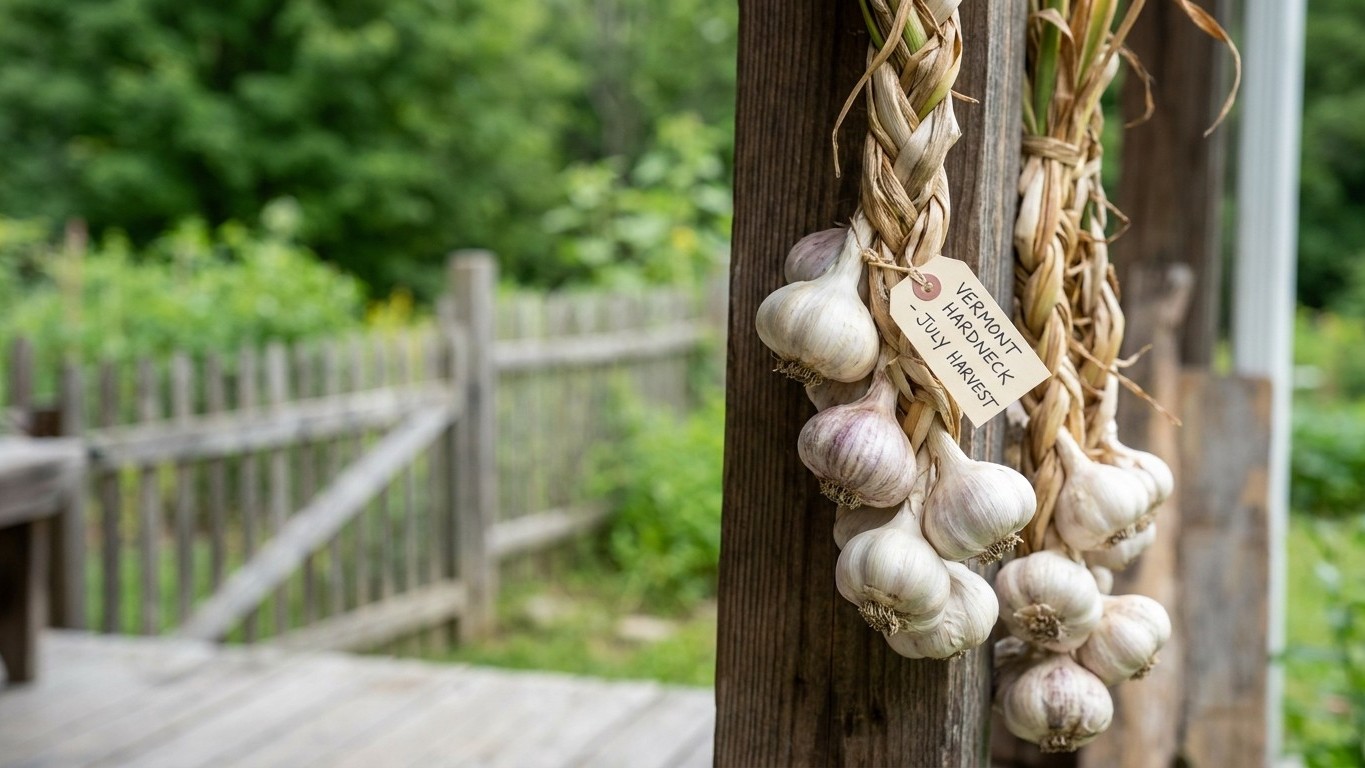

German Red garlic doesn’t split into full cloves because a catalog says to plant it — it splits because it gets a real cold snap, and Vermont hands over roughly thirty weeks of that chill, four times what the plant strictly needs. That surplus is the difference from milder regions where softneck rules unquestioned. Here, along most of the state, hardneck wins by a wide margin, with softneck holding on only where Lake Champlain’s water keeps the frost line soft.
The short answer for Vermont

Plant hardneck garlic here unless your garden sits right on Lake Champlain. Varieties such as German Red, Chesnok Red, Georgian Crystal and Duganski come out of cold, high-elevation growing regions and split into full, evenly sized cloves only after a real winter chill. Vermont supplies that chill with room to spare. Winter here holds an average of 30.4 weeks with air temperatures below 40°F, according to University of Georgia Extension publication C854, far more than the six to eight weeks garlic needs after planting to differentiate into cloves. That surplus is why nearly every garlic catalog written for northern growers puts a hardneck first.
Softneck garlic is not ruled out. Early Red Italian, Inchelium Red, Italian Late and Lorz Italian all grow in Vermont gardens, particularly on the milder valley floors near Lake Champlain, though they carry more risk of frost heave and uneven bulbing in a hard winter with thin snow cover.
All of it starts from one date. NOAA’s 1991-2020 climate normals put the first fall freeze at the Burlington station between October 3 and October 13, a 30 to 70 percent probability band rather than a fixed day. It is also a midpoint: in roughly one year out of two, the first freeze arrives later than this window, not earlier. Treat it as the planting anchor and set cloves in the ground mid September to late September, ahead of that freeze window, so roots get moving before the soil goes properly cold.
| Variety | Type | Set-out window |
|---|---|---|
| Early Red Italian | Softneck | Mid to late September |
| Inchelium Red | Softneck | Mid to late September |
| Italian Late | Softneck | Mid to late September |
| Lorz Italian | Softneck | Mid to late September |
| Bavarian Purple | Hardneck | Mid to late September |
| Blue Music | Hardneck | Mid to late September |
| Chesnok Red | Hardneck | Mid to late September |
| Duganski | Hardneck | Mid to late September |
| Fall Festival | Hardneck | Mid to late September |
| Georgian Crystal | Hardneck | Mid to late September |
| Georgian Fire | Hardneck | Mid to late September |
| German Red | Hardneck | Mid to late September |
| German White | Hardneck | Mid to late September |
| Ivan | Hardneck | Mid to late September |
Working it out for your own garden
The October 3 to October 13 freeze window comes from a single NOAA station at Burlington, and Burlington sits directly on Lake Champlain, the mildest corner of Vermont. If your garden sits somewhere else in the state, work the date out rather than borrowing Burlington’s outright, using this article about Growing Garlic in Vermont as background on the steps that come before planting.
Start from the frost window, then move it
Begin with the October 3-13 band and ask what separates your garden from the lakeshore: elevation, distance from open water, and how cold air pools in your particular yard on a still night. NOAA’s own caution attached to this dataset is blunt about it. The Green Mountains and the Northeast Kingdom run substantially shorter seasons than the Burlington numbers describe, which means their growing season closes earlier and their garlic planting window slides earlier too, by an amount the Burlington station’s data cannot tell you on its own.
Once you have a working idea of your own frost date, count backward the way the seed catalogs already count forward for you. Every variety on this list carries a set-out window of mid September to late September, a range built to cover the whole state rather than any single town, which is part of why it already spans two full weeks. Do the arithmetic on the two ranges together: plant on September 15 and the earliest edge of Burlington’s frost window, October 3, is 18 days out. Plant on September 30 and the latest edge, October 13, is 13 days out. That gap, roughly two to two and a half weeks at Burlington, is the buffer cloves get to grow roots before the ground turns properly cold. Apply the same subtraction to your own local frost estimate rather than Burlington’s, and you get a planting date built for your garden, not for the lakeshore.
Soil matters as much as the calendar. A raised bed or a south-facing slope warms and drains faster in spring and holds heat a little later into fall, which can buy a grower a few extra days on either end of the window. A low, shaded spot with heavy clay does the opposite. It freezes earlier and stays wet in spring, both of which work against garlic roots and against the clove itself sitting in the ground over winter.
If you garden away from the lake, the plainest test is watching your own thermometer rather than the nearest weather station’s. Keep a written record of the first fall morning your yard touches 32°F for two or three years running, and you will end up with a local frost date more useful to your own planting decisions than any regional average, Burlington’s included. For the fuller mechanics of counting backward from frost, including how this window lines up with mulching and spring green-up, see When to Plant Garlic in Vermont: Counting Back From the First Frost.
What changes across Vermont
Vermont’s growing season is not one climate stretched over one map. The Champlain Valley, anchored by Burlington and the shoreline towns near it, holds the state’s mildest and longest season because Lake Champlain stores summer heat and releases it slowly into fall, delaying the first freeze compared with inland ground at the same latitude.
Move east into the Green Mountains and the season closes earlier. NOAA’s note on this same dataset says plainly that the Green Mountains and the Northeast Kingdom run substantially shorter seasons than the Burlington numbers describe, a result of both elevation and distance from the lake’s moderating water. A garden at higher elevation loses warm air faster on a clear night, so frost settles into mountain valleys and hillsides well before it reaches the lakeshore below.
The Northeast Kingdom, in the state’s far northeast corner, combines that elevation with the greatest distance from any large body of water in Vermont, which is why growers there plan their whole season, garlic included, around an earlier close to autumn and a later opening to spring than a gardener in Burlington or on the Champlain Islands would see.
None of this changes which garlic varieties will grow. Hardneck garlic tolerates the coldest ground the state has, mountain valleys included, and growers in the Northeast Kingdom and higher valleys often lean toward the hardiest hardnecks, such as Blue Music and Georgian Fire, both bred for cold, continental growing regions. What the geography changes is the calendar. A Northeast Kingdom grower needs to plant toward the early edge of the mid-to-late September window and should check local frost history rather than lean on the Burlington station’s dates, since one reference point in the mildest corner of the state does not describe conditions near the Canadian border.
The mistakes this climate punishes
The single costliest mistake in a Vermont garlic patch is planting too late. Cloves set in the ground well past the catalog’s late-September window run short on time to grow roots before the soil freezes, and a clove that has not rooted well is far more likely to heave out of the ground over a winter of freeze-thaw cycles, exposing it to cold injury and drying out it would otherwise survive underground.
The second is planting too shallow, or skipping mulch altogether. Vermont winters push soil temperatures well below freezing for months, and a garlic clove sitting close to the surface without a mulch layer to buffer those swings is at far greater risk of heaving than one planted at proper depth and covered once the ground has cooled.
Disease risk from planting stock, not the climate
Vermont’s cold does not make garlic disease impossible, and it would be a mistake to treat a cold state as an automatically safe one. The University of California Statewide IPM Program, UC ANR Publication 3453, publishes soil temperature ranges for two of garlic’s worst pathogens: white rot, caused by Sclerotium cepivorum, at 50 to 75°F, and Fusarium basal rot, caused by Fusarium oxysporum f. sp. cepae, at 59 to 90°F. Measured against Burlington’s average air temperature rather than actual soil readings, white rot’s range overlaps four months of the growing season, including one month at its exact published optimum, and Fusarium’s range overlaps three. Soil temperature lags behind air temperature and swings less through the day, so this comparison is a rough guide to season length, not a soil reading, and a monthly average hides plenty of days that fall well outside that range on either side. It is also one station’s data standing in for a state with wide swings in elevation and lake exposure.
None of that means the disease is common in Vermont gardens. It means the state’s air temperature does not shut the door on it the way a true cold desert would, and the actual risk still arrives on infected seed stock, not through the weather itself. The mistake this climate actually punishes is buying cheap, untested garlic bulbs and planting them without checking their source, since a fungus this comfortable for three to four months of a Vermont growing season needs nothing more than one contaminated bulb to get established in a bed.
The last mistake is treating softneck garlic as the safe default because it stores well in the kitchen. Early Red Italian and Lorz Italian both perform fine in the Champlain Valley’s milder ground, but the same softneck planted in a Northeast Kingdom garden with thinner snow cover and harder freezes into the crown is more likely to lose cloves to winter injury than a hardneck like Bavarian Purple or German White planted in that same spot.
- Planting after the late-September window closes
- Setting cloves too shallow or mulching before the ground has cooled
- Assuming cold weather alone rules out white rot or Fusarium basal rot
- Planting untested bulbs from an unknown source
- Choosing a softneck variety for a cold, low-snow site
Checking this against your county
Every figure above comes from one station near Burlington, and Vermont’s climate does not hold still from one county to the next. UVM Extension keeps county-level growing information and can point you to a more precise frost history for wherever your garden actually sits, from Addison County to Essex County. Check with them before locking in a planting date, especially if you garden well above the valley floor or far from Lake Champlain, where the Burlington numbers stop applying closely. Find your nearest office through UVM Extension, and treat their county-specific figures as the tiebreaker over any statewide average.
Common questions
What happens if I plant garlic too late, after the ground starts to freeze?
The clove will usually survive, since garlic is planted specifically to overwinter in the ground, but it misses the root-establishment period this whole schedule is built around. A late-planted clove tends to produce a smaller bulb the following summer and is more prone to heaving out of the soil during freeze-thaw cycles than one planted in the mid-to-late September window.
Can I use grocery store garlic as seed stock?
You can, but it carries more risk than named seed stock from a garlic supplier. Grocery bulbs are rarely labeled by variety, are often grown in a warmer climate that does not need Vermont’s cold tolerance, and give you no way to know whether they carry soil pathogens like white rot before you plant them into your own ground for years to come.
Do hardneck and softneck garlic need different soil?
Not fundamentally. Both need loose, well-drained soil, since wet, heavy ground is exactly the condition that favors basal rot and white rot regardless of which type of garlic you plant. The difference between hardneck and softneck in Vermont is cold tolerance in the crown over winter, not soil preference during the growing season.
Is Vermont’s growing season long enough for the biggest hardneck varieties?
Days-to-maturity figures on a seed packet are counted from a general planting date and shift by a week or two depending on the season, so check the packet for whichever variety you buy rather than assuming a fixed number. Vermont’s fall-planted, summer-lifted schedule gives hardneck garlic a full winter and spring to develop, which is the growing pattern these varieties are bred for in the first place.