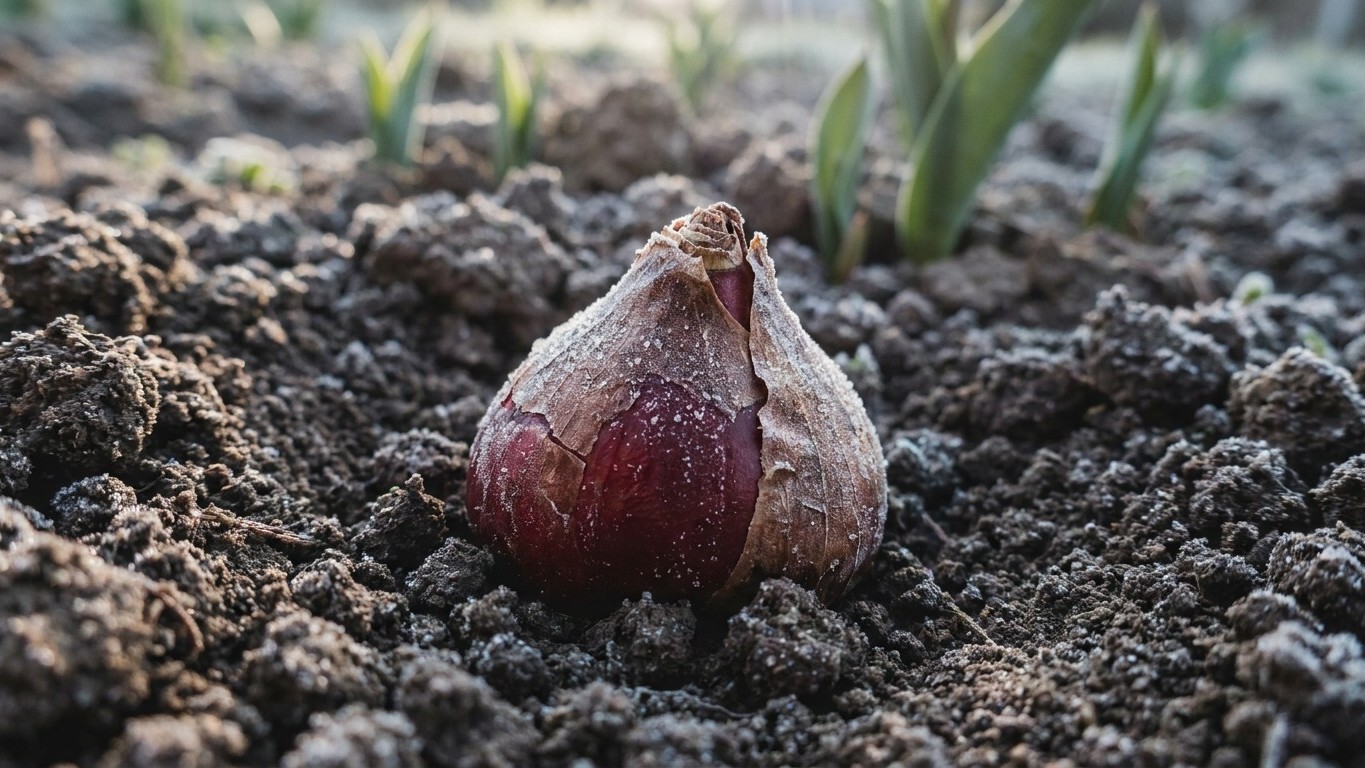

Garlic has few enemies in North Carolina, but the ones it has arrive on a schedule. Wireworms and voles go after cloves in the ground over fall and winter. Thrips and aphids show up when spring warms. Mites and nematodes ride in on the bulbs themselves, often unnoticed until after harvest. The date to build around is the first fall freeze.
The short answer for North Carolina
The calendar hangs on one number: in Charlotte, the first fall 32 F freeze falls between October 30 and November 8 in the middle band of years, the stretch where the odds of a freeze having already happened run from 30 to 70 percent. That comes from the NOAA NCEI U.S. Climate Normals for 1991-2020. Cloves go in around that window, and every pest on this page is timed against it.
Treat it as a midpoint, never a safe date. In one year out of two the freeze arrives later than the middle of that window. A warm autumn can push it well past the first week of November, and the garlic in the ground lives through that extra warmth. Soil insects stay active longer, and aphids keep feeding on whatever green has emerged.
Why the frost date is a pest date too
Garlic is planted in autumn and lifted the following summer, so the crop spends roughly three seasons exposed to different threats. Autumn belongs to the soil: wireworms, which are the larvae of click beetles, chew into cloves and sprouting roots, and voles tunnel under mulch looking for a winter meal. Spring belongs to leaf feeders. Onion thrips rasp the foliage and leave silvery streaks, and they build up fastest when the weather turns warm and dry.
Summer, after lifting, belongs to the mites. Bulb mites and curl mites move into cloves that are damaged or stored in damp air, and North Carolina summers supply plenty of damp air. A late frost in autumn simply shifts the front end of this sequence. The back end stays tied to the weather.
Working it out for your own garden
A state is not one climate, and Charlotte’s window is only a starting point. Elevation, the coast and distance from either can move the dates by two weeks in either direction. North Carolina has no large lake to blur things the way the Great Lakes do for gardeners in Ohio or Michigan, so the two levers here are altitude and salt water. Here is how to redo the arithmetic for your own yard.
- Start with the Charlotte window of October 30 to November 8, and treat it as the midpoint of your first freeze.
- Shift it earlier if you garden at elevation, and later if you are near the coast. Allow up to two weeks either way.
- Count back from that adjusted date to your planting day. The lead time lives in When to Plant Garlic in North Carolina: Counting Back From the First Frost, which is the right place to settle that number.
- Count forward from planting to mark the pest checkpoints: soil insects while cloves root, aphids on any green that shows before winter, thrips when spring warmth returns, mites after the bulbs come out.
Say your frost lands a week later than Charlotte’s because you are in the eastern part of the state. Your planting date moves later too, but the pest clock does not move with it. Wireworms and aphids respond to soil and air temperature, not to your calendar. A garlic bed planted into a warm November is exposed to them for longer before the ground cools than the same bed planted in a cold one.
Keep a simple notebook for a season. Write down the planting date, the first night that dips to 32 F where you actually live, and the date you first spot thrips on the leaves. After one year you have your own district’s numbers, which beat any regional table. After two years you can plan around them, and the garden stops being a guess.
What changes across North Carolina
Three regions run on different clocks, and the pests follow them. The brief fact worth repeating: Charlotte sits in the Piedmont, so its frost window is not the mountains’ and not the coast’s. The Blue Ridge to the west sees its fall freeze earlier and runs several weeks later in spring. The coastal plain freezes later in fall and warms earlier in spring.
| Region | Compared with Charlotte’s frost window | What it means for pests |
|---|---|---|
| Blue Ridge and western mountains (the Asheville area, Boone, the high valleys) | First fall freeze arrives earlier; spring comes several weeks later | Shorter soil-insect season in fall, and a later start for thrips and aphids in spring. Voles under winter mulch are the bigger worry. |
| Piedmont (Charlotte, Greensboro, Raleigh) | The baseline: October 30 to November 8 | Soil pests during fall rooting, thrips from spring warmth, humid summers that favor mites in storage. |
| Coastal plain (Wilmington, New Bern, the Outer Banks) | First fall freeze arrives later; spring warms earlier | A longer fall for aphids and soil insects, an earlier thrips season, and light sandy soils where nematodes can persist. |
The mountains deserve a closer look because they behave more like a northern state than a southern one. A grower at higher elevation is closer in spirit to the advice in When to Plant Garlic in North Dakota: Counting Back From the First Frost, though the winters are nowhere near as severe. The coast is the opposite case. Salt air tempers winter, and the garden never fully stops being a habitat for insects.
The Piedmont’s red clay adds its own wrinkle. It holds water through winter, which suits bulb mites and the rots that follow them more than it suits insects. Raised rows or a loose, well-drained bed do more for garlic health here than any spray.
The mistakes this climate punishes
The costliest error in a mild-winter state is planting the wrong type. Hardneck garlic wants a real stretch of cold to form a good bulb, and most of North Carolina cannot guarantee it. A hardneck planted in a warm Piedmont or coastal winter often yields small, poorly divided heads, and weak plants attract more thrips and mites. Softnecks and the milder-winter types cope better, and Garlic Varieties That Suit North Carolina Winters sorts them out. The mountains are the exception, since a hardneck can work there.
Planting too early, because the weather still feels like summer, is the second mistake. Cloves that sprout and put up tall green tops before the first freeze invite aphids and give winter damage a bigger target. Waiting for the calendar window, not the warm afternoon, solves it. And because the frost is only a midpoint, a late freeze can stretch the problem further, so a bed that looks fine in early November may be carrying lush, pest-prone growth by Thanksgiving.
Soil history matters more than most people expect. Garlic planted straight into a patch that was lawn or pasture meets wireworms in numbers. Break new ground a season ahead, or grow something else there first. Reusing the same bed year after year builds up stem and bulb nematodes, which twist and swell the leaves and leave soft, rotted cloves. Rotating away from onions, leeks and garlic is the standard fix, and nematodes from saved seed garlic are the reason to buy clean stock rather than replant questionable heads.
Last comes the summer after lifting. Humid weather punishes bulbs that are cured in a stuffy shed or stored while still moist. That is when bulb mites take hold, and a head that looked perfect in June can be riddled by August. Cure in shade with air moving through, and discard any bulbs with soft or discolored cloves instead of trusting them with the rest.
These are the opposite of the northern lessons. In a state such as North Dakota, the failure is cloves too shallow or too late to root before the ground locks up, a point covered in Garlic Varieties That Suit North Dakota Winters. In North Carolina the danger is too much warmth, not too little.
Checking this against your county
County-level frost dates and pest pressure vary more than a single station can show. NC State Extension runs an office in every county, and the agents there can tell you what is hitting local gardens this season and send soil or tissue samples to a lab if you suspect nematodes. Ask for the typical first-freeze date near you, then adjust the Charlotte window accordingly. For a broader view of the crop, see Growing Garlic in North Carolina.
Common questions
Does garlic have any pests at all in North Carolina?
Yes, though fewer than most vegetables. Wireworms, voles, onion thrips, aphids, bulb mites and stem and bulb nematodes are the usual list. Garlic’s strong sulfur compounds seem to put off many insects and most deer, which is why a bed of garlic often survives where the lettuce next to it does not.
When do thrips show up?
When spring warms and dries out, on the leaves of garlic that overwintered. The exact week depends on your region: earlier on the coastal plain, later in the mountains. Check the leaf bases and the folds of the foliage where thrips hide, and watch for silvery streaks.
Can I replant bulbs from my own harvest?
You can, as long as the heads were clean. Never replant from bulbs that showed twisted growth, soft cloves or mite damage, because nematodes and mites travel inside the seed garlic and carry the problem into the next bed.
Is the first fall freeze date a safe planting target?
No. The October 30 to November 8 window for Charlotte is a midpoint, and the freeze falls later in one year out of two. Use it as the anchor for counting back, not as a guarantee, and adjust by up to two weeks for elevation or the coast.