
Spinach gives you two good cutting windows a year in Massachusetts, one in spring and one in fall, and neither is long. Once cut, the leaves keep for two weeks at the very best, and only near freezing. Below: when to start cutting, when to stop, and how to hold the harvest in an ordinary kitchen. For sowing dates and varieties, see Growing Spinach in Massachusetts.
When spinach is ready in Massachusetts
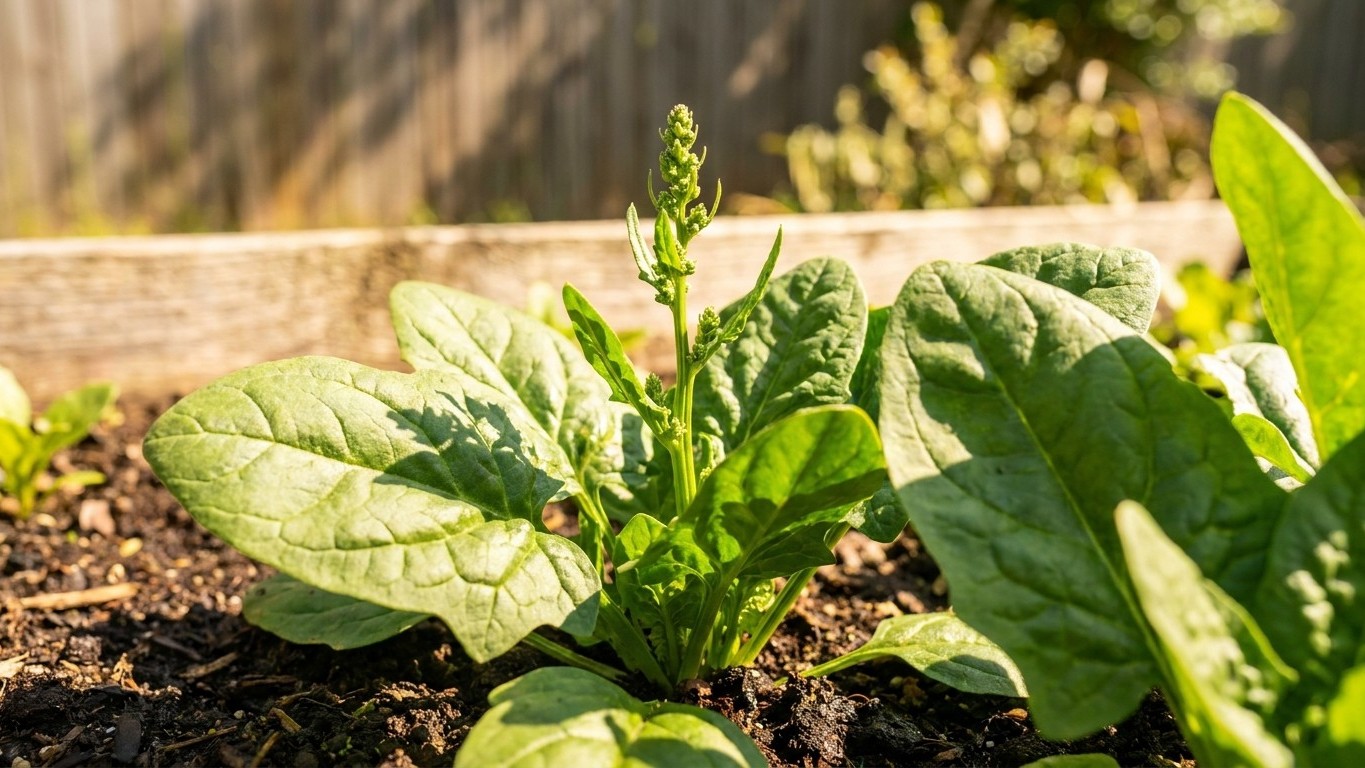
Start cutting when the plant has a full rosette of dark green leaves and the center is still a flat, tight cluster. For a spring sowing around Boston, that usually lands in May into early June. The plant is a better guide than the calendar, because a cold April and a mild one can shift the date by weeks.
What does ready spinach look like?
The outer leaves are broad enough to be worth picking, firm, and glossy. Taste one. Good spinach is mild and a little sweet, and a bitter edge means the plant has already started to turn. You can cut the whole plant at the soil line, or take only the outer leaves and leave the growing center so it keeps producing. The second method works until the plant bolts, which is when the center stretches into a stalk and the leaves narrow and turn pointed. Chewed or lacy leaves are a separate problem, and What Eats Spinach in Massachusetts, and When covers who is doing it.
How long does the spring window last?
It opens early. At Boston’s Logan station, the mildest spot in the state, the last spring freeze falls between April 1 and April 8 by NOAA’s 30-year climate normals. Spinach tolerates cold, so seed goes in as soon as the soil can be worked, often before that date. Inland suburbs and the Berkshires freeze later in spring, so their windows open later too.
The window closes on two things. Spinach grows best where temperatures stay at or below 75 F, and that same number is where the leaves start turning bitter. Day length matters just as much. Utah State University Extension notes that spinach bolts during long days as well as warm temperatures. Boston gets 15 h 06 of daylight on the longest day of the year, so a cool June does not buy extra weeks. The city sees only 10.2 days a year at 90 F or more, but spinach is finished long before the thermometer gets there. The companion piece, Will Spinach Bolt Early in Massachusetts?, goes deeper on that.
When can you cut fall spinach?
Work backward from the harvest you want. Utah State University Extension says to plant so the crop matures before the weather turns hot. The late-summer sowing is held up by warm soil, because germination drops when the soil is above 80 F. Cold has nothing to do with it. Sow when the ground has cooled, then cut through autumn. The first fall freeze at Logan comes between November 3 and November 14, and inland gardens and the Berkshires get theirs earlier. The same extension service names several spinach varieties suited to the garden.
Keeping it, and for how long
Cut spinach is still alive. It keeps breathing after harvest, using up its own sugars and moisture, and warmth speeds that up. Anything you can do to cool it quickly after cutting, such as picking in the morning and getting it indoors fast, adds to the storage time you have left.
What temperature and humidity does spinach keep best at?
The UC Davis Postharvest Technology Center, in its produce fact sheet on spinach, lists the optimum temperature as 0°C, which is 32°F. It lists the optimum relative humidity as 95-98%. That is nearly saturated air, the kind inside a sealed bag with a little moisture. Dry fridge air pulls water out of the leaves, which is why unwrapped spinach goes limp so fast.
How long does cut spinach actually last?
The same UC Davis sheet is blunt: spinach “is highly perishable and will not maintain good quality for more than 2 weeks.” Read that as a ceiling reached only at 32°F and high humidity, with leaves that went into the cold right after cutting. It is not a plan. The sheet says wilting, yellowing of leaves, and decay are likely to increase after 10 to 14 days of storage, and faster at the 5 to 10°C (41 to 50°F) common in distribution. A home fridge often sits in that warmer band, so the realistic goal is to eat the spinach well before the two-week mark.
A practical habit follows. Cut only what you will use within a few days, and let the rest of the row keep growing in the garden, which is the best storage of all. Spinach left standing will bolt eventually, so if the center is rising, cut the whole plant and either eat it or blanch and freeze it. Before you cook any stored spinach, check for yellowing and slime. Yellow leaves can be picked off, but a slick, dark patch means that section has started to rot.
Where in the house that actually is
A kitchen fridge is not a cold room built for leafy greens. Most home models hold food well above 32°F, and the door runs warmest of all, close to the 41 to 50°F band where spinach yellows in days. Every time the door opens, that shelf takes a hit of room air.
Which fridge shelf is coldest for spinach?
The back of the bottom shelf comes closest to the optimum, since cold air settles low and the rear wall sits farthest from the door. Skip the door shelves, and skip the front edge of any shelf. A cheap fridge thermometer, set on that shelf for a day, tells you how far your appliance sits from 32°F. If it reads warm, turn the dial colder a notch, but keep an eye on the leaves nearest the back wall, because some models freeze things there.
How do you keep spinach moist without rotting it?
High humidity in practice means a bag. Put the leaves in a loosely closed bag or a covered container, with a damp paper towel laid over or around them. Damp, not dripping, because free water pooling in the bottom speeds decay. If your crisper drawer has a humidity slider, set it to high and still use the bag.
Bunched spinach with the roots or stems intact can be handled another way. Stand the cut ends in a little water, as you would with flowers, and cover the leaves loosely. Skipping the moisture costs you the leaves themselves, which go limp and papery within a couple of days in a dry fridge. Wash only what you plan to eat, since extra handling bruises the leaves, and shake off the water before bagging them.
Common questions
Can you cut spinach more than once?
Yes. Take the outer leaves and leave the center growing point alone, and the plant puts out new leaves. This works until the plant bolts, after which the leaves turn small and bitter and the plant is done.
How can you tell spinach is about to bolt?
Watch the center of the rosette. When it starts to rise and lengthen into a stalk, and new leaves turn narrow and pointed, the plant is flowering. Long days and warmth trigger it, with 75 F as the growth ceiling, so cut everything once the center lifts.
How long does cut spinach last in the fridge?
Two weeks is the ceiling, according to UC Davis, and it requires 32°F and 95-98% humidity. In a typical home fridge, plan to use it sooner. Yellowing and wilting increase after 10 to 14 days even in good conditions.
When should you stop waiting for fall spinach to grow?
Time your sowing so the harvest you want comes before the weather turns hot, and remember the seed will not sprout well in soil above 80 F. If you missed the sowing window, your county extension office can help you judge whether a covered bed is worth trying. Frost does not end the season for the plants already up, but the growth slows sharply as the days shorten.