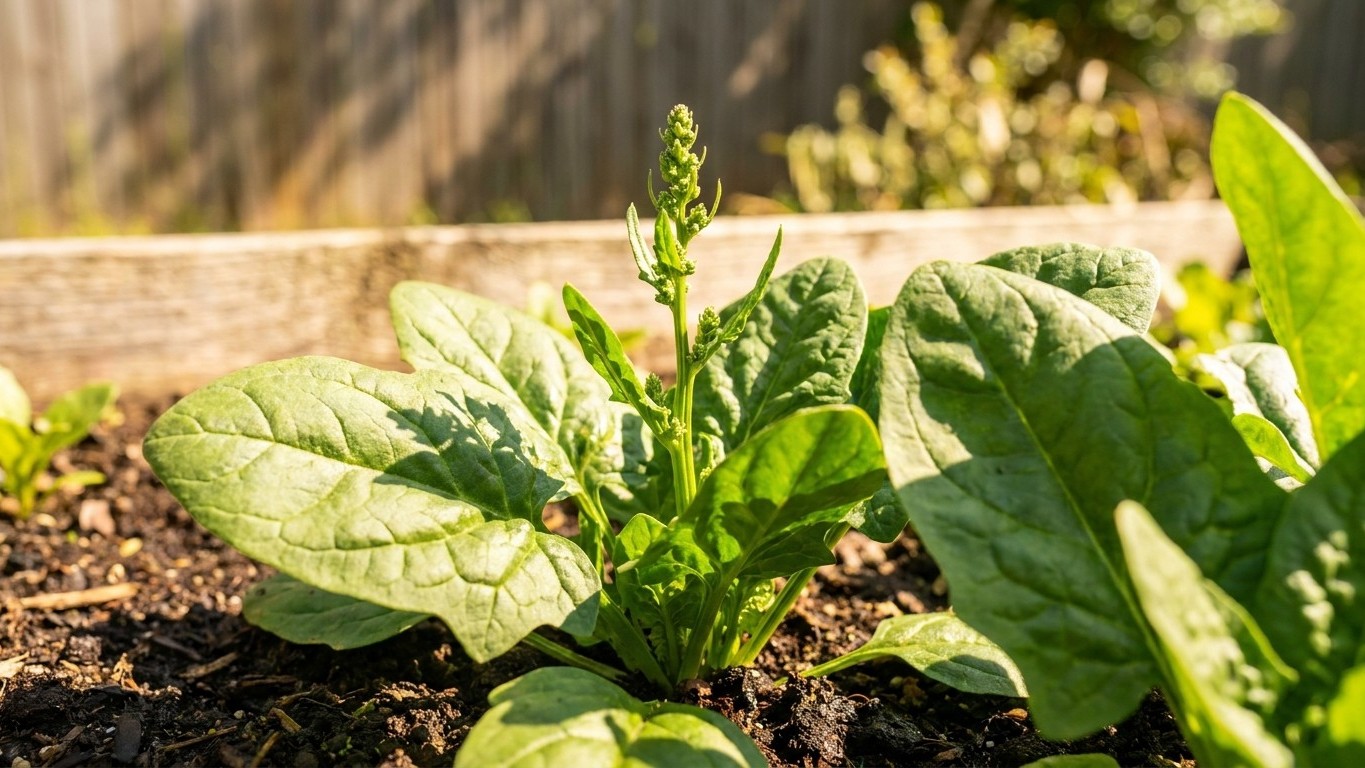

Cut spinach when the leaves are about the length of your hand and the center of the plant is still a flat rosette, before a stalk starts to rise. In Yukon that means roughly late June through July from an early sowing, and late August into September from a midsummer one. After cutting, it holds two weeks at best, and only in a fridge colder than most kitchens run. For the full season plan, see Growing Spinach in Yukon.
When spinach is ready in Yukon
The plant tells you before the calendar does. A rosette of tender, dark leaves with a flat center is ready to cut, either by taking the outer leaves or by cutting the whole plant at the base. A tight cone of leaves in the middle that starts to lengthen means a flower stalk is coming, and the leaves turn bitter soon after. The date will shift from year to year, and the signal travels with you from garden to garden.
The calendar still helps for planning. At the Whitehorse A station, Environment and Climate Change Canada’s long-term normals put the mean last spring frost on June 5 and the mean first fall frost on August 25. The reference station’s frost dates mark the midpoint of a window, not a safe date. Both are midpoints. In one year out of two, the last frost falls after June 5, and in one year out of two, the first frost arrives before August 25. The airport station also reads differently from northern or upland districts, which often run weeks behind it, so treat these dates as the center of a window and not as a safe date.
Why long days matter more than heat
Heat is usually the first worry with spinach. Utah State University Extension says the crop grows best where temperatures stay at or below 75 F (about 24 °C), and that is also the point where leaves turn bitter. But Whitehorse A averages only 0.92 days a year above 30 °C, so heat is rarely what ends the crop here.
Day length is the bigger risk. Spinach bolts during long days as well as warm weather, and the longest day at the reference city has 18 h 45 of daylight. A cool summer does not offset that. Plants that grow through the weeks around the solstice are pushed toward flowering even when the air stays mild. For the timing of that push, read Will Spinach Bolt Early in Yukon?. The practical answer is to sow as soon as the soil can be worked, cut the early crop before the days peak, and treat a late-June row as a crop that may not make it.
A fall crop reverses the problem. Utah State’s advice is to plant before the date you want to harvest, counting back from the packet’s days to maturity. A sowing in early July points to a harvest from late August into September, as days shorten. Soil hotter than 80 F reduces germination, so a bare, sun-baked bed in July is worth checking with a soil thermometer, and shading the row helps if it reads high. Because the first fall frost arrives before August 25 in half of years, keep a sheet of row cover nearby. Packet days count from sowing, and your local county extension office can suggest varieties suited to your area. If you want local guidance on dates, the territorial agriculture office or a local gardening group can tell you what works in your valley. Animals tend to find a row at the same time you do, which is covered in What Eats Spinach in Yukon, and When.
Keeping it, and for how long
Spinach is among the shortest-lived vegetables you can grow. The UC Davis Postharvest Technology Center gives the optimum storage temperature as 0°C (32°F) and the optimum relative humidity as 95 to 98%. Its fact sheet adds that spinach is highly perishable and “will not maintain good quality for more than 2 weeks.” So 32°F is the number to write down, and two weeks is the ceiling you get only when that temperature and humidity are held.
The same fact sheet describes what happens past that point. Wilting, yellowing of leaves and decay are likely to increase after 10 to 14 days of storage. It also says the decline is faster at common distribution conditions of 5 to 10°C (41 to 50°F). That range matters because it is close to what a home refrigerator actually holds, especially in the door. At 41 to 50°F, a bag of fresh-cut leaves is on a shorter clock than the two weeks suggests, and yellow edges can show in days.
The humidity figure is less intuitive than the temperature. A range of 95 to 98% means the air around the leaves is nearly saturated, which keeps the thin leaf tissue from losing water and going limp. Spinach leaves are mostly water, and they wilt quickly when the air around them is dry. Cold alone will not keep them crisp if the air is dry.
Start the clock at the moment of cutting, not at the moment you bring the leaves inside. A bunch cut in the middle of a warm afternoon and left on a counter has already used part of its two weeks. Cutting in the cool of the morning and getting the leaves into the fridge within the hour gives you the best chance of reaching the ceiling. Soil and grit should come off, but leaves that stay wet and warm invite decay faster than dry ones, so shake off standing water before storing them.
A fall crop in Yukon has one advantage here. September mornings are already cool, so freshly cut leaves start out colder than summer ones would. That helps a little, and it does not change the limit. Plan to eat or blanch and freeze whatever you cut within the first week, and think of days 10 to 14 as the point where quality is likely to be falling off.
Where in the house that actually is
A domestic fridge usually runs warmer than 32°F, and the door runs warmer than the shelves. Every time the door opens, the shelf on it gets the first rush of room air. A bag of spinach standing in the door sits near the warm end of that 41 to 50°F range, which is the worst place to keep it.
The closest you will get to the optimum is the back of the bottom shelf, or a crisper drawer set to its high-humidity position. That is the coldest, steadiest spot in most refrigerators, and it is farthest from the door. Cold air also tends to settle low in the fridge. Keep spinach away from the back wall if the wall is cold enough to freeze the leaves, since frozen and thawed spinach turns slimy. A fridge thermometer left on that shelf for a day will tell you more than the dial does.
The high humidity in the fact sheet translates into a closed container or a bag, plus some moisture. Two simple methods work. Wrap the leaves loosely in a damp paper towel or cloth and slide them into a bag or a lidded box. For cut-at-the-base bunches, stand the stems in about an inch of water in a jar and loosely cover the leaves with a bag. Either way, the leaves stay in humid air without sitting in a wet pile. Do not seal them into a tight bag while they are soaking wet, because standing water in a closed bag breaks the leaves down faster than a dry fridge would.
Put the spinach on the back of the bottom shelf, wrapped damp, within an hour of cutting, because leaving it in the door or on the counter can cost you most of the days the cold would have given you. Check it every few days, remove any slimy or yellow leaves, and use the rest first. If it has already passed a week in the door, cook it and don’t count on salad quality.
Common questions
Can I cut spinach before the leaves are full size?
Yes. Young leaves are tender and mild, and cutting the outer ones lets the center keep growing. The limit is the plant’s own timing: once the center starts to rise into a stalk, the best leaves are behind you.
How do I know spinach is about to bolt?
Watch the center of the rosette. When it stops being flat and starts to stretch upward, flowering has begun. Long days and temperatures above 75 F speed it along, and in Yukon the long days around the solstice are the main trigger. Cut the whole plant at that point.
How long does cut spinach keep in the fridge?
UC Davis says it will not hold good quality for more than two weeks, and that is at 32°F and 95 to 98% humidity. In a home fridge, expect less, and plan to use it in the first week. Yellowing and decay become likely after 10 to 14 days.
Is it too late to sow spinach in July?
Not in Yukon. A fall crop works backward from the harvest date: count back the packet’s days to maturity and add a margin for slowing growth. A sowing in early July points to late August into September. Check the soil temperature first, since germination drops above 80 F, and have row cover ready for an early frost.