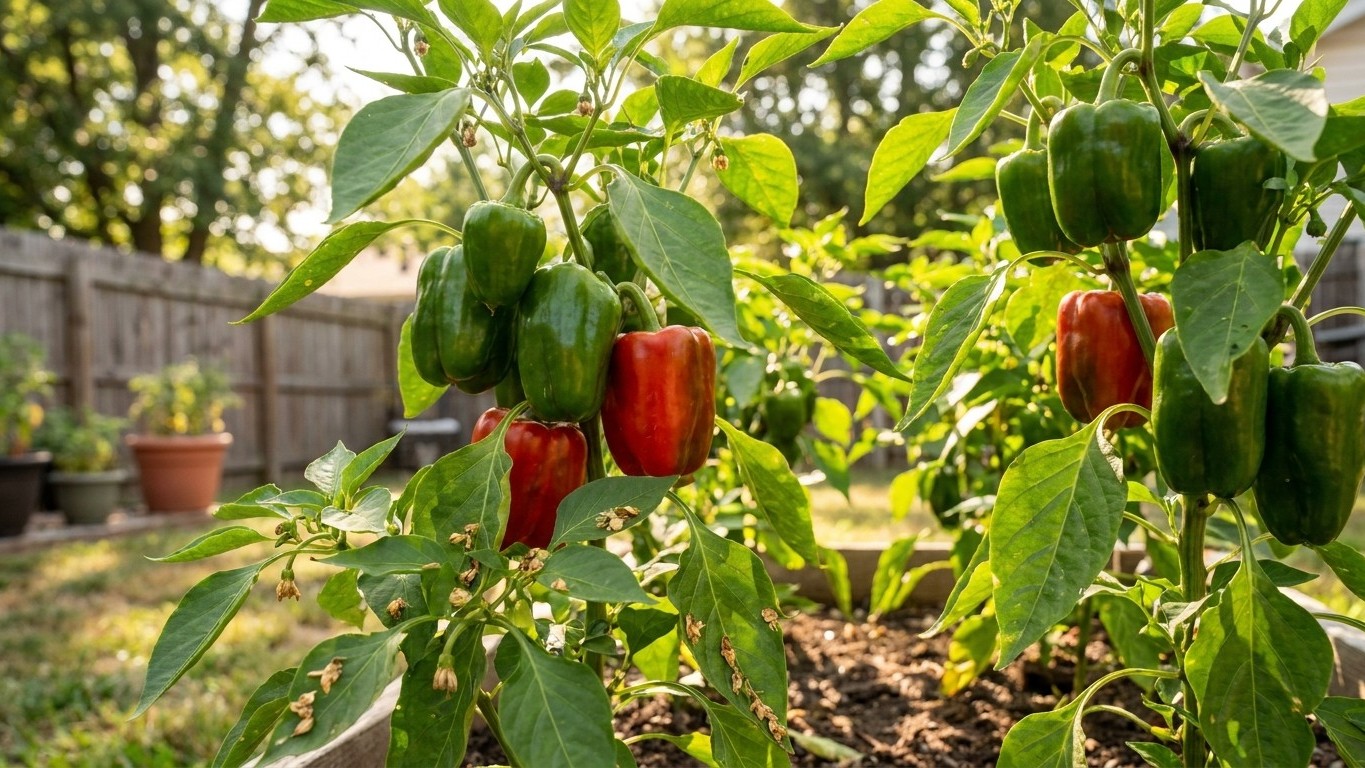

Pick peppers when they are full-size, firm and glossy, which comes about 70 to 85 days after transplanting, according to Clemson Cooperative Extension. Then keep them out of the refrigerator. Peppers store best at 45 to 50 °F, and a refrigerator runs colder than that. Below about 45 °F the skin pits and the flesh goes soft, a cold-storage injury that ruins more garden peppers than any insect. Most New York homes have a better spot, and a thermometer will find it.
Keeping them, and for how long
Why does the fridge ruin peppers?
Peppers are a warm-season crop, and their tissue is damaged by cold even when nothing freezes. This is chilling injury. It shows up as small sunken pits on the skin, a wrinkled surface and flesh that turns soft and watery. The pits are also open doors for mold and rot, so a pepper that spent a few days in a cold crisper drawer often breaks down faster than one left on a cool shelf. The damage can appear a day or two after the pepper comes out and warms up, which is why people blame the pepper instead of the drawer.
A kitchen refrigerator is set to stay well below the 45 °F line, because it is built for milk and meat. That makes it the wrong tool for a fresh whole pepper. Nearly everyone makes this mistake, since the crisper drawer looks like it was designed for exactly this. For cucumbers, snap beans and eggplant the same caution applies, since all of them dislike cold.
How long do picked peppers last?
Clemson Cooperative Extension gives the optimal storage conditions for peppers as 45 to 50 °F with 80 to 90 percent relative humidity, and says peppers kept that way will hold for two to three weeks. Treat the three weeks as a ceiling. It applies to sound fruit picked at its best, handled gently and kept in steady conditions. A pepper with a cracked shoulder, a sunscald patch or an insect puncture will not make it that long, and neither will one stored somewhere warmer.
The humidity number matters as much as the temperature. In dry air a pepper loses water and the skin shrivels. In wet air, with water standing on the fruit, rot sets in. Picking on a dry day, leaving the stem cap on and not washing the fruit until you are ready to cook all help. Sort the batch when you bring it in, and use the blemished fruit first. If damage from chewing insects is what you are finding, What Eats Pepper in New York, and When covers who is responsible and when they show up.
Once a pepper is sliced or chopped, the rules change. A cut pepper has no skin to protect and will be eaten within days, so the refrigerator is the right place for it. The warning applies to whole, fresh fruit.
Where in the house that actually is
Which room comes closest to 45 to 50 °F?
Start by ruling things out. The refrigerator is too cold. Any heated living space, including the kitchen counter, runs well above 50 °F for most of the year. A garage or shed swings with the weather: it can bake on a sunny afternoon and drop hard on a clear night, and late in the season it can reach freezing. A pepper in that kind of swing gets the worst of both.
The most promising spots are the steady, unheated or lightly heated ones. An unfinished basement, especially along a wall that is partly below grade, changes slowly and often sits in the right range for part of the year. A pantry on an outside wall, a mudroom or an enclosed porch can work in autumn. A cool closet over a crawl space is another candidate. In August and early September, when many peppers are ripening, even the basement may be warmer than 50 °F. In that case the fruit will keep for less than the full two to three weeks, so plan to eat or process it sooner.
How do you check the temperature?
Guessing is how people end up with pitted peppers, because a room that feels cool to your hands can still be well off the target. Put a thermometer in the exact spot where you plan to store the fruit and read it morning and evening for three days before you commit a harvest to it. A model that records the daily high and low is the most useful, since it catches the swings you are not home to see. If it is cheap to add one, a hygrometer will tell you whether the humidity lands in the 80 to 90 percent band.
Once you have a spot that works, a loosely closed paper bag, a perforated plastic bag or a shallow box lined with a paper towel keeps moisture in without trapping water on the fruit. Spread the peppers in a single layer or a shallow pile, and check the container every few days so that one bad pepper does not spoil the rest.
How do you know a pepper is ready to pick?
Use two signals together: the calendar and the fruit. Clemson Cooperative Extension puts harvest at about 70 to 85 days after transplanting. By that count, a transplant set out in the second half of May reaches its first usable fruit somewhere between late July and late August, depending on variety. The pepper itself is the better guide. It should be full-size for its type, firm when squeezed gently and glossy. Peppers can be picked at the mature green stage or left on the plant to color, which takes extra time and leaves the fruit exposed longer to weather and pests. Cut the stem with pruners or scissors, leaving a short piece attached, because the branches snap easily when fruit is yanked.
The calendar starts later than most people expect. Seedlings need 8 to 10 weeks indoors, and Utah State University Extension says to transplant when the soil reaches 60 F, after frost. For New York City, NOAA NCEI climate normals put the last spring freeze at 32 °F between March 23 and April 3. That is the city figure, from a dense urban station. Upstate New York and the Adirondacks freeze later in spring and earlier in fall, so those gardeners have both a later start and an earlier finish. Soil reaching 60 F comes well after the last frost date, so the frost date alone is no guide to planting.
Weather can also push the harvest back. Utah State University Extension notes that pepper fruit set fails at both ends: nights below 55 F or days above 90 F. The reference station in New York City averages 12.2 days a year at 90 F or more, so a few hot spells are normal there and can drop blossoms. The cool end depends on your own yard, so watch your own nights in the weeks after transplanting and again late in summer. A bad stretch of either kind shows up weeks later as a gap in the picking. For causes and fixes, see Why Peppers Fail to Set Fruit in New York, and for the whole season in order, Growing Peppers in New York.
When fall frost is forecast, pick every pepper that has reached full size. Fruit left out in a freeze is damaged. Mature-sized green peppers are fine to eat and will keep under the same storage conditions.
Common questions
Can I store whole peppers in the refrigerator?
It is the wrong place for them. Below about 45 °F, peppers develop pits and soften from chilling injury, and a refrigerator is colder than that. Keep whole fruit in a cool room at 45 to 50 °F and move only cut pieces to the fridge.
How long do fresh peppers keep after picking?
Clemson Cooperative Extension says two to three weeks at 45 to 50 °F and 80 to 90 percent relative humidity. That is the best case for sound fruit. In a warmer room, or with any damaged fruit in the batch, plan on less.
When should I transplant peppers in New York?
Wait until the last frost has passed and the soil has reached 60 F. For New York City, the last 32 °F freeze falls between March 23 and April 3, but soil takes longer to warm, so the transplant date comes later. Upstate and Adirondack gardeners should expect later springs. Start seedlings 8 to 10 weeks before that date, and ask your county extension office for the local timing.
Why do my peppers flower but not produce fruit?
Fruit set fails when nights drop below 55 F or days climb above 90 F. New York City sees 12.2 days a year at 90 F or more, and your own yard may run hotter or cooler. A thermometer in the garden will show whether heat or cool nights are the cause.