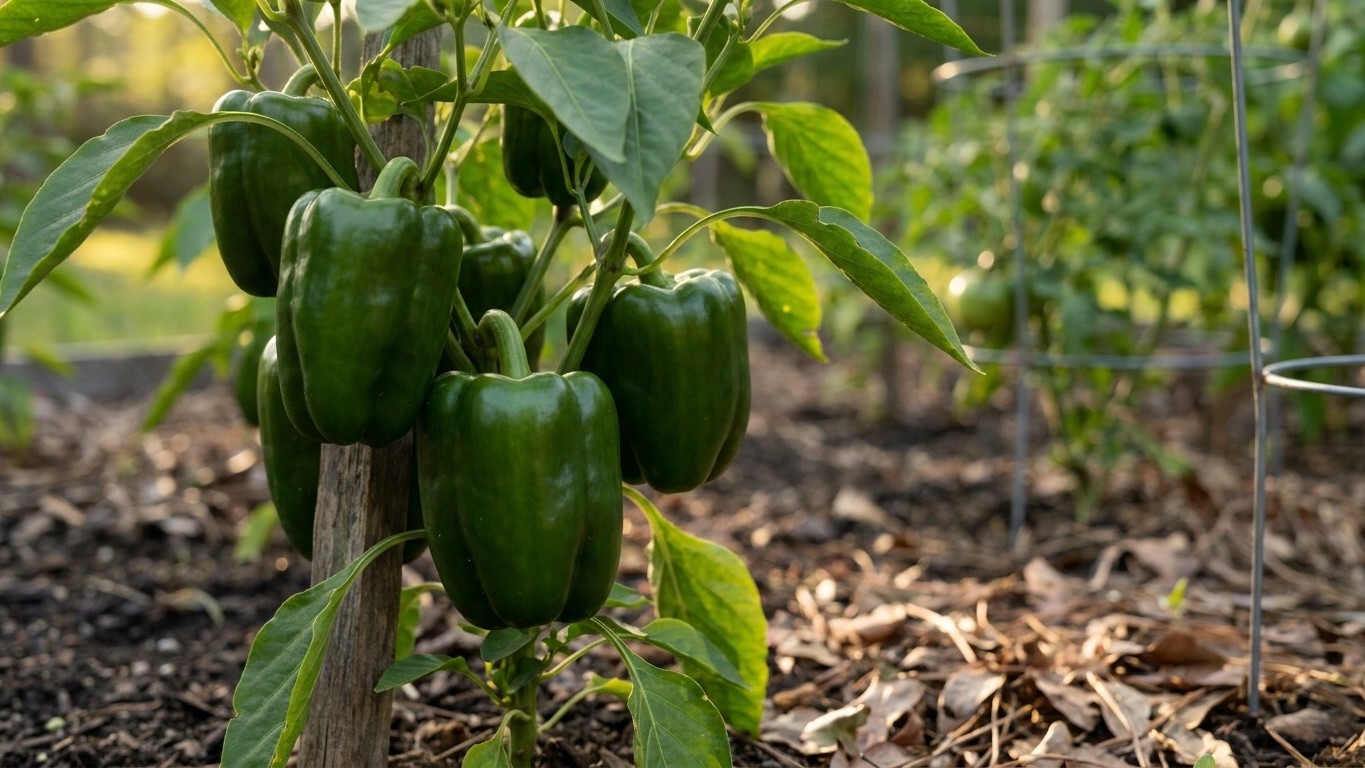

Pick peppers when the fruit has reached full size and feels firm and glossy, usually 70 to 85 days after transplanting, and bring in everything of size before a frost. Then keep them out of the refrigerator. A domestic fridge runs colder than peppers tolerate, and the cold leaves the skin pitted and soft. The right storage range is 45 to 50 °F (roughly 7 to 10 °C) with high humidity, for two to three weeks at the very most.
Keeping them, and for how long
Clemson Cooperative Extension’s Home & Garden Information Center puts the harvest window at about 70 to 85 days after transplanting. For storage it gives the optimal conditions as 45 to 50 °F and 80 to 90 percent relative humidity, for two to three weeks. That duration is a ceiling reached under ideal conditions. A pepper picked past its prime, bruised in the bucket, or held a few degrees off the range will not last that long.
The temperature floor matters more than the ceiling. Peppers are a warm-season fruit, and below about 45 °F the tissue suffers chilling injury. The skin develops small sunken pits, the flesh softens, and rot gets a foothold in the damaged spots. Most home gardeners make this mistake, because the fridge feels like the obvious place for anything fresh. The humidity range does its own work. In dry air the skin wrinkles, and in dripping-wet air the stem end molds.
When is a pepper ready to pick in Manitoba?
The clock starts at transplanting, so the calendar starts with the frost date. Transplants need 8 to 10 weeks indoors, and they go out once the soil reaches 60 °F (about 16 °C), after frost danger has passed. At the Winnipeg Richardson Int’l A station, Environment and Climate Change Canada’s long-term climate normals put the mean last spring frost on May 23. That is the midpoint of a window. In one year out of two the last frost falls later, and northern and upland districts run weeks behind the airport. Count your 70 to 85 days from the day your own plants go in the ground, not from a date on a chart.
A green pepper can be picked as soon as it reaches full size and feels firm. Waiting for red, orange or yellow adds time, and in a short season frost often decides how long you can wait. Cut the fruit from the plant, since the branches snap easily. When a frost is forecast, pick every fruit that has reached full size, because the plants will not survive it. Small fruit will not size up afterward.
Why does fruit set change the harvest date?
Flowers that never set fruit push the harvest later. Pepper fruit set fails at both ends of the thermometer: nights below 55 °F (about 13 °C) or days above 90 °F (32 °C). The hot end is rare at the Winnipeg Richardson Int’l A station, which averages 4.54 days a year reaching 32 °C and 13.3 days a year above 30 °C. That count says nothing about the length of the growing season, which is what decides whether peppers succeed. The cool end is harder to read from outside, so watch your own nights through June and early July with a thermometer in the garden. The causes and fixes are covered in Why Peppers Fail to Set Fruit in Manitoba.
Chewed or scarred fruit belongs on the kitchen counter, not in storage, since an opening in the skin invites rot. If something keeps taking bites, What Eats Pepper in Manitoba, and When explains what to look for. For the broader picture from seed to harvest, see Growing Peppers in Manitoba.
Where in the house that actually is
The target of 45 to 50 °F sits in an awkward gap. It is warmer than a refrigerator and cooler than any room people live in. Every spot in a Manitoba house misses it in a different way, so it helps to go through them.
- The refrigerator is too cold. It is set below the range, so whole peppers pit and soften there.
- The kitchen, or any heated main-floor room, is too warm. Peppers kept there ripen, wrinkle and soften within days.
- An attached or detached garage swings with the weather. A mild afternoon in September can be followed by a night near freezing, and a freeze ruins the fruit outright.
- A cool basement room, away from the furnace and the water heater, usually comes closest. Concrete walls hold a steadier temperature through the day and night, and the air is often damper than upstairs.
A cold room or a spare room with the heat register closed can also work. Houses differ a great deal, so the only way to know is to measure. Put a thermometer in the spot before you trust it, and read it morning and evening. A cheap digital model with a min and max memory shows the overnight low without any waking up. If the reading drifts out of the 45 to 50 °F range, try another spot or a different shelf. Skipping the check can cost you the whole bucket, since a room that feels cool to your hand can still sit well above 50 °F.
Humidity matters as much as temperature. The target is 80 to 90 percent, and a basement often sits near that, but a small hygrometer will tell you for certain. If the air is drier, put the peppers in a perforated bag or a container with the lid left ajar. That slows moisture loss without trapping standing water. Keep the fruit dry when it goes in, and check the pile every few days for soft spots. One bad pepper spreads rot to its neighbours.
Common questions
Can I keep whole peppers in the fridge for a day or two?
You can, but the risk of chilling injury rises the longer they stay below about 45 °F. If you plan to eat them within a few days, leave them on the counter instead. Once a pepper is cut, cooked or sliced for freezing, the storage question no longer applies.
Should I pick green or wait for the color to change?
Both work. A full-size green pepper is edible, and picking it early lets the plant put energy into more fruit. Waiting for color gives a sweeter pepper but adds time, and a short season may not allow it. Leave the last fruit on the plant only if no frost is forecast.
What do I do if frost is forecast before the fruit ripens?
Pick every pepper that has reached full size, color or not. A bedsheet or row cover can carry the plants through a light frost, but a hard freeze ends the season. Fruit picked green still keeps in the 45 to 50 °F range and may color slowly in storage.
Do hot summer days hurt my peppers in Manitoba?
Only on the rare days above 32 °C, when flowers can drop. At the Winnipeg Richardson Int’l A station that happens on average 4.54 days a year, and 13.3 days a year pass 30 °C. Airport stations read differently from a backyard, so your own thermometer is the better guide. Cool nights under 55 °F (about 13 °C) are the more common reason flowers fail, and the station figures cannot tell you what yours do.