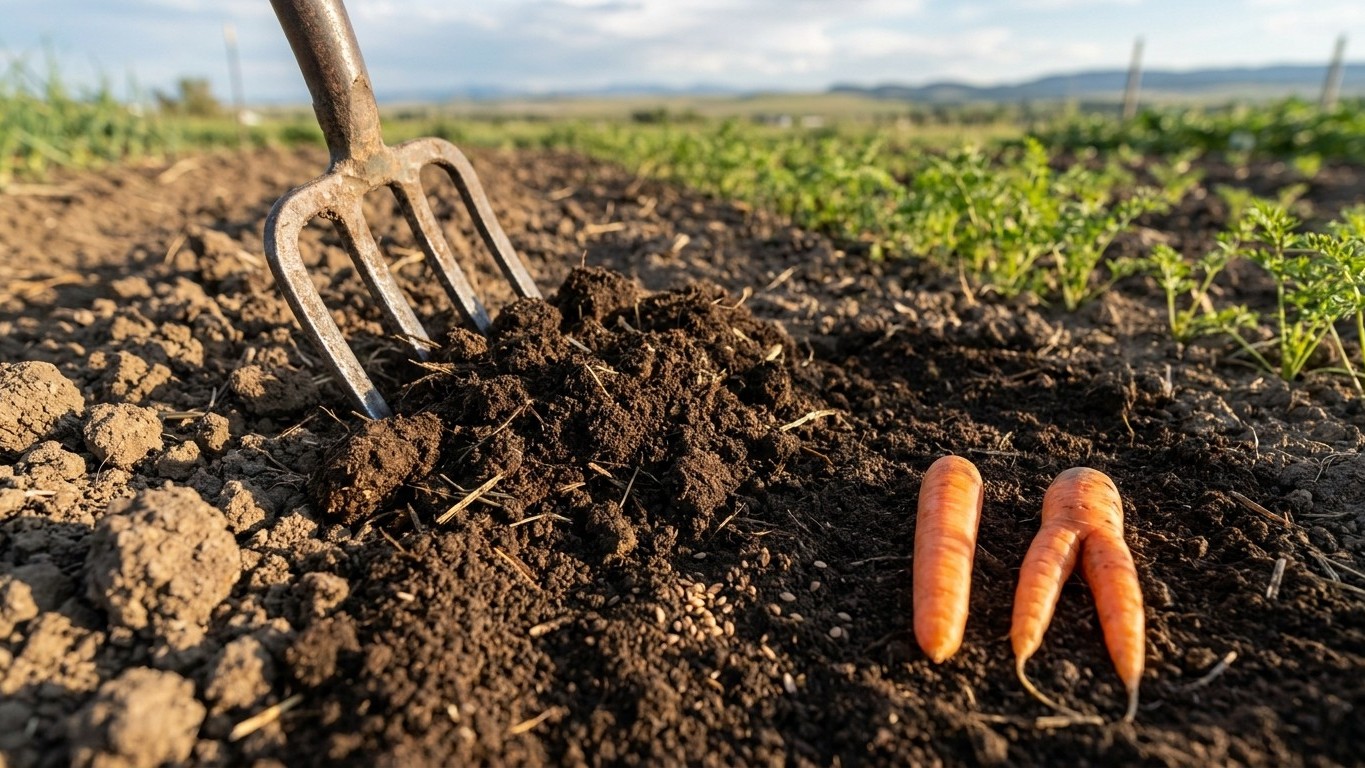

Pull carrots once the roots reach the size the packet promises, usually 70 to 100 days from seeding, and before the soil freezes hard. In gardens with cold winters, that means a harvest window in fall. Cut the tops off the same day. Then store the roots at 33 °F with high humidity. Left with their leaves on, they last about 10 to 14 days. Trimmed and kept cold, they can last months.
How do you know carrots are ready to pull?
Count from the day you sowed the seed. Carrots are never transplanted, so the 70 to 100 days on a seed packet run from seeding. Clemson Cooperative Extension puts the harvest at about 65 to 75 days after planting, which fits the quicker end of that range. Mark the sowing date on a stake or in a notebook, because by September few gardeners remember which row went in when.
The calendar only tells you when to start looking. The roots tell you the rest. Brush the soil away from the top of one carrot and check the shoulder. If it is about as wide as the packet describes, the row is ready. A carrot that has had a few extra weeks in the ground is not ruined, but a root left far too long can crack or turn woody and coarse.
- The days since sowing fall inside the range on the packet.
- The shoulder at the soil line is the width the variety should reach.
- The tops are full and dark green, not yellowing from the bottom up.
- The soil is still soft enough to loosen with a fork.
Carrots keep sizing up in cool fall soil, so you can pull a few at a time while the rest wait. Cold soil does them little harm until it freezes hard. After that you are chipping roots out of the ground and snapping them. A deep layer of straw over the row helps. Slugs, voles and rodents also work a row that sits too long, which is covered in What Eats Carrot in Minnesota, and When. For the whole season from seed to harvest, see Growing Carrots in Minnesota.
Keeping them, and for how long
Clemson Cooperative Extension’s Home & Garden Information Center gives the storage target in one line: “Store them at 33 °F and high humidity to prevent wilting.” That is just above freezing, colder than a typical basement. The same Clemson factsheet adds that bunched carrots, meaning plants with the tops on, can be stored for about 10 to 14 days.
Those 10 to 14 days are a ceiling for carrots held at the right temperature. A kitchen counter will do worse. So will a fridge door that opens twenty times a day.
Why do you cut the tops off before storing carrots?
The leaves keep pulling moisture out of the root after harvest. A carrot with its tops on is still being drained, even in a cold, humid spot. That is why bunched carrots last 10 to 14 days while trimmed ones can keep for months under good conditions. Twist or cut the tops off the day you pull the row. Do it before the carrots go into any bag, box or drawer.
Pull on a dry day if you can. Brush off loose soil with your hand and save the scrubbing for the kitchen. Roots left sitting in a pile in the sun will wilt within hours, so move them into the shade or indoors right away.
How long do carrots keep at 33 °F?
Months is the best case. It assumes the temperature holds, the humidity stays high and the roots are sound. Sort as you trim. Carrots with cuts from the fork, cracked shoulders or soft spots go to the kitchen first. Only whole, firm roots go into long storage.
Warmth shortens everything. A reader who stores carrots at 50 °F will lose them to sprouting and softening in a fraction of the time. The roots start to grow again and go rubbery. Humidity matters as much as temperature. Carrots in dry air shrivel even when it is cold, so they need a container that holds moisture, such as a perforated plastic bag or a box packed with damp material.
Where in the house that actually is
A refrigerator comes closest to 33 °F, but it can miss in both directions. A domestic fridge can run colder than carrots tolerate near the back wall or the cooling vent, and it dries the air. The crisper drawer, with the vent closed if yours has one, holds the most humidity. A heated room is far too warm. A garage swings with the weather and may be mild in October and frozen by January.
| Place | What goes wrong | Verdict |
|---|---|---|
| Refrigerator crisper drawer | Dry air; spots near the back can run colder than the rest | Closest match; use a bag to hold humidity |
| Heated kitchen or pantry | Far too warm; roots sprout and soften | Short-term only |
| Attached or detached garage | Temperature follows the weather, including hard freezes | Unreliable without a thermometer |
| Cold corner of a basement | Often warmer than 33 °F early in fall; may cool later | Possible late in the season |
In a cold-winter house, a basement corner along an outside wall or an unheated mudroom can drift toward the target in late fall. Whether it does depends on the house, so measure it. Put a thermometer in the spot for a few days before you commit a harvest to it, and read it morning and evening. A spot that swings between freezing and warm will cost you the crop.
Try this first. Set a glass of water with a thermometer in it where the carrots will go. Leave it overnight and read it in the morning. Water changes temperature slowly, so it shows the real shelf temperature rather than a passing blast of warm air. Then store a small test bag and check it regularly. Whatever softens or sprouts first tells you what to eat first.
Does soil change how carrots come out of the ground?
It changes the shape, and it changes how hard they are to pull. Utah State University Extension says carrots want deep, sandy, well-drained soil rich in organic matter. It adds that heavy or rocky soil makes the root fork. Forked and twisted roots are harder to store because they trap soil and crack when pulled.
Minnesota’s official state soil, the Lester series, is a useful starting point. USDA NRCS records its surface layer as an Alfisol, a forest soil of moderate fertility, with a pH of about 6.6, near neutral. It is a loam to silt: 39 percent sand, 24 percent clay and 37 percent silt, with about 3.0 percent organic matter, and it is well drained. That is more clay and silt than carrots like, and less organic matter than a well-built bed, but the good drainage helps. Treat it as a starting point and not a diagnosis. The state has hundreds of soil series, and river bottoms, hill country and any ground a builder has scraped or filled will differ.
The test that settles it at home is a jar test. Fill a jar a third full of soil from the bed, add water and a squirt of dish soap, and shake it well. The thickness of each layer shows your own mix. A county extension office can run a lab soil test for pH and organic matter. If the bed turns out heavy, the fix is a raised bed or double digging with plenty of compost, not a different variety. The Will Carrots Fork in Minnesota Soil? page goes deeper.
When it is time to pull, loosen the soil with a digging fork alongside the row before you tug. Dry, packed ground grips the root and snaps it at the shoulder. Watering the bed ahead of time softens it.
Common questions
How many days from seeding until carrots are ready?
Seed packets run from 70 to 100 days, counted from seeding. Clemson Extension says about 65 to 75 days after planting. Check the shoulder of a test carrot to see if yours is ready.
How long do carrots keep with the tops on?
Clemson Extension says bunched carrots can be stored for about 10 to 14 days. The leaves keep drawing moisture out of the root, so cut them off the day you pull the row if you want to keep the carrots longer.
What temperature should I store carrots at?
Clemson Extension gives 33 °F with high humidity, which is just above freezing. A warmer spot makes carrots sprout and soften much faster. A spot that dips below freezing can damage them.
Why do my stored carrots go limp?
They are losing moisture. The usual causes are tops left on, air that is too dry or a storage spot that is too warm. Cut the tops, hold the roots at 33 °F in a humid container, and check them weekly.