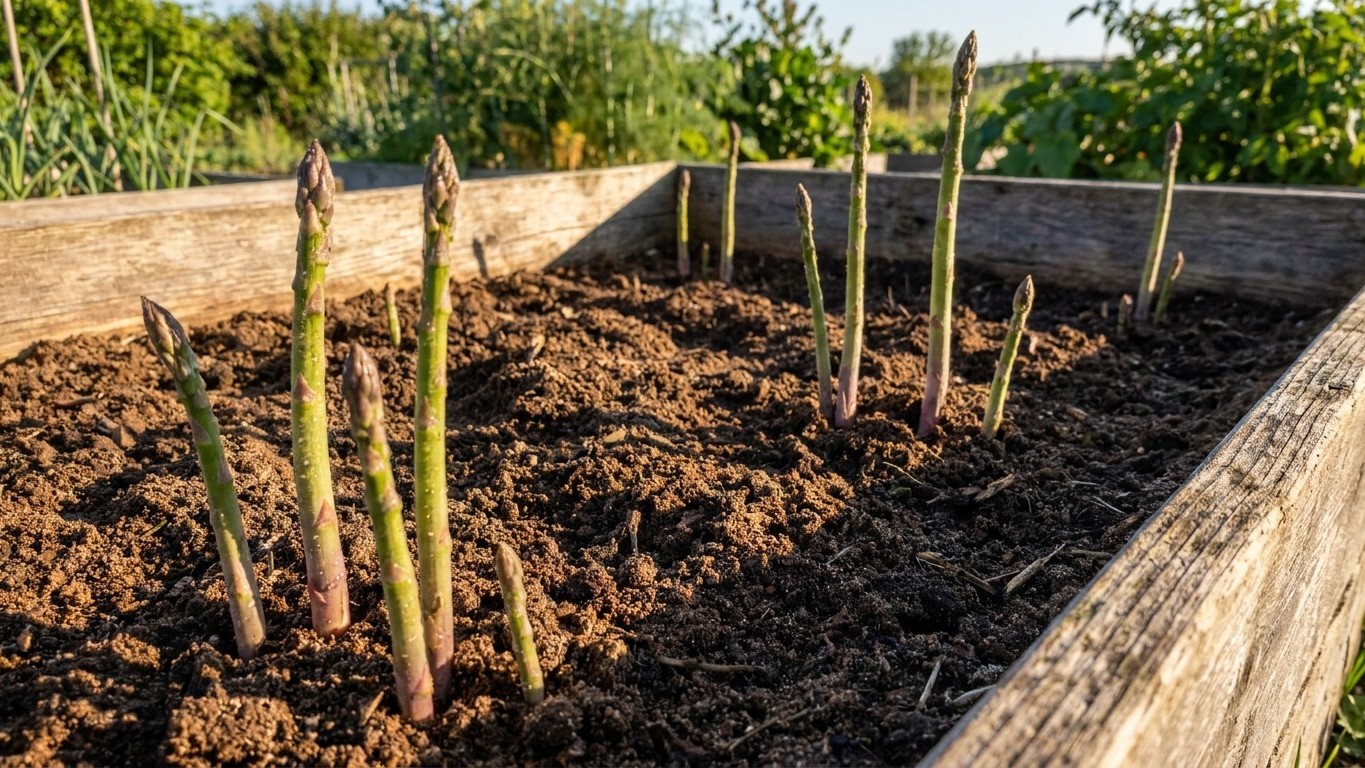

Stop cutting when most of the spears coming up are thinner than a pencil. That is the signal, and it matters more than any date on the calendar. What you cut keeps best cold and wet, just above freezing, and it toughens fast on a warm counter. Here is how to hold the harvest once it is in your hands.
Keeping it, and for how long
The storage numbers come from the UC Davis Postharvest Technology Center. Its produce fact sheet for green asparagus gives an optimum temperature of 32°F to 35.6°F (0°C to 2°C) and an optimum relative humidity of 95 to 100 percent. A cut spear keeps breathing and losing water after it leaves the crown, and those conditions slow both. The sheet calls high humidity essential to prevent desiccation.
How narrow is the safe temperature range for asparagus?
Narrow, and both edges cost you. Above 50°F (10°C), the sheet says, spear toughening occurs rapidly. A warm kitchen counter, a hot car or a sunny porch rail can do that damage while you are busy with something else. At the cold end, freezing injury will likely result at 30.9°F (-0.6°C) or lower. The spear takes on a water-soaked look, then turns extremely soft. The target is 32 to 35°F in air that is close to saturated.
That is a gap of only a few degrees between ideal and trouble on the cold side. It is also why a spear pushed against the back wall of a fridge can come out ruined while the one beside it is fine.
How long do cut asparagus spears last?
A storage time attached to those conditions is a ceiling. It describes the best case, with temperature and humidity held steady the whole time, and a household refrigerator seldom manages that. Plan on cooking spears within a day or two of cutting, and treat every extra day as a trade against tenderness. Spears you grew yourself have no long truck ride behind them, so you start with a head start. Don’t waste it.
Cut in the cool part of the morning, carry the spears indoors right away, and get them cold before you do anything else. A bucket left in the sun while you finish the row puts the spears past the 50°F line before they ever reach the kitchen. For Maryland gardens, where the last spring freeze at the reference station falls between April 3 and April 16 (NOAA NCEI, 1991-2020 normals), the harvest starts in cool weather. Late in the season a warm afternoon can arrive fast, so the habit of cutting early and chilling fast matters more as the weeks go by.
Where in the house that actually is
Most home refrigerators are set warmer than the optimum range, and the door runs warmer still because it meets room air every time someone reaches for the milk. The fridge is still far better than the counter. The job is to find the spot in it that comes closest to 32 to 35°F and to supply the humidity the fridge does not.
Which shelf in the fridge keeps asparagus best?
The lowest main shelf, toward the back, comes closest. Cold air sinks, so the bottom runs coldest and the door and top shelf run warmest. Keep the spears off the back wall itself, where a cooling surface can push the temperature toward the freezing-injury line. A crisper drawer helps if you can close it up and it holds humidity, but most drawers are drier than 95 percent. Treat the drawer as a place to set the jar, not as the humidity solution. A fridge thermometer on that shelf tells you the real number in about an hour, and it is cheaper than a ruined bundle.
How do you get 95 percent humidity in a home refrigerator?
With water, a bag or a damp wrap. Spears lose moisture through the cut ends faster than anywhere else, so that is where to put the water. Stand the bundle upright in a jar with about an inch of cold water, the way you would hold cut flowers, and slip a loose plastic bag over the tips. Skip it and the cut ends dry, the spears go limp and wrinkled, and the stalk toughens even in a cold fridge.
If a tall jar will not fit under the next shelf, wrap the cut ends in a damp paper towel, set the bundle in a bag and lay it on its side. It is a second-best method, but it still keeps the cut ends wet. Change the water or re-wet the towel every day or two.
Common questions
Can you cut asparagus in the first two years?
No. Utah State University Extension has crowns going into 8-inch furrows in early spring with no harvest until year 3. After that the bed produces for 10 to 15 years. A few early spears are still spears taken from a crown that is building its roots. The furrow itself fills in gradually through the first year, not all at once.
Since you are choosing a spot for up to fifteen years, drainage is the deciding factor. Extension says most soils will do provided they are well drained. The Sassafras series, the soil USDA lists as representative of Maryland, is sandy (67 percent sand, 10 percent clay, 23 percent silt), well drained and naturally acid at the surface. Your own yard can differ a lot, especially along rivers, in hill country or on ground a builder has scraped or filled. A soil test through your county extension office gives your number. For the long view, read Will Maryland Soil Hold an Asparagus Bed for Fifteen Years?
How do you know when to stop cutting asparagus?
Look at the spears, not the date. When most of the new spears are thinner than a pencil, stop. In the early years, the harvest limit applies even if the spears are still thick. The last spring freeze at the reference station falls between April 3 and April 16, while Western Maryland (Garrett and Allegany counties) is mountainous and runs weeks later, and the Eastern Shore runs milder. Because the season shifts that much from county to county, the pencil test is the dependable guide.
What should you do after the last cut?
Let every spear grow into a fern. The ferns feed the crown for next year’s harvest, so they need to stay green through summer. Watering depends on both rain and ground. The reference station averages about 12.6 inches of rain across June, July and August, with June driest at 3.98 inches, then 4.48 in July and 4.09 in August (NOAA NCEI Monthly Climate Normals, 1991-2020). Sandy ground lets that rain through within a day, and days at or above 90°F pull water back out. Rain that arrives as one thunderstorm mostly runs off. A rain gauge on your own plot settles it. Ferns are also where the insects gather, which What Eats Asparagus in Maryland, and When covers.
Does the variety change how long you can cut?
Extension names several varieties, some all-male and some male and female. Your county extension office can tell you what has done well in your part of the state. The cutting schedule and the pencil rule apply to all four. For the full planting plan, see Growing Asparagus in Maryland.