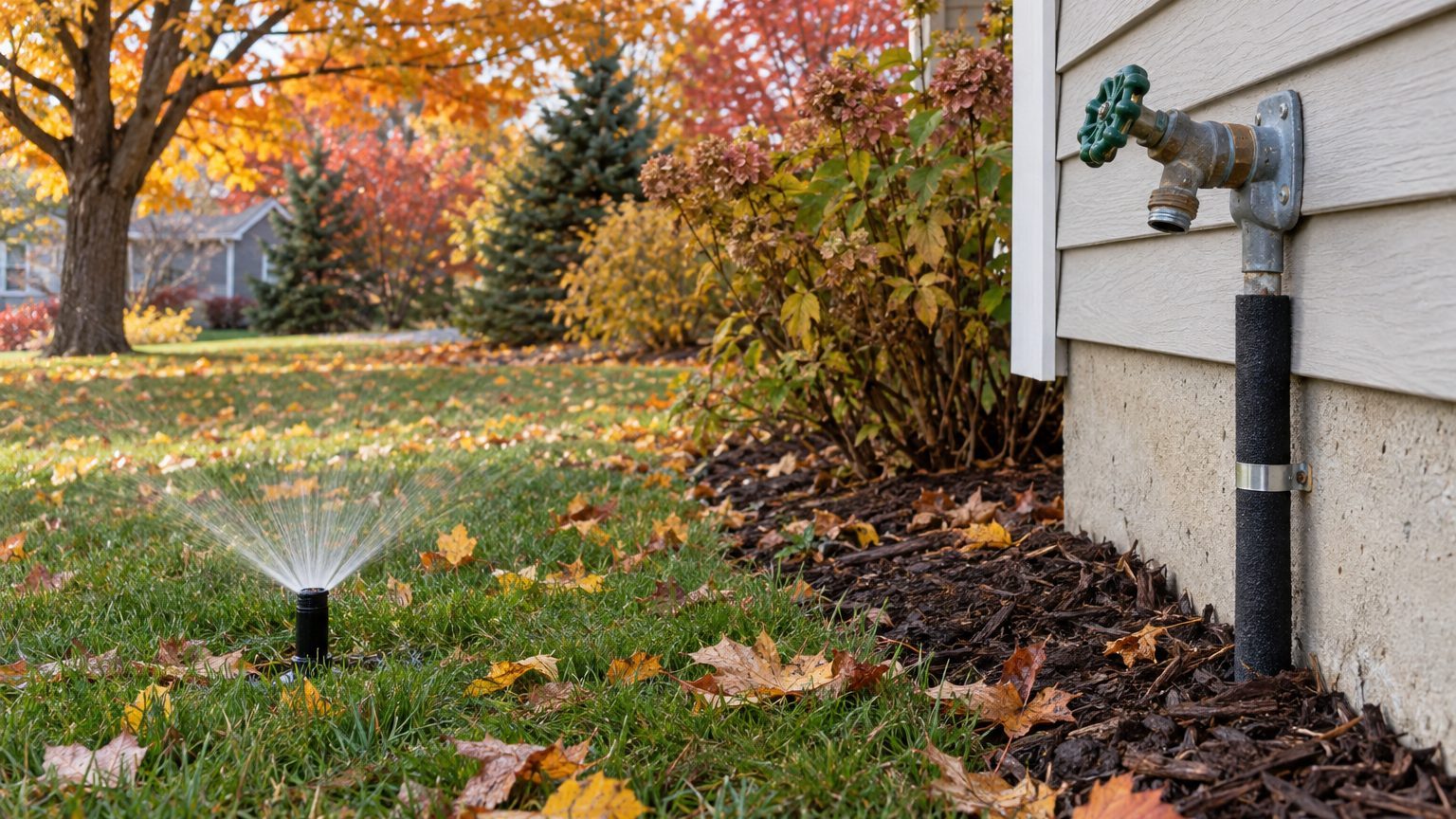

Washington has two different winters, and the right timing depends on which side of the Cascades your pipes sit. West of the mountains, cold is brief and mild, and winterizing outdoor water is mostly a matter of closing valves and pulling hoses. East of them, the high desert gets a longer, harder season, and the same chores come sooner and call for more. The dates below follow Seattle, then shift for colder ground.
When to do it in Washington
Winterize before the first hard freeze, not after the first light one. In the Seattle area, NOAA’s 1991-2020 Climate Normals put the first fall 32°F freeze between November 13 and November 30, so plan to finish before the November 13 to November 30 window opens. West of the Cascades a full compressed-air blowout is often unnecessary. What is worth doing is pulling hoses, shutting off and draining the supply to outdoor taps, draining the sprinkler lines at their drain valves, and covering the exposed backflow assembly.
How cold does western Washington really get?
Less than most of the country. NOAA’s normals for Seattle’s reference station show a mean daily minimum of 37.1°F in the coldest month. That is above freezing, which is why buried pipe on the west side rarely freezes. The window of November 13 to November 30 is the stretch where the odds of having seen a 32°F night climb through the 30 to 70 percent band.
An average still hides the odd clear, calm night that runs well below it. Those nights go after whatever sticks out of the ground: hose bibs, the backflow assembly, short runs of above-ground pipe, and valves in shallow boxes. A light freeze (a night that touches 32°F and warms by morning) is the signal that a harder one can follow soon. Waiting for it to prove the point is how people end up draining a system in sleet.
Does the window change east of the Cascades?
Yes, and in one direction only: earlier. Eastern Washington beyond the mountains is high desert with a far shorter season, so the Seattle dates should not be applied statewide. The USDA Plant Hardiness Zone Map 2023 lists Washington as 4a-9a, a range built on the average annual extreme minimum temperature. That spread tells you the state holds very different winters, and Seattle sits at one end of it.
Colder ground, whether farther north, higher up, or inland, sees its first fall freeze sooner, so draining and blowouts there belong well ahead of mid-November. Your county extension office or local water utility can tell you when freezes typically start in your town. The Washington guides cover other regional differences worth knowing before you set a date.
Sprinkler lines: drain or blow out
Why do frozen sprinkler lines split?
Water expands as it turns to ice, and a closed pipe has nowhere to put the extra volume. Pressure builds until the weakest point gives way, usually a fitting, a valve body, a swing joint, or a stretch of above-ground pipe. The damage stays hidden all winter. In spring, when the system is pressurized again, water shows up where it should not be.
Soil protects buried pipe. On the mild west side the ground seldom freezes hard, so the parts that fail are the exposed ones. The backflow assembly, the device that keeps irrigation water from siphoning back into the drinking supply, sits above ground on most systems and is the first thing a cold night finds. Valves in shallow boxes come next.
Which method fits Washington’s climate?
Three methods get water out of the lines, and they differ in how much they reach.
| Method | What it clears | Who does it | Fit in Washington |
|---|---|---|---|
| Manual drain | Water at the low points of each line, through drain valves opened by hand | Homeowner, after shutting off the supply | Often enough west of the Cascades, if the installer put drain valves in |
| Automatic drain | The same low points, through valves that open on their own when pressure drops | Nothing beyond shutting off the supply and checking the valves | Reasonable on the mild west side; grit can leave a valve stuck |
| Compressed-air blowout | Water pushed out of each zone, including heads and uneven runs | Irrigation professional | Standard east of the Cascades; insurance on sloped or flat west-side lots |
For most homes near Seattle, the practical routine is to close the main supply to the system, open the drain valves, let the lines and the backflow assembly empty, and cover the exposed pipe and assembly. Set the controller to its off or rain mode so it does not try to run an empty system. With nights that average above freezing, that routine handles the usual winter.
East of the Cascades, where the ground and the air both get colder, a blowout is the sound default. Air clears water that drains cannot reach, such as low spots in a flat run or the inside of the heads. West-side owners with a hilly lot, a long flat run, or no drain valves at all should treat it as the safer option too.
When is a professional the sensible choice?
Blowouts go wrong when too much air pressure meets old fittings, or when air runs through a zone with no water to cool it. Heads and joints can crack, which is the same damage you were trying to avoid. A trained irrigation technician knows the safe sequence and how to work through the zones one at a time.
Hire out the job if your system has no drain valves, if you do not know where the lines run, or if the lot slopes enough to trap water. Some water utilities also require a certified tester to handle the backflow assembly, so check with yours before touching it. Book the blowout for the weeks before the November 13 to November 30 window so you are not scrambling on the first cold forecast.
Outdoor faucets and hoses
How do you drain an outdoor faucet before winter?
The job takes a few minutes and involves turning valves, nothing more. Start with the hoses, because they cause more broken faucets than any other single mistake. Then work through the sequence below.
- Unscrew every hose, splitter, and hose-end timer from the outdoor taps, drain the hoses, and coil them indoors or in a shed.
- Find the interior shutoff valve that feeds each outdoor tap, often in a basement, crawl space, or garage, and close it.
- Open the outdoor tap fully so the water in the line runs out.
- Leave the tap open through winter so any trapped drops have room to expand. An insulated cover over an older faucet adds a layer of protection.
If the interior valve has a small drain opening, opening it lets the line empty from the other end as well. If you cannot find a shutoff, or the valve leaks when closed, that is a plumber’s call. So is replacing a tap or changing how a line is pitched. The full walkthrough in Winterizing Outdoor Faucets Before the First Freeze covers the same steps in more detail.
Why does a frost-free faucet still fail with a hose attached?
A frost-free tap has a long stem that places the valve seat inside the heated part of the wall. After you shut it off, the water left in the barrel is supposed to run out through the spout, which only works if the barrel slopes slightly downward and the spout is open to the air.
A hose screwed onto the spout, even one with a closed nozzle, traps that water in the barrel. When it freezes, the ice splits the pipe, and the split usually sits inside the wall where you cannot see it. The first sign comes in spring, when you turn the tap on and water shows up in the siding, the ceiling below, or the crawl space. Frost-free taps handle cold well on their own terms, and the details are in Frost-Free Outdoor Taps.
Take every hose off in the weeks before the November 13 to November 30 first-freeze window, even if your tap is frost-free. On the west side, where most nights stay above freezing, it is easy to leave a hose out because winter has not shown up yet. One clear, calm night can end that habit, and the repair is a wall-opening job.
What goes wrong here
What happens when a cold snap beats you to it?
The most likely failure on the west side is a cold night that arrives before anyone has drained. Mild, wet weather through October lulls people into waiting, and the first freeze, even a light one, then catches a hose-connected tap or an undrained backflow assembly. In spring, the tap sprays from inside the wall or drips from the siding when turned on. A sprinkler zone shows a geyser at a cracked riser, a head that runs weak, or a soggy patch in the lawn.
Prevention is a calendar habit. Pick a weekend in the weeks before the November 13 to November 30 window and do the whole routine at once. Where you live farther north, higher up, or east of the Cascades, move that weekend earlier. If a line does freeze, Frozen Pipes explains what to do next.
How do forgotten hoses and flooded valve boxes show up?
A forgotten hose looks innocent in the fall and costs you in spring. The frost-free tap it was attached to holds water in the barrel, the barrel splits, and the leak appears inside the wall when you first use the tap. A walk around the house with a checklist, looking at every tap, prevents most of these.
The valve box is the quieter problem. Western Washington’s wet winters can leave a box sitting in saturated ground with standing water around the valves. When a cold night follows, that water freezes around the valve bodies and fittings and cracks them. In spring, the zone fails to shut off, leaks at the valve, or will not turn on. Check that the lid is on and the box is not full of water before cold weather. If a box floods every year, have an irrigation technician look at drainage and regrade the spot before the next first-freeze window, because fixing that is more than a valve-turning chore.
Cold ground also asks for some lawn prep on the same schedule, and Winterizing a Lawn covers that side of the fall list.
Common questions
Do I need to blow out my sprinkler system in Seattle?
Often you do not. With the coldest month averaging a 37.1°F nightly low, many west-side systems do fine with the supply shut off, the drain valves opened, and the exposed backflow assembly covered. A blowout makes sense if the system has no drain valves, the lot slopes, or you are unsure where water can pool in the lines.
Is it harmful to winterize too early?
No. Draining the lines and pulling the hoses in the weeks before the November 13 to November 30 window costs you nothing, and fall rain covers most lawn watering by then. If a warm spell comes back, you can run the system briefly and drain it again, though most owners simply wait for spring.
Should I leave the outdoor faucet open all winter?
Yes, after the interior shutoff valve is closed and the line has drained. Leaving the outdoor tap open gives any leftover water room to expand without splitting the pipe. Keep hoses off the tap for the whole season, frost-free or not.
When should I winterize east of the Cascades?
Earlier than the Seattle window of November 13 to November 30. The high desert has a shorter season and colder nights, and the farther north or higher up you are, the earlier the first freeze arrives. Ask your county extension office or local water utility when freezes typically start in your area, and schedule a blowout ahead of that.