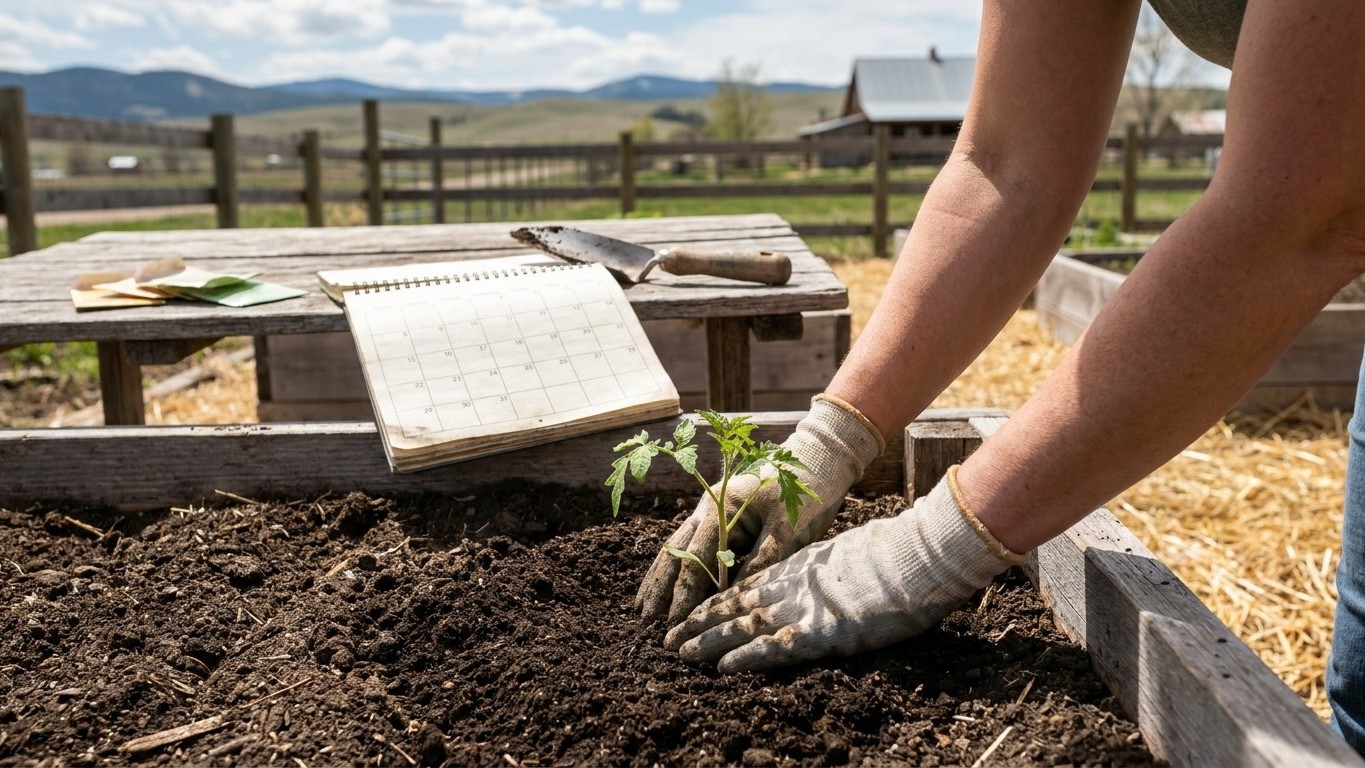

Billings’ last spring freeze lands somewhere between April 29 and May 10, and that spread is the whole reason tomato dates in Montana resist a single answer. Freeze risk fades on a curve, not a switch, so the early end of that window still carries real 32°F risk while the late end mostly doesn’t. Tomatoes tolerate none of it either way. Colder ground elsewhere in the state pushes that window later and closes it sooner — sometimes by weeks.
What this comes down to in Montana

Tomatoes are the least frost-tolerant plant most home gardeners grow, and Montana’s spring is the least forgiving part of the calendar for them. Near Billings, NOAA’s 1991-2020 Climate Normals put the last spring freeze in a window running from April 29 to May 10. That’s a range, not a date, because freeze risk is a probability curve, not a switch that flips on a single day. Even within that window, a 32°F freeze remains plausible on the early end and increasingly unlikely by the end of it.
What this means in practice is that you should not set transplants outside before that window closes, and you should build in some slack rather than transplanting on the very last day of it. The USDA’s Plant Hardiness Zone Map puts Montana across zones 3a to 6a, which is one of the widest hardiness spans of any state in the country, and Billings sits toward the milder end of that range. If you garden somewhere colder, your own window opens later and closes earlier than what a Billings-based figure suggests, and the gap can be substantial in a mountain valley.
Timing matters more than which cultivar to plant into that window. For that decision, see Tomato Varieties That Ripen in Time in Montana, and for the insects that show up once your plants are in the ground, see Tomato Pests in Montana: Which Ones Actually Show Up Here. Both assume you’ve already worked out the dates below.
Working it out for your own garden
Counting Back From the frost window
Seed packets and nursery guides typically call for starting tomato seed indoors six to eight weeks before the outdoor transplant date. Applied to Billings’ NOAA window of April 29 to May 10, that arithmetic gives you a range, not a single day: six weeks back from April 29 lands you in mid-March, and six weeks back from May 10 lands you in late March. Add the extra two weeks some growers use for slower-germinating cultivars and the earliest end of that pushes into early March. The honest way to state your seed-starting date is “mid to late March,” not a specific day, because the frost window it’s built on is itself a range.
Checking whether a cultivar finishes in time
Once you have a transplant window, you can test a specific cultivar against it. Take a fast cultivar like ‘Early Girl‘, listed at roughly 50 days to maturity from transplant. Transplant at the late end of the Billings window, around May 10, and count 50 days forward: you land near the end of June for the first ripe fruit, with NOAA’s first fall frost at Billings not expected until October 1 to October 14. That leaves a wide cushion, plenty of room for a slow spring or a stretch of cool nights to push the harvest back and still finish comfortably.
Now try the other end of the catalogue. A long-season heirloom like ‘Brandywine‘, often listed near 90 to 100 days to maturity, transplanted at the same May 10 date, doesn’t put first fruit on the vine until roughly mid-August under ideal conditions. Catalogue day-counts assume steady summer heat, and Montana’s nights cool off earlier than that assumption expects. Add the usual real-world stretch and you’re pushing toward the edge of the October frost window before you get a full crop rather than just the first tomato. That’s the line: a cultivar with a comfortable maturity number on paper can still lose the race against an early fall frost once actual conditions slow it down.
What changes across the state
Billings sits in a relatively mild river valley, and NOAA’s numbers for it are not a stand-in for the whole state. Elevation is the biggest lever: gain a few thousand feet and you lose growing days on both ends of the season, since cold air pools in mountain valleys and drains slower than it does along the lower Yellowstone corridor. A garden in one of Montana’s higher mountain valleys can see a frost in a summer month that would be unthinkable at Billings, which is exactly the caution NOAA attaches to this dataset.
Distance from large water bodies matters too, though its effect is smaller in Montana than in states that border an ocean or a Great Lake. Water moderates temperature swings nearby, so a garden close to one of the state’s larger reservoirs or rivers can lag slightly behind a similar-elevation site further from water in spring, and hold warmth slightly longer into fall. North-facing versus south-facing slope, and how much cold air a particular yard can drain away overnight, shift things by days as well, and none of that shows up in a single climate-station figure.
The practical takeaway is a habit rather than a new number, since the Billings window is one reference point. It’s a habit: treat the Billings-based window as a starting estimate, and adjust it earlier or later based on how your own site compares to a valley floor near a river. If you’re not sure which direction to adjust, ask your county extension office, since they track local frost patterns that a statewide climate normal can’t resolve.
The mistakes this state punishes

The single most common error is transplanting into cold soil after a run of warm days. A week of 70-degree afternoons in April can feel like permission, but Montana’s spring is volatile enough that a warm stretch inside the NOAA-defined frost window is not the same as the window actually closing. Tomatoes set into soil that hasn’t warmed sit stalled for weeks even if they survive, and a stalled transplant is more vulnerable to the next cold snap than a healthy one would be.
The second is choosing a long-season cultivar for a short-season site without doing the days-to-maturity math shown above. It is easy to fall for a beautiful heirloom description and skip the arithmetic. The season length calculation from the previous section exists precisely to catch that mistake before you’ve spent a summer on a plant that never finishes.
The third is ignoring how much colder your specific site runs compared to the reference city behind these figures. Gardeners who copy a Billings-based date verbatim into a mountain valley garden are effectively borrowing someone else’s climate. Match the figure to your elevation and your own frost history, not just to the nearest weather station on a map, before you set a hard date on the calendar.
- Don’t trust a warm week inside the frost window as proof the danger has passed.
- Don’t pick a cultivar by looks alone. Run its days-to-maturity against your transplant date.
- Don’t apply Billings’ numbers to a higher or colder site without adjusting.
Checking this against your county
Everything above is anchored to one NOAA weather station near Billings, and Montana is too large and too varied in elevation for one station to speak for it. Before you commit to a planting date, check it against your own county’s extension office and the state’s tomato-growing guidance through Montana State University Extension. They track frost patterns closer to your actual garden than a statewide normal can, and they can tell you how much earlier or later your local window tends to run compared to the figures cited here.
If you haven’t already sorted out which cultivar to grow within that window, that decision comes before this one in the actual sequence of the gardening year, even though it’s covered separately: see growing tomatoes in Montana for the full picture before you lock in dates.
The Moon calendar is a separate, older custom: see when to plant tomatoes by the moon, written as tradition rather than fact.
Common questions
Can I just plant on the same date every year?
No, because the frost window itself is a range, not a fixed day, and the actual last frost in any given year can land anywhere inside or occasionally outside it. Treat last year’s successful date as a data point, not a rule, and keep watching the forecast as your target window approaches.
What if I want to plant earlier than the frost window allows?
You can, but only with protection: row cover, a cold frame, or wall-of-water style plant protectors that buy you a few degrees of cushion on a cold night. Even with protection, cold soil will still slow root growth, so an early transplant under cover often doesn’t outrun one planted on time into warmer ground.
Does starting seeds earlier indoors get me an earlier harvest?
Only up to a point. A tomato transplant that’s spent too many weeks in a small pot before the ground is ready gets rootbound and stressed, and often performs worse after transplanting than a younger, less leggy seedling started on the six-to-eight-week schedule.
How do I know if my yard is colder than the Billings figures suggest?
Watch it for a season: note when frost actually appears on your own thermometer or frost gauge in spring and fall, and compare that to the NOAA window cited here. If your yard consistently lags or leads that window by more than a week or two, adjust your planting calendar to match your own recorded pattern rather than the reference-city figure.