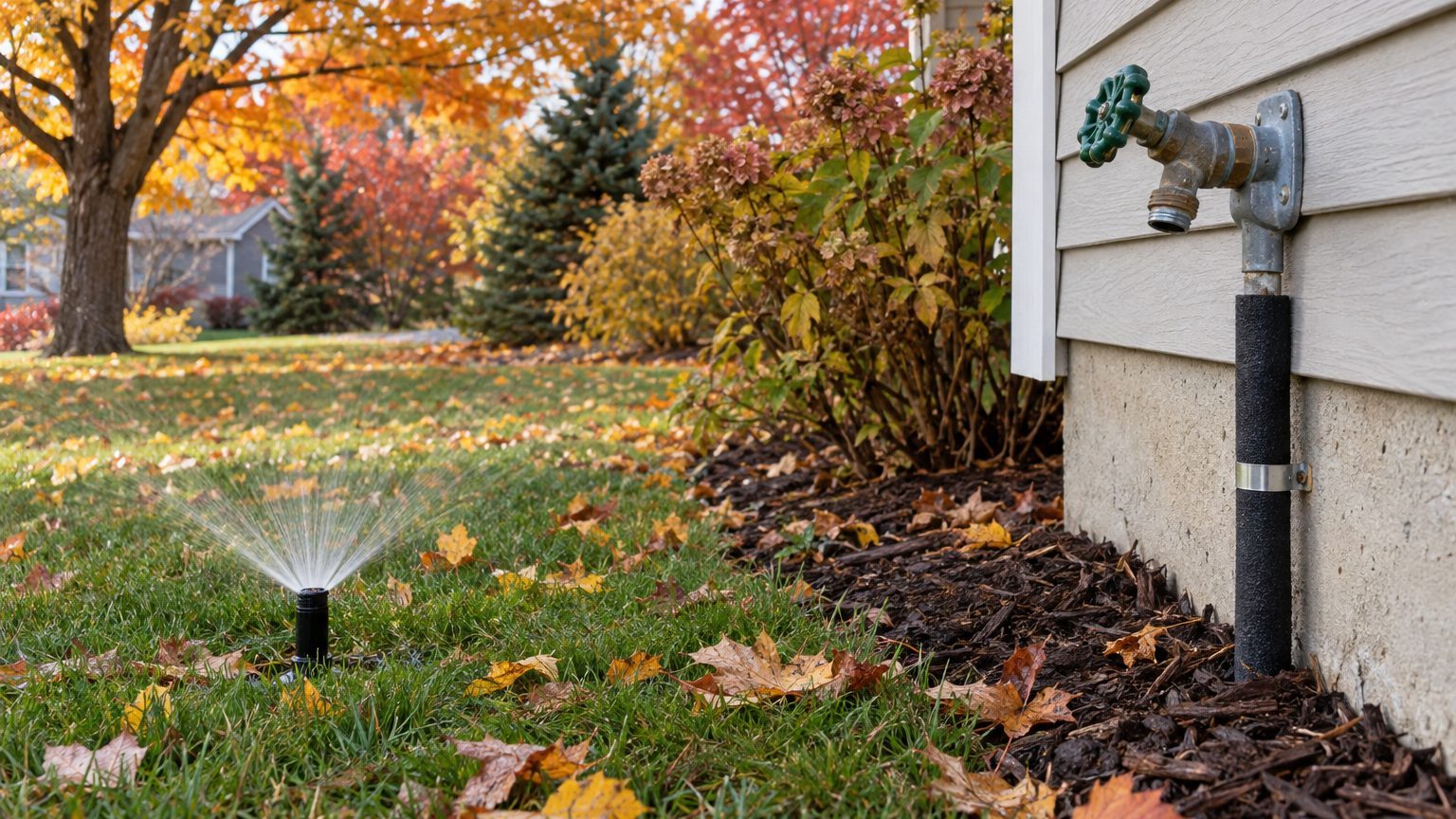

Nevada has no single winterizing date, because the first hard freeze lands months apart in Las Vegas and in the high country. The USDA Plant Hardiness Zone Map (2023) runs from 4a to 10a across the state, which shows how much the answer depends on your address. Northern and high-elevation homes drain sprinklers in autumn, well ahead of the first hard freeze. In the Las Vegas valley, a full blowout is often unnecessary, and a short list of targeted steps does the job.
When to do it in Nevada
Finish winterizing before the first hard freeze, not after the first light one. At the Las Vegas airport, NOAA’s 1991-2020 U.S. Climate Normals put the first 32°F night between December 8 and December 23 (the 30 to 70 percent probability band), while Reno, Carson City and anywhere at elevation see that first freeze months earlier in the fall.
A light frost whitens the lawn at dawn and is gone by mid-morning. A hard freeze is a night that stays cold for hours, long enough to chill the soil, the pipes in it and anything sticking up into open air. Sprinkler damage comes from the second kind. The first kind is your warning, and in the north the first frost on the windshield means the hard freeze is close behind.
The Las Vegas numbers come with a caveat. The airport sits in a desert urban heat island, which makes it a warm reference point for the state, and the mean daily minimum of its coldest month is 39.6°F (NOAA NCEI climate normals, 1991-2020). Read those dates as the warm end of the range. Your county extension office can give the average first-frost range for your elevation, and the Nevada guides cover how conditions shift from region to region.
| Where | First fall freeze | What it means for the job |
|---|---|---|
| Las Vegas valley | Airport reference: December 8 to December 23 (30 to 70 percent probability band for 32°F) | Full blowout often unnecessary; protect exposed parts and watch the forecast |
| Reno and Carson City | Months earlier in fall than Las Vegas | Drain and blow out in autumn, before the first hard freeze |
| Higher ground anywhere in the state | Earlier than nearby low ground | Make it one of the first chores of autumn |
What should you do in Las Vegas instead of a full blowout?
A coldest-month mean minimum of 39.6°F is only an average, and individual nights can run much colder, so check with your county extension office about buried pipes. The exposed parts are the problem. The above-ground backflow assembly, the short run of pipe feeding it and any hose bib on a shaded wall cool off fast on a clear, still night, and one cold night after months of mild weather is all it takes.
Before the December window opens, cover or insulate those parts and take hoses off the taps. Cut watering back for winter, since turf and shrubs use far less. On a night when the forecast calls for 32°F or lower, shut off the irrigation supply and skip the early-morning cycle. If a system has long flat runs that hold water, a blowout is a reasonable precaution, but it is optional here.
How do you know the first hard freeze is close?
In northern Nevada and at elevation, don’t wait for the forecast. Cold snaps can arrive while afternoons are still warm and the sprinklers are still running, so pick a weekend in early autumn, do the work then and put it on the calendar every year. Cool-season turf has its own fall tasks, listed in Winterizing a Lawn, and they fit the same weekend.
In the valley, the trigger is the National Weather Service forecast. A freeze watch or freeze warning for your area means tonight’s the night to drain exposed parts and shut off the irrigation supply.
Sprinkler lines: drain or blow out
Water sitting in a pipe, valve or sprinkler head turns to ice on a hard-freeze night, and ice takes up more room than water. A plug trapped between closed valves has nowhere to go, so the pressure splits the pipe, cracks a fitting or breaks a valve body. The damage stays hidden until spring, when the system pressurizes and a geyser or a soggy patch of lawn gives it away.
Manual drain, automatic drain or blowout: what is the difference?
Each method empties the lines in a different way, and each leaves a different amount of water behind.
| Method | How it works | Where it fits |
|---|---|---|
| Manual drain | You shut off the supply and open drain valves at the low points so gravity empties the lines | Sloped systems built with those valves; water can stay in heads and sags |
| Automatic drain | Valves at low points open on their own when line pressure drops | Mild climates; they can stick or leak and may not clear every low spot |
| Compressed-air blowout | A compressor pushes air through each zone and forces water out of lines, valves and heads | The most thorough option, and the one for places with routine hard freezes |
Gravity can only move water downhill, and lines rarely slope perfectly. Heads, the low loops of a manifold and sags in a long run keep a little water, and a little is enough to crack a fitting. That is why drain valves alone are a weak plan once nights regularly fall well below freezing.
Northern Nevada, Reno, Carson City and higher ground should plan on a blowout every fall, even if the system has drain valves, so blow out every zone each autumn before the first hard freeze. In the Las Vegas valley, where the coldest-month minimum is 39.6°F and the first 32°F night falls in the December 8 to December 23 range at the airport, automatic or manual drain valves plus insulation on exposed parts normally cover it.
Can you blow out sprinklers yourself, or should you hire a professional?
A homeowner with the right equipment can do it. The compressor has to be large enough to keep air moving, because a small one fills the line without clearing it. Set the regulator to the low pressure the system’s manufacturer specifies, wear safety glasses and never stand over a sprinkler head or the backflow assembly while air is flowing. Work one zone at a time, in short bursts, until only mist comes out of the heads. Air running dry through a zone for too long can overheat plastic parts.
Hiring a professional is the sensible choice in a few situations: you don’t own a suitable compressor, the property has many zones, the layout of buried lines is unknown to you, or a hard freeze is only days away and you can’t risk a mistake. Systems with a pump or drip zones that don’t drain in the usual way also call for someone who has done it before. Many homeowners also use the visit to have the backflow assembly checked, and your water provider can tell you what it requires.
Outdoor faucets and hoses
A hose left screwed onto a tap is a common reason a faucet freezes. It holds water in the faucet and the line behind it, and that water has the same problem as the water in a sprinkler pipe. Taking the hose off takes seconds and removes a major cause of winter faucet damage.
How do you drain an outdoor faucet for winter?
Everything here is turning valves and unscrewing hoses, nothing more.
- Unscrew every hose, splitter, sprayer and timer from each outdoor tap, then drain the hoses and coil them indoors.
- Find the interior shutoff valve for that tap, usually in a basement, crawl space or utility room, and turn it off.
- Open the outside tap fully and leave it open, so the last water in the pipe runs out.
- On exposed faucets in the Las Vegas valley, add an insulated faucet cover for forecast freeze nights.
If a tap has no interior shutoff, or the faucet drips after you close it, that is a plumber’s job. So is adding a valve, replacing a faucet, or thawing a pipe. For the full walk-through, see Winterizing Outdoor Faucets Before the First Freeze.
Why does a frost-free faucet still freeze with a hose attached?
A frost-free faucet has a long stem that puts the shutoff seat inside the heated part of the wall, and the barrel is built to tilt slightly downhill so it empties when you close the handle. A hose on the outlet blocks that drain. Water stays in the barrel, and the part of the barrel that passes through unheated space freezes and splits, usually inside the wall. Nothing shows until spring, when you turn the tap on and water sprays behind the siding or into the basement. A faucet installed tilting the wrong way holds water even without a hose, and fixing that is also a plumber’s call.
So take every hose off, even from a frost-free faucet, before the first hard freeze. Frost-Free Outdoor Taps explains how the stem and slope work.
What goes wrong here
Three common failures cause spring repairs, and each has a simple prevention.
What happens when a cold snap arrives before you have drained?
In the north and at elevation, a hard freeze can show up while afternoons are still mild and the system is still running. In spring the damage looks like a zone that won’t come up, a wet patch over a buried line, a geyser at a cracked head or a valve that weeps. Prevention is timing: drain in early autumn instead of waiting for a forecast. If a snap is already coming, shut off the supply and open the drain valves tonight.
Why is the forgotten hose such a problem?
It is usually the one on the far side of the yard, the soaker hose, or a splitter nobody remembers. A forgotten hose on a frost-free faucet leaves a leak inside the wall that appears when you first turn the tap on. Walk the whole property once, include the back and side taps, and check that every tap is open with nothing attached. If a pipe has already frozen or split, Frozen Pipes covers what to do next.
How does a valve box flood?
Valve boxes sit at ground level and collect runoff and snowmelt. Valves submerged in a box can freeze solid and crack, leaving a zone that won’t shut off or a box full of water in spring. After a blowout, open every valve box lid and check for standing water. If it holds water, ask a landscaper or irrigation pro about drainage, because the fix involves digging and plumbing.
The valley has its own version of these failures: the exposed backflow assembly that was never covered because the winters are mild. Wrapping it takes minutes before the December 8 to December 23 range begins.
Common questions
Do I need to blow out my sprinklers in Las Vegas?
Usually not. The mean daily minimum of the coldest month is 39.6°F at the reference station, which is an average of daily lows, not the coldest night of the year. Still, a 32°F night falls in the December 8 to December 23 range at the airport (NOAA, 1991-2020 normals), so insulate exposed pipes and the backflow assembly, remove hoses and drain when the forecast says freeze.
Can I wait for the first frost in Reno or Carson City?
No. The first light frost is the signal that a hard freeze is close, and both cities see their first freeze months earlier than Las Vegas. Finish draining and blowing out in autumn, and ask your county extension office for the average first-frost range at your elevation.
Does my USDA hardiness zone tell me when to winterize?
No. The USDA Plant Hardiness Zone Map (2023) rests on the average annual extreme minimum temperature, and it runs from 4a to 10a across Nevada. It tells you which plants survive the winter, not the date of the first hard freeze. For timing, use the first fall frost range for your area.
When do I turn the sprinklers back on in spring?
After the hard freezes are finished, which comes later in colder, higher places. Open the main valve slowly, run one zone at a time, and check each valve box and exposed pipe for leaks as the pressure comes up. A zone that sputters or a box that fills with water points to winter damage you can repair before the hot season starts.