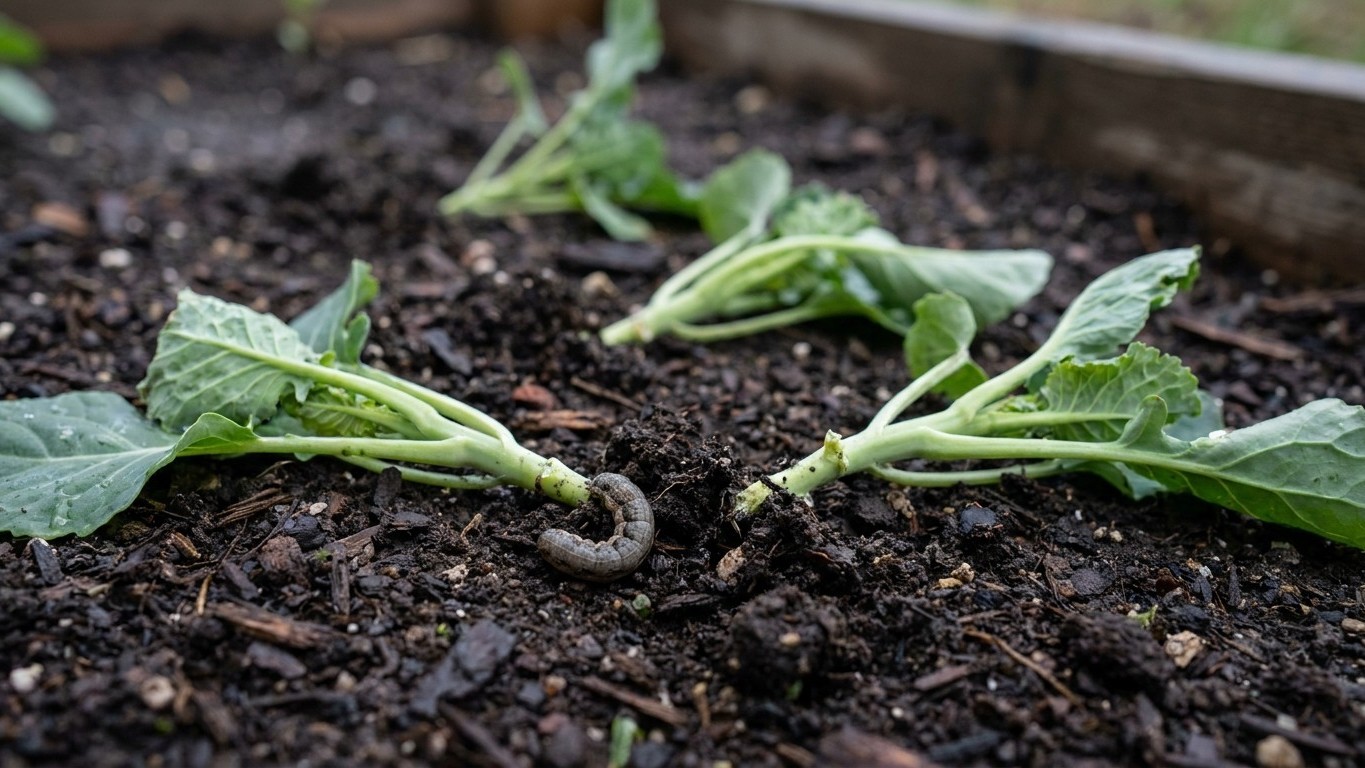

Cutworms show up in Alaska gardens once soil temperatures climb into the 50s, which usually means mid-to-late May in Anchorage and the Matanuska-Susitna Valley, and closer to early June in Fairbanks and the Interior. Unlike warmer states that deal with two or three overlapping generations a season, Alaska’s short growing window limits most cutworm species to a single generation per year. The larvae feed at night, sever seedling stems at the soil line, and then hide during the day, which is why so many gardeners find a row of toppled cabbage or broccoli transplants with no visible culprit in sight.
What’s Actually Chewing Through Your Seedlings

Cutworms aren’t a single species. The name covers the larval stage of several moths in the Noctuidae family, and in Alaska the most commonly reported culprits are variegated cutworms and army cutworms, both of which tolerate cold soil better than their southern relatives. The caterpillars are usually 1 to 2 inches long, dull gray or brown, and curl into a tight C-shape when disturbed, a habit that gives the group its common name.
What makes them frustrating for Alaska growers specifically is timing overlap. The state’s compressed planting season means gardeners are often setting out transplants right as overwintered larvae wake up and start feeding, so there’s no gap between “seedlings go in the ground” and “cutworms are hungry.” In the Lower 48, staggered planting dates sometimes let gardeners dodge peak activity. Alaska’s short window doesn’t offer that luxury.
When Cutworms Show Up in Alaska
Most cutworm species overwinter as partially grown larvae buried a few inches into the soil, sometimes below the frost line where the ground stays just warm enough to keep them alive through winter. As soil temperatures rise past roughly 50°F, they resume feeding close to the surface. That threshold typically arrives:
- Mid-to-late May in the Matanuska-Susitna Valley and Anchorage bowl
- Late May to early June in the Fairbanks area and Interior
- Slightly earlier, often by a week or two, along the milder Kenai Peninsula and Southeast coastal areas
Feeding activity peaks through June and into early July, right when transplants are still tender and root systems haven’t had time to establish. Because Alaska’s long summer daylight speeds up plant growth dramatically, there’s a narrow window where a cutworm can do outsized damage before a seedling gets tough enough to shrug off a nibble. By late July, most larvae have pupated, and adult moths that emerge in August lay eggs that will overwinter as the next generation’s larvae, resetting the cycle for the following spring.
Cool, wet springs tend to push activity later and compress it into a shorter window, while an early thaw can mean cutworms are already active before most gardeners have even hardened off their starts.
Where the Damage Concentrates
The Matanuska-Susitna Valley, famous for its giant cabbages and long-daylight vegetable growth, sees some of the state’s most consistent cutworm pressure simply because so much brassica and root crop gardening happens there. Broccoli, cabbage, kale, and young corn are frequent targets, and the valley’s loamy, well-drained soils happen to be exactly the kind of ground cutworms prefer for overwintering.
Fairbanks and the Interior report damage more sporadically, often tied to unusually warm springs that wake larvae up early. Because Interior soils freeze deeper and stay cold longer, cutworm populations there tend to be smaller but can still wipe out a row of seedlings overnight when conditions line up.
Southeast Alaska’s wetter, more temperate climate supports different pest pressures overall, but home gardeners in Juneau and Sitka still report occasional cutworm damage in raised beds, particularly where grass or weedy borders sit close to vegetable plots. Cutworms lay eggs in grassy areas, so a lawn edge or fallow patch next to a garden bed is often the source of the next season’s problem.
Signs You’re Dealing With Cutworms, Not Something Else
The telltale sign is a seedling stem cleanly severed at or just below soil level, with the top of the plant lying nearby, sometimes partially eaten. That distinguishes cutworm damage from slug damage, which leaves ragged, irregular holes in leaves rather than a clean cut at the base. Digging an inch or two into the soil around a damaged plant, especially in the evening or early morning, often turns up the curled larva hiding just below the surface.
What Stops Cutworms in Alaska Gardens
Physical barriers work better against cutworms than almost any other control method, and they’re especially practical for Alaska’s smaller-scale home gardens and raised beds. A collar made from a cardboard tube, a cut-open aluminum can, or a plastic cup with the bottom removed, pushed an inch into the soil around each transplant stem, blocks larvae from reaching the plant at ground level. This single step is often enough to protect an entire row of brassica transplants through their most vulnerable weeks.
Fall tillage matters more in Alaska than gardeners might expect. Turning over garden soil in September or October, after harvest but before hard freeze, exposes overwintering larvae to birds and to the cold itself, reducing the population that survives to feed the following spring. This is a low-effort step that pays off months later.
Diatomaceous earth, sprinkled in a ring around seedling stems, works as a mechanical barrier that damages the soft-bodied larvae on contact. It needs reapplication after rain, which in Southeast Alaska’s wetter climate can mean fairly frequent touch-ups, but in the drier Interior and Mat-Su Valley it holds up longer between applications.
Biological controls have a place too. Bacillus thuringiensis var. kurstaki, sold under several commercial names as Bt, targets caterpillar pests including cutworms when applied to soil and lower plant stems in the evening, close to when larvae become active. It breaks down in sunlight and needs reapplication after rain, but it doesn’t harm beneficial insects, birds, or pets, which makes it a reasonable option for home gardens near play areas or pet runs.
Keeping garden borders mowed and weed-free removes the egg-laying sites that draw female moths in the first place. Since Alaska gardens often sit adjacent to lawn, brush, or undeveloped lots, a simple mowed buffer strip can meaningfully cut down on the following year’s cutworm population without any chemical input at all.
Encouraging birds pays off more than most gardeners realize. Robins, thrushes, and other insect-eating songbirds actively hunt cutworms exposed during fall tillage or spring bed preparation. Leaving a section of turned soil exposed for a day or two before planting, rather than immediately covering it with mulch, gives birds a window to pick off larvae before they can burrow back down.
For larger plots or repeat problem areas, beneficial nematodes applied to soil in spring, once soil temperatures reach the mid-50s, can reduce larval populations before they reach damaging size. They’re most effective in consistently moist soil, which suits raised beds and irrigated garden rows better than dry, sandy patches.
Timing Your Defense to Alaska’s Season
Because Alaska’s growing season leaves so little margin for error, the most effective approach combines fall prevention with spring protection rather than relying on either alone. Tilling exposed soil in autumn, adding physical collars at transplant time in late May or early June, and checking beds nightly for the first two to three weeks after planting covers the period when cutworm damage is most likely and most costly. Once seedlings develop a woody stem base, usually a few weeks after transplanting, they become far less vulnerable, and the threat largely passes until the following spring’s cycle begins again.