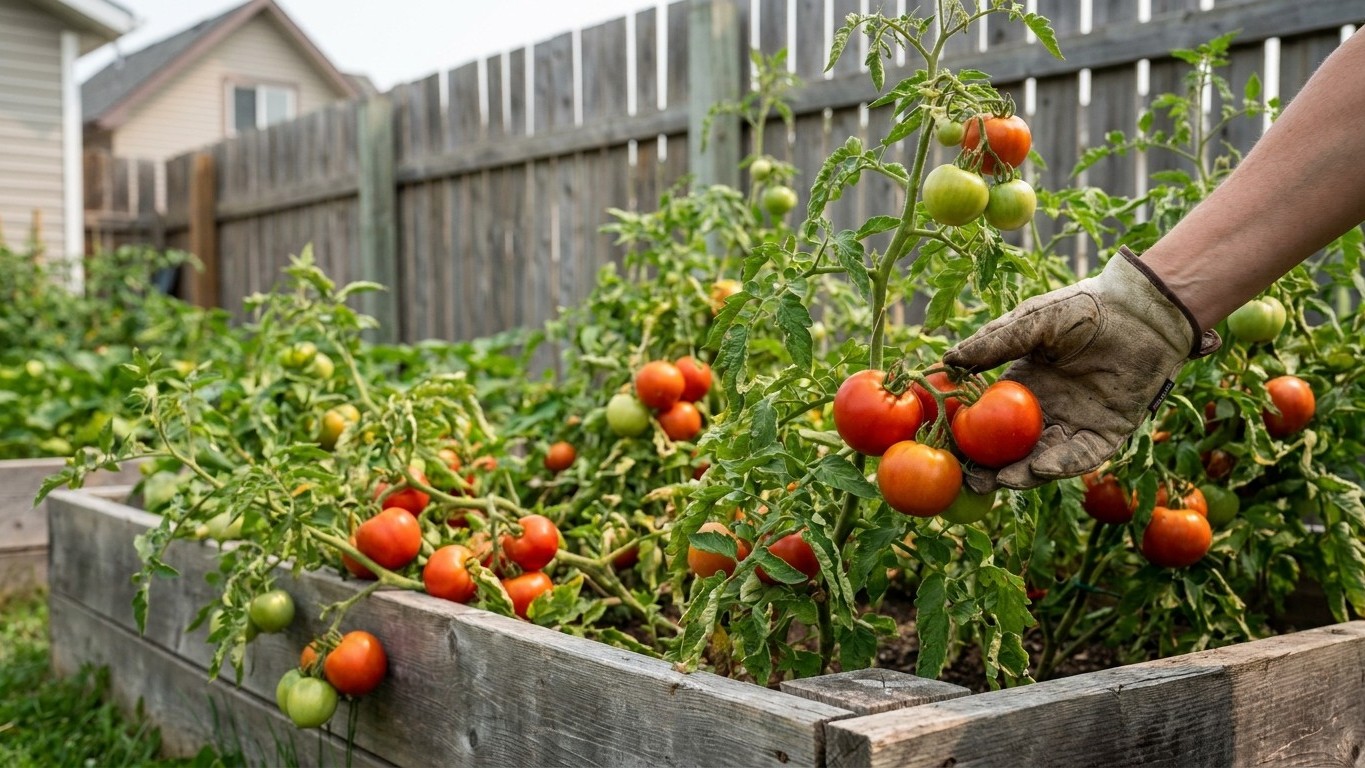

Environment and Climate Change Canada’s 1981-2010 climate normals for the Calgary Int’l A station put the average last spring frost at May 21 and the average first fall frost at September 16, which works out to roughly 118 frost-free days in a typical year. That means only tomatoes rated in the 55 to 68 day range from transplant have real margin to ripen a full crop here. Pick from that end of the maturity range before you pick for flavor.
What this comes down to in Alberta

In Alberta, the deciding factor for a tomato variety is not flavor or size. It’s whether it can finish before the season closes. Environment and Climate Change Canada’s 1981-2010 climate normals for the Calgary Int’l A station put the average last spring frost at May 21 and the average first fall frost at September 16, a frost-free window of roughly 118 days in a typical year. That May 21 date is a mean, not a guarantee: frost arrives later than that in about half of all years, and earlier in the other half, so a warm week in mid-May is not proof the risk has passed. Treat early June as the realistic transplant point for tomatoes set outdoors here, and count forward or backward from that using the variety’s days-to-maturity figure.
The catalogue figures below are counted from transplant, not from seed, and they shift by a week or two with the weather each season. The nine varieties are ordered from the shortest season to the longest, so you can see exactly where your own risk tolerance runs out.
Sakura
Sakura needs about 55 days from transplant, an indeterminate cherry tomato bearing small, round, red fruit in long clusters. Set out in early June, it is projected to start ripening in late July, leaving roughly 49 days of margin before the September 16 average frost. It carries resistance to nematodes, tomato mosaic virus and two races of fusarium wilt.
Glacier
Glacier is also a 55-day variety but a determinate one, a compact bush that carries small, slightly ribbed red fruit around two ounces. Its determinate habit concentrates the harvest into a shorter window rather than trickling fruit all season, which suits a gardener who wants one main picking for canning rather than a long dribble.
Sun Gold
Sun Gold needs about 57 days from transplant, two days past the shortest group, and produces small, round, golden-orange cherry fruit on a vigorous indeterminate vine. An early June transplant still projects a late-July first ripe fruit and 47 days of margin, with high resistance to tobacco mosaic virus and fusarium wilt race 1.
Juliet
Juliet takes 60 days from transplant and produces oblong, red, grape-shaped fruit, larger than a true cherry tomato, on an indeterminate vine that keeps bearing until frost. Early June transplants should start ripening in early August, leaving 44 days of margin, with intermediate resistance to both late blight and early blight.
Amalfi
Amalfi is a 68-day determinate paste tomato, producing elongated red fruit built for sauce and canning. An early June transplant puts first ripe fruit in mid-August, with 36 days of margin, and it carries intermediate resistance to nematodes, late blight and early blight, the broadest disease package on this list.
Cherokee Purple
Cherokee Purple is a 72-day indeterminate heirloom, producing large fruit with dusky purple-pink skin and darker shoulders, grown for flavor rather than disease resistance since it carries none of the resistance codes on this list. Set out in early June, it projects a mid-August first ripe fruit and 32 days of margin, tight enough that a cold, late spring pushes it close to the September 16 average frost.
Big Beef Plus
Big Beef Plus needs 72 days from transplant and produces large, round, red beefsteak fruit on an indeterminate vine, with the same mid-August ripening projection and 32-day margin as Cherokee Purple. It carries resistance to nematodes, gray leaf spot and tomato mosaic virus, which makes it the sturdier choice at this length of season.
Granadero
Granadero needs 75 days from transplant and produces elongated, blocky red roma-type fruit for sauce, with a projected mid-August start and only 29 days of margin. It carries resistance to nematodes, verticillium wilt and tomato mosaic virus, but the narrow margin means a late frost can still catch part of the crop unripened.
Celebrity Plus
Celebrity Plus needs 78 days from transplant, the longest on this list, and produces medium-large, round, red slicing fruit on a determinate bush. It is projected to reach first ripe fruit in late August, leaving 26 days of margin, the thinnest cushion of any variety here, though its resistance to nematodes, gray leaf spot and tomato mosaic virus gives it a better chance of filling that window than an unprotected variety would.
Working it out for your own garden
The method matters more than any single number, because it still works if you move to a different county or hit a colder year. Start from the frost window, Not the Calendar date you’d like to use. Environment and Climate Change Canada’s Calgary normals give a mean last spring frost of May 21, and growers typically wait a stretch past that mean before setting tomatoes outdoors, to let soil and night temperatures settle rather than gamble on the average holding. That is where the early-June transplant point used above comes from. For the exact reasoning behind that gap, the Tomato Planting Dates in Alberta: Counting Back From Your Frost Window page walks through it in more detail than fits here.
Once you have a transplant date, days-to-maturity does the rest of the work. Take Sakura, rated 55 days from transplant. Setting it out in early June projects first ripe fruit in late July, which leaves 49 days before the September 16 average first fall frost. That is a wide enough cushion to absorb a cool week or two without losing the crop. Now take San Marzano II, rated 78 days from transplant, the longest figure on the full cultivar list for this state. The same early-June transplant date pushes projected first ripe fruit to late August, only 26 days ahead of the same September 16 average. Because that frost date is itself a mean, arriving earlier than September 16 in about half of all years, a cool or early-frost season can catch the last fruit on that vine still green.
Comparing the margin across varieties
Laid side by side, the gap between a 55-day and a 78-day variety is not small once you account for a frost date that moves in either direction from year to year.
| Variety | Days from transplant | Type | Projected first ripe | Margin before average frost |
|---|---|---|---|---|
| Sakura | 55 | Indeterminate cherry | Late July | 49 days |
| Sun Gold | 57 | Indeterminate cherry | Late July | 47 days |
| Juliet | 60 | Indeterminate grape | Early August | 44 days |
| Amalfi | 68 | Determinate paste | Mid August | 36 days |
| Big Beef Plus | 72 | Indeterminate slicer | Mid August | 32 days |
| Granadero | 75 | Indeterminate paste | Mid August | 29 days |
| Celebrity Plus | 78 | Determinate slicer | Late August | 26 days |
The mistakes this state punishes

The most common mistake is transplanting on the strength of a warm week rather than the actual frost risk. A stretch of mild days in early or mid May does not mean the last frost has passed. Since May 21 is only the average at the Calgary Int’l A station, going out earlier than that in a colder-than-normal year exposes tender transplants to a frost the calendar hasn’t ruled out yet. Hardening off transplants gradually, covered in our guide to growing tomatoes in Alberta, does not fix a transplant date chosen too early.
The second mistake is picking a variety for its reputation rather than its days-to-maturity figure. A 78-day tomato that ripens reliably in a longer growing region can still fail to fill out here, not because the plant is unhealthy but because the season closes on it. Anything past about 70 days from transplant is working with a margin under 35 days against the September 16 average frost, and that margin shrinks further in a year when frost arrives early or the spring runs cool and delays transplanting past early June.
The third mistake is losing the transplant window itself while waiting for perfect conditions. Every week a transplant date slips past early June eats directly into the margin shown in the table above, and for a variety already sitting at 26 to 29 days of cushion, a two-week delay is the difference between a full harvest and a windowsill of green tomatoes pulled ahead of frost.
Checking this against your county
Every figure above comes from one station, Calgary Int’l A, and Environment and Climate Change Canada’s own normals make clear that a province this size is not one climate. Counties north of Calgary, at higher elevation, or closer to the foothills typically see a shorter frost-free stretch than the 118 days used in these calculations, while some southern pockets may run slightly longer. Treat the Calgary figures as a starting point, not an instruction, and confirm the local frost record with your own county’s agricultural office. Alberta’s Ministry of Agriculture and Irrigation, at alberta.ca/agriculture-and-irrigation, is the place to start for local extension contacts and provincial tomato guidance.
Common questions
Why did my tomato take longer to ripen than the days-to-maturity on the packet?
Catalogue days-to-maturity figures are counted from the day of transplant, not from seed, and they assume fairly steady warm conditions after that. A cool June or a stretch of cloudy weather in July can push the real ripening date a week or two past the catalogue number, so treat those figures as ranges rather than fixed dates.
Is it worth growing a 78-day tomato in Alberta at all?
It can work in a normal or warm year, but the margin is thin. Celebrity Plus and San Marzano II both sit around 26 days of cushion before the September 16 average frost, so a cool spring or an early fall frost can leave the last fruit unripe. Pairing a long-season variety with a shorter one hedges against a bad year.
Are cherry tomatoes a safer bet here than big slicers?
Generally yes, simply because the shortest catalogue days-to-maturity figures tend to belong to cherry and grape types like Sakura, Sun Gold and Juliet. That is a function of fruit size and breeding, not a rule that all cherry tomatoes ripen faster, so it is still worth checking the specific variety’s days-to-maturity rather than assuming by type.
What does a resistance code like “HR” or “IR” on a seed packet actually mean?
High resistance means the variety strongly suppresses a specific disease under normal pressure, while intermediate resistance means it suppresses the disease but can still show some symptoms under heavy pressure. Neither code means the plant is immune, and resistance is specific to the named disease only, not a general guarantee of health.