
Alberta’s growing season runs barely five months, from late May to mid-September in most zones, and that compressed window shapes which pests actually matter here. Cutworms and flea beetles hit hard in spring when seedlings are most vulnerable. Aphids and cabbage worms build through June and July. Grasshoppers peak in dry, hot stretches of late summer. And because winters routinely drop below -20°F across the province, several pests common in milder climates simply can’t survive here year-round, which is one reason Alberta gardens face a shorter but more concentrated pest calendar than gardens in, say, coastal regions.
Understanding that timeline, and matching your response to it, matters more in Alberta than almost anywhere else in Canada. Miss the two-week window when flea beetles emerge, and you’re fighting a losing battle for the rest of the season.
The Alberta Pest Calendar: What Arrives When

Spring in Alberta (late April through early June) belongs to soil-dwelling pests that overwintered as larvae or eggs. Cutworms are the classic early offender, chewing through transplants at the soil line so fast a healthy seedling can be gone overnight. Wireworms, the larval stage of click beetles, tunnel into root vegetables and can persist in soil for two to five years, making them a multi-season problem rather than a one-time nuisance.
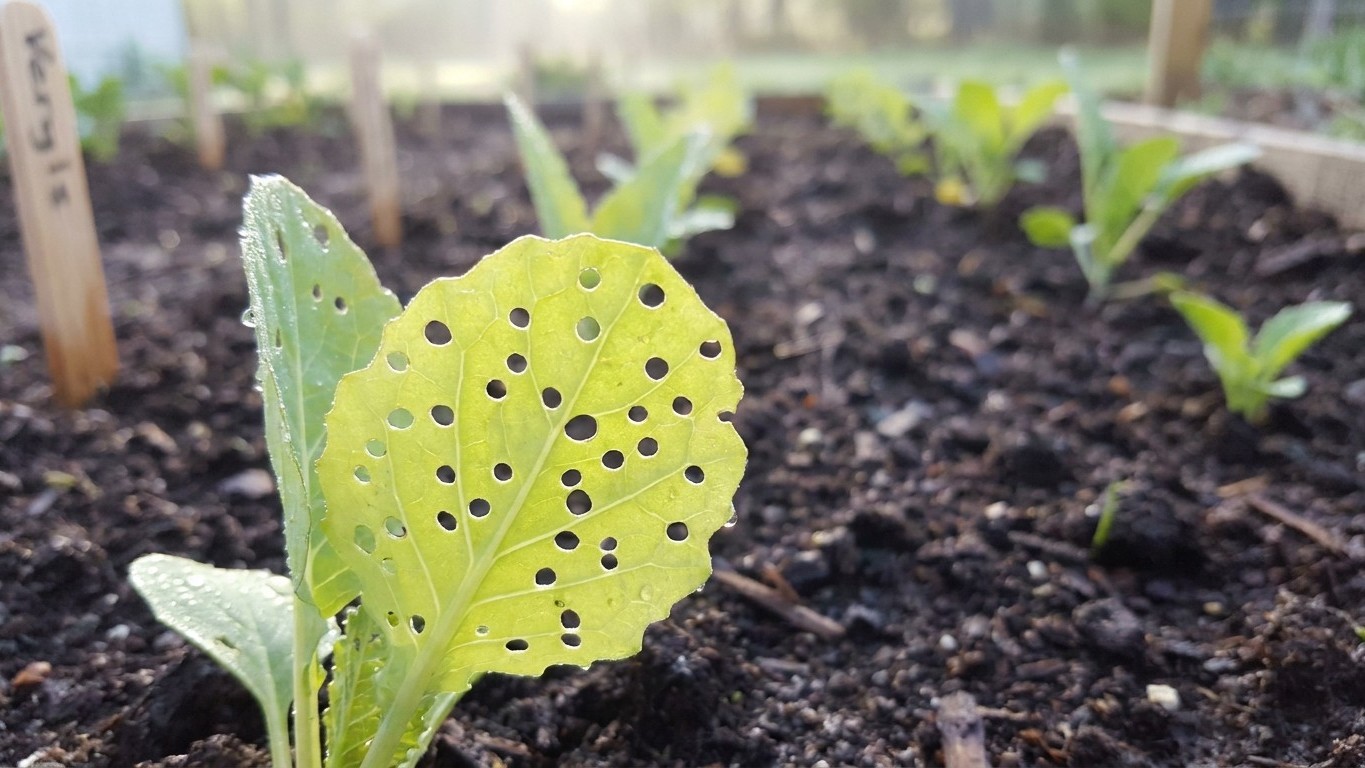
By early summer, flea beetles show up on brassicas, canola-family plants, and even ornamental cabbage, leaving telltale “shotgun holes” in leaves within days of emergence. This is also when root maggots lay eggs at the base of radishes, turnips, and cabbage, a pest that thrives in Alberta’s cooler, moist spring soil.
Midsummer (July into August) is aphid and cabbage worm season. Aphid populations can explode in as little as a week under warm, dry conditions, especially on peas, beans, and roses. This is also when Thrips in Alberta that gardeners often overlook can begin damaging leaves and flowers, silvering foliage and distorting new growth. Cabbage white butterflies lay eggs on brassica leaves, and the resulting green caterpillars can strip a cabbage patch before most gardeners even notice the adults fluttering around.
Late summer brings Grasshoppers in Alberta that gardeners dread, favoring the province’s drier southern and central regions and tending to surge in years following mild winters and dry springs. It’s also when the Brown marmorated stink bug Alberta gardeners increasingly report becomes more active, seeking out ripening fruits and vegetables before cooler weather sets in. This is also the season when swarms of Social wasps Alberta gardeners contend with become more active, drawn to ripening fruit and outdoor activity, alongside Miller moths Alberta residents notice around porch lights and windows, migrating through the province on their way to higher elevations. Alberta Agriculture has tracked grasshopper outbreaks tied directly to weather patterns, since eggs laid in fall survive better when snow cover is thin and soil doesn’t freeze as deeply.
The Pests That Actually Matter Here
Chewers and Cutters
Cutworms, cabbage worms, and grasshoppers make up the bulk of visible leaf and stem damage across Alberta vegetable gardens. Cutworms are nocturnal, curling into a C-shape when disturbed during the day, which is the easiest way to identify them if you dig around a severed seedling. A simple cardboard collar pushed an inch into the soil around each transplant stops cutworms cold, since the larvae can’t climb over the barrier.
Grasshoppers are trickier because they migrate in from surrounding fields rather than starting in your garden. Row covers installed before egg-laying season (typically by early July) offer the most reliable protection, since once grasshoppers are established in a yard, they’re difficult to remove without affecting beneficial insects too.
Sap Suckers
Aphids are Alberta’s most persistent sap-feeding pest, clustering on new growth and secreting honeydew that attracts ants and promotes sooty mold. A strong jet of water from a garden hose knocks most aphid colonies off a plant within a few sprays, and it’s often enough on its own for light infestations. Heavier populations respond well to insecticidal soap applied in the cooler part of the day, since soap sprays can scorch leaves in direct midday sun.
Ladybugs and their larvae are natural aphid predators already present in most Alberta gardens, and a single ladybug larva can eat dozens of aphids a day. Avoiding broad-spectrum insecticides preserves this free pest control, which matters more in a short growing season where you can’t afford to lose a month rebuilding a beneficial insect population.
Soil and Root Feeders
Root maggots and wireworms operate underground, so damage often isn’t obvious until you pull a plant and find tunneled, scarred roots. Crop rotation is the single most effective long-term defense, since both pests build up in soil where the same host crops (brassicas for maggots, potatoes and root vegetables for wireworms) are planted year after year. Alberta’s clay-heavy and chernozem soils in the central and Peace Country regions tend to hold moisture longer, which favors root maggot survival compared to the sandier soils found in parts of the southeast.
Why Alberta’s Climate Changes the Equation
Alberta’s dramatic swings, chinook winds that can spike temperatures 40°F in a day, followed by a hard freeze, create stress conditions that make plants more vulnerable to pests even when pest populations themselves aren’t unusually high. A plant weakened by an early frost or a sudden thaw-freeze cycle is easier prey for aphids and root maggots alike.
Regional differences within the province matter too. Southern Alberta’s drier, warmer summers favor grasshopper outbreaks and support multiple aphid generations per season. The Peace Country and areas around Edmonton, with slightly cooler and wetter conditions, see more root maggot and slug pressure instead. Foothill and mountain-adjacent gardens near Calgary often deal with a shorter frost-free window, which compresses the entire pest cycle into fewer weeks but doesn’t necessarily reduce total damage.
Alberta’s long, cold winters do provide one advantage: several pests that overwinter as adults in milder climates, including some slug and snail species common in coastal British Columbia, can’t establish permanent populations here. That’s a small silver lining in a province where the growing season already asks a lot of anyone trying to keep a vegetable patch alive.
Practical Control Strategies for Alberta Gardens
Timing beats intensity when it comes to pest control in a short season. Floating row covers installed at planting time block flea beetles, cabbage moths, and root maggot flies from ever reaching your plants, and they’re one of the few tools that work against multiple pests at once without chemicals. The covers need to come off before flowering on crops that require pollination, so timing removal correctly is part of the strategy, not an afterthought.
Crop rotation on a three-year cycle disrupts the life cycle of soil-dwelling pests like wireworms and root maggots, since both need their specific host plants present in the same spot repeatedly to build damaging populations. Even a small backyard plot benefits from rotating brassicas, root vegetables, and legumes through different beds each year.
A few habits make a measurable difference across an Alberta growing season:
- Inspect the undersides of leaves weekly starting in late May, since most infestations are caught early enough to manage without heavy intervention
- Remove garden debris and weeds in fall, which eliminates overwintering sites for cutworm eggs and aphid eggs alike
- Water in the morning rather than evening, since damp soil overnight favors slug activity and root maggot egg survival
- Plant a diverse mix of flowering herbs like dill and yarrow to attract predatory insects that keep aphid and cabbage worm populations in check
- Delay planting brassicas by even a week or two past the typical root maggot fly emergence window, which can reduce egg-laying pressure significantly
For persistent problems, especially wireworm populations that have built up over several seasons, some Alberta gardeners use trap crops like whole potatoes buried a few inches deep and dug up weekly to intercept larvae before they reach main crops. It’s slow, but it works without introducing any chemical controls into food-growing beds.
When Pest Pressure Signals a Bigger Issue
Recurring wireworm or root maggot damage year after year in the same bed usually points to a rotation problem rather than a pest population problem, and no amount of spraying fixes that without changing what’s planted where. Similarly, an aphid infestation that returns despite regular water sprays often means beneficial insect populations have been knocked down by a broad insecticide application earlier in the season, whether from your own garden or a neighboring property.
Grasshopper outbreaks tied to regional weather patterns are largely out of any single gardener’s control, but Alberta Agriculture and Forestry tracks provincial grasshopper forecasts each spring based on the previous year’s fall counts, which can help gardeners in high-risk areas decide whether row covers are worth the extra effort that season.
Other Pests Worth Knowing About
Alberta’s pest calendar isn’t limited to the usual suspects covered above — a few other visitors are common enough that it’s worth knowing what they are before they show up on your porch or in your garden. The brown marmorated stink bug hasn’t established the breeding populations here that it has in Ontario or British Columbia, so what you’re more likely to encounter are stray individuals rather than an infestation. Come spring, many Albertans notice a sudden wave of miller moths, which appear from mid-May through late June as the adult army cutworm moth leaves wheat and canola fields and starts flying at dusk in search of shelter — often finding it in homes. And through the warmer months, social wasps move through three distinct phases: queens scouting for nest sites in April and May, worker colonies building up through July, and food-seeking swarms turning aggressive from late August on. Each of these pages breaks down the timing and the fixes in more detail, so if one of these sounds like what’s bothering you, that’s the place to look next.