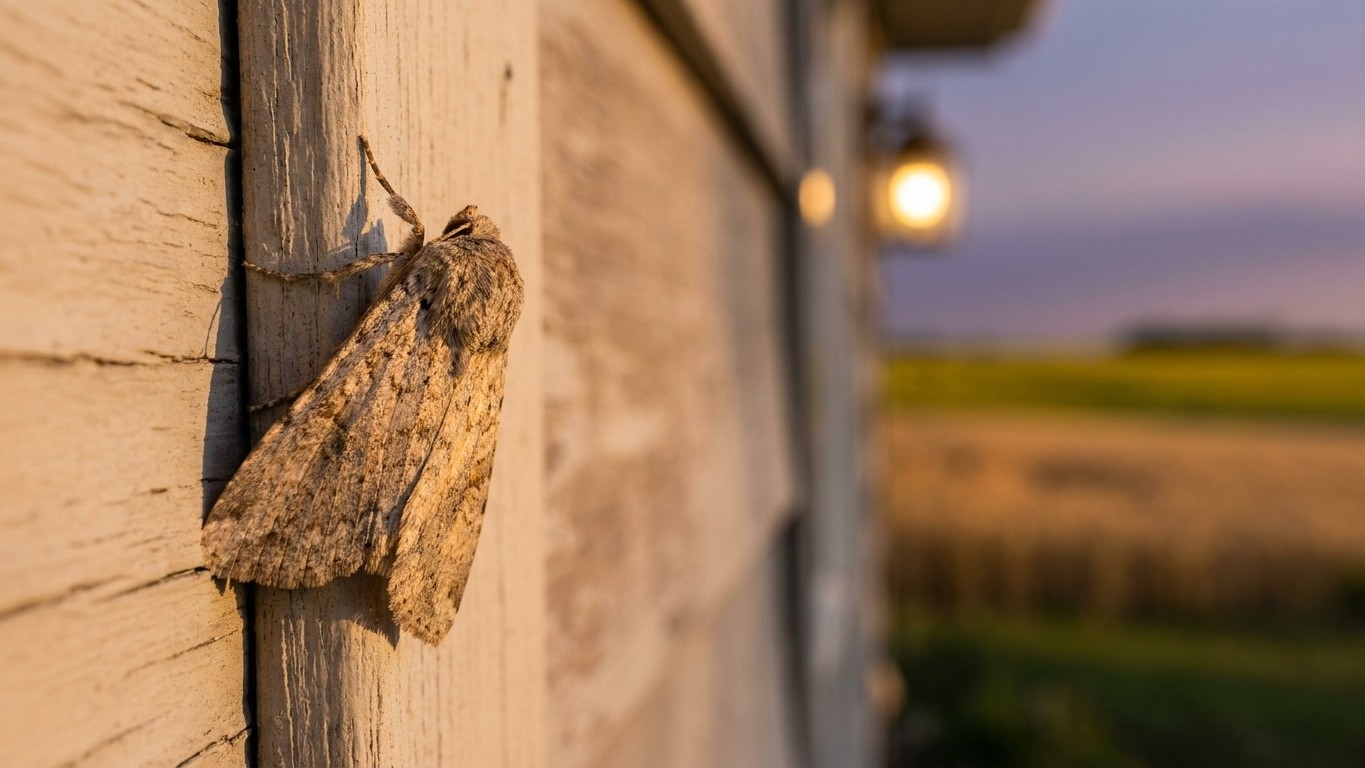

Miller moths show up across Alberta each spring, typically from mid-May through late June, when the adult stage of the army cutworm moth emerges from wheat and canola fields and starts flying at dusk looking for shelter and food. The swarms taper off by early July as the moths move toward cooler foothill and mountain areas for the summer, then some return briefly in September before winter. Sealing entry points, switching porch bulbs to yellow or sodium lights, and cutting back on outdoor lighting during peak weeks are the most effective ways to keep them from piling up on your siding and window screens.
Why Alberta Sees Miller Moths Every Spring

The moth that Albertans call a “miller” isn’t a distinct species on its own. It’s the adult form of the army cutworm (Euxoa auxiliaris), a caterpillar that spends the winter and early spring feeding on winter wheat, canola seedlings, and pasture grasses across the prairie provinces. Once that caterpillar pupates and emerges as a flying adult, it earns the “miller” nickname from the fine, powdery scales that rub off its wings, similar to flour dust on a mill worker’s clothes.
Alberta’s mix of cropland and grassland gives these insects exactly the habitat they need. Wide stretches of cereal and oilseed fields provide food for the larvae through fall and early spring, and mild spells during winter let some larvae keep feeding under snow cover instead of going fully dormant. That head start means a bigger emergence of adult moths once temperatures climb in May.
The Life Cycle Behind the Swarm
Understanding the timeline explains why the moths seem to disappear almost as fast as they arrive. Adult miller moths live for several weeks, and during that stretch they’re driven by two things: finding sugar-rich nectar to fuel flight, and finding a mate. Neither of those tasks has anything to do with your kitchen, but the moths end up there anyway because they’re strongly attracted to light and to small gaps that offer daytime shelter from birds and heat.
After the spring flight, many miller moths in regions near the Rocky Mountains shift toward higher, cooler elevations for the hottest part of summer, a behavior entomologists call aestivation. Alberta’s proximity to the foothills and mountain parks means a portion of the local population follows that same pattern, thinning out swarms in towns and cities by midsummer. The moths that stay behind or return in early fall are laying eggs in field soil, starting the cycle over for next year’s cutworm generation.
That fall return is usually smaller and shorter than the spring flight, often just a couple of weeks in September, but it can still send a wave of moths toward porch lights and garage doors as temperatures cool and outdoor food sources dry up.
What Attracts Miller Moths Into Homes
Light is the biggest draw, and it’s not subtle. Miller moths are strongly phototactic, meaning they fly toward light sources at night and then tend to rest nearby during the day. Porch lights, garage door sensors, and even the glow from a television through a window can pull moths in from a surprising distance. Once they’re near the house, any small crack around a window frame, vent, or door threshold becomes a convenient place to hide from sunlight and predators until dusk.
Food matters too, though less directly than light. Flowering plants near entryways, especially fragrant or brightly colored blooms, give the moths a reason to linger in your yard instead of passing through. Homes surrounded by winter wheat, canola, or hay fields tend to see heavier moth pressure simply because the larvae had more food nearby the previous fall and winter.
Moisture and warmth play a smaller role. Basements, crawl spaces, and attached garages offer stable temperatures that moths find appealing during the day, which is why a single evening of lights-on activity can translate into moths turning up indoors for days afterward if they found a gap to slip through.
Why They Seem Worse Some Years
Miller moth numbers swing noticeably from year to year, largely tied to weather during the fall and winter before the spring flight. A mild autumn that lets cutworm larvae feed longer, followed by a winter without deep, sustained cold, tends to produce a bigger spring emergence. Drought conditions in surrounding grain-growing regions can also push moths to disperse more widely in search of nectar, which sometimes means more of them showing up in towns that don’t normally see heavy activity.
What Actually Stops Miller Moths
Sprays and bug bombs generally underperform against miller moths because the problem is less about killing existing moths and more about controlling how many new ones get pulled toward your house night after night. The moths that die from contact insecticide are quickly replaced by the next wave flying in from the fields, so the smarter approach focuses on light management and exclusion.
Switching exterior bulbs to yellow “bug light” or high-pressure sodium bulbs cuts down on the wavelengths that attract moths most strongly. Motion-activated fixtures help too, since they stay dark most of the night instead of broadcasting a constant beacon. During peak weeks in late May and early June, even closing blinds or curtains after dark to block interior light from spilling outside can measurably reduce the number of moths gathering near windows.
Exclusion work matters just as much as lighting changes. Weatherstripping around doors, sealing gaps where utility lines enter the house, and repairing torn window screens close off the resting spots moths look for during daylight hours. Garage doors deserve particular attention since they’re often left open during warm evenings right when moth activity peaks, giving dozens of insects a direct path inside.
A few more practical steps round out the approach:
- Vacuum moths that get indoors rather than crushing them, since their wing scales can leave a greasy stain on walls and fabric.
- Trim back flowering plants and hanging baskets near entry doors during peak weeks to reduce nectar sources right at the threshold.
- Keep porch lights off when they’re not needed, or move fixtures away from doors so moths gather at a distance instead of right at the entrance.
- Check window screens and door sweeps each spring before the flight starts, since worn weatherstripping is one of the most common entry points.
None of these steps eliminate miller moths from the landscape, since the underlying population is tied to agricultural land use across the province rather than anything happening in an individual yard. What they do is cut the number of moths that end up inside your home or piled against your siding, which for most Alberta households is really the only part of the problem that matters.
When the Swarm Signals a Bigger Issue
Occasional moths indoors during peak season are normal and not a sign of a structural problem. But if moths are consistently finding their way into living spaces well after the spring flight has ended, or if you’re noticing cutworm damage in a home garden or lawn edge, that points to gaps in the building envelope or an active larval population close to the house rather than just seasonal migration. In those cases, a broader pest inspection focused on foundation gaps, vent screens, and soffit seals tends to solve the recurring problem faster than repeated attempts to manage the adult moths after they’ve already arrived.