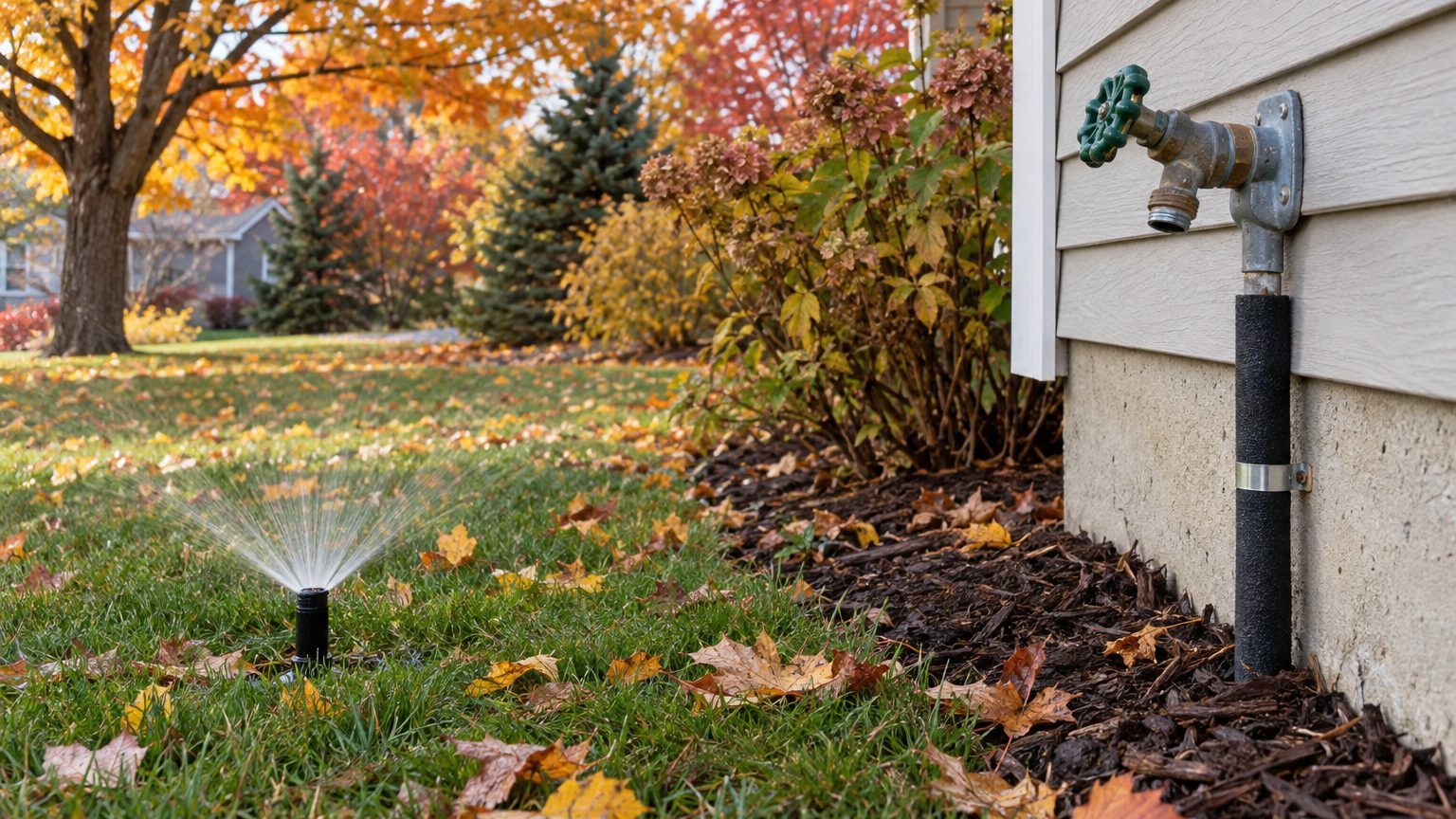

Across the Arizona low desert, there’s no fall date to circle on the calendar. NOAA’s 1991-2020 normals for Phoenix show no reliable fall freeze, so a full sprinkler blowout is often unnecessary there. In Flagstaff and the rest of the high country, the job is real and the clock is tight: finish draining before the first hard freeze, which arrives earlier the higher you live. Where your yard sits decides how much work you have.
When to do it in Arizona
In the high country, the window opens in early fall and closes ahead of the first hard freeze, and the rule is before the first hard freeze, not after the first light one. In the low desert there is no reliable first fall freeze to race, so a full blowout is often unnecessary, and what is worth doing is a short cold-night routine for exposed pipes and hose bibs.
Elevation draws the line. The USDA Plant Hardiness Zone Map 2023, which is built on a single variable (the average annual extreme minimum temperature), runs from 4b to 10b across Arizona. That is a statewide spread, not a zone for your street, so a neighbor 2,000 feet higher can be living a different winter. The direction never flips: the colder and higher the spot, the earlier the first fall frost, and the earlier the draining has to happen.
Low desert: what the Phoenix numbers say
NOAA’s 1991-2020 Climate Normals list the frost-free season at Phoenix as 365 days. The station’s daily records show 32°F reached in only 6 of 30 springs. The mean daily minimum of the coldest month is 45.3°F (an average of the lows, not the record low), so a typical winter night stays well above freezing.
Averages don’t cover the odd clear, still night, though. A few small habits cost nothing and fit the climate:
- Know where the irrigation system’s main shutoff valve is, so you can close it in seconds.
- Keep hoses unhooked from the spigots through the cooler months.
- Glance at the forecast on clear, calm evenings and cover exposed above-ground pipes and the backflow assembly when a near-freezing night shows up.
- Skip the full blowout unless you’re heading to higher country with the same plumbing.
High country: Flagstaff and above
Flagstaff and the high country freeze hard, and a frost-based calendar applies. Start watching the forecast in early fall and treat the first light frost as your warning shot, because it tells you the hard freeze is close. Do the work in the stretch between those two events. Waiting for the first hard freeze to confirm the season has turned means the pipes are already holding ice.
| Criterion | Low desert (Phoenix) | High country (Flagstaff) |
|---|---|---|
| First fall freeze | No reliable fall freeze (NOAA NCEI 1991-2020) | Hard freeze arrives each fall, earlier with elevation |
| Frost-free season | 365 days (NOAA) | Ends each fall with a hard freeze |
| Full sprinkler blowout | Often unnecessary | The standard fall job |
| Main task | Cold-night checks, hoses off | Drain or blow out, shut off, disconnect |
Sprinkler lines: drain or blow out
Water sitting in a pipe turns to ice when the temperature drops, and ice takes up more room than the water it came from. The pipe has nowhere to give, so it splits, usually along a seam, at a fitting, or at a valve body. Spray heads crack. Backflow assemblies, which sit above ground and take the most exposure, crack too. None of it shows until spring, when the system is pressurized again and water goes where it shouldn’t.
Three ways to clear the water
A manual drain uses low-point drain valves built into the system. You open them, the water runs out by gravity, and you close them again. It only works when the system was installed with enough slope to drain toward those valves.
Automatic drain valves do the same thing without you. When pressure in the line drops after the supply is shut off, they open and let the water out. They are convenient, but they can leave pockets in low spots, so they’re better than nothing and short of a guarantee.
A compressed-air blowout is the thorough option. A compressor connects to the system, and air pushes water out through the heads, one zone at a time. It clears more water than gravity can, which is why it’s the standard in cold climates. It also carries the most risk: too much pressure can burst fittings and heads, and air should never run through a zone that’s still closed off or with anyone leaning over a head.
What this climate calls for
In the low desert, a manual or automatic drain, or simply shutting off supply to exposed parts on a rare cold night, is generally enough. Most owners there keep the system running through winter on a reduced schedule. Lawn needs shift in the cooler months, which is covered in Winterizing a Lawn.
In Flagstaff and other high-country yards, plan on blowing out the lines between the first light frost and the first hard freeze. Shut the supply valve, open any manual drains, then clear each zone with air. Closing a valve is something any homeowner can do. Running a compressor through buried lines is a different level of risk.
A professional is the sensible choice in a few situations. One is a system with no drain valves and a long run of buried pipe. Another is a setup you can’t map, where you don’t know how many zones there are or where the low points sit. A third is equipment you don’t own or haven’t used, since a rented compressor with no pressure control can do more harm than the freeze it’s meant to prevent. In the high country, where one missed zone can mean a cracked line, hiring it out is cheap insurance.
Outdoor faucets and hoses
Outdoor faucets give up first. They sit on the exterior wall, closest to the cold, and the pipe behind them is short enough to freeze through. The routine is a few valve turns and no tools beyond your hands.
Start by disconnecting every hose, along with splitters, timers and sprayers. Next, find the interior shutoff valve for that faucet, usually in a basement, crawl space or utility closet, and close it. Then open the outside tap and leave it open so whatever remains in the pipe can drain. Coil the hose and store it somewhere it won’t hold water.
Many Arizona homes, especially in the low desert, have no interior shutoff for outside faucets at all. If you can’t find one, leave the faucet closed, keep the hose off, and watch for cold nights. Adding a shutoff is plumber work, not a weekend project.
Why a frost-free faucet still fails with a hose attached
A frost-free outdoor tap has a long stem that places the actual valve inside the warm side of the wall. When you shut it off, the water in the barrel drains out through the spout, as long as the faucet tilts slightly downward. Hook up a hose and that drainage stops. Water stays in the barrel, the spout is sealed, and a freeze turns the exposed section to ice. The fault is in how it’s used, not in how it’s built.
A full walkthrough for colder situations lives in Winterizing Outdoor Faucets Before the First Freeze. For Arizona, the sorting is simple. In the high country, disconnect every hose before the first hard freeze, between the first light frost and that hard freeze at the latest. In the low desert, keep hoses unhooked through the cooler months and let a clear, near-freezing forecast be your reminder.
Stop at the valves. If a faucet drips after it’s closed, if the stem won’t turn, or if you suspect a faucet already split, call a plumber. Anything beyond turning a valve or removing a hose is licensed work.
What goes wrong here
The early cold snap tops the list. In the high country, the first hard freeze can land before a single chore is done, because the light frost that should have prompted action passed unnoticed. In the low desert the problem is the reverse: a 32°F night is rare enough (6 springs in 30 at Phoenix, per NOAA’s daily records) that few people have a routine for it. The one night that gets through is the one nobody prepared for.
The forgotten hose is next. A hose left on a spigot traps water in the faucet barrel, and the freeze splits the pipe behind the wall rather than the visible spigot. You won’t see anything wrong until spring, when you turn the tap and water sprays inside the wall. The sign is a wet interior wall, a stain on the ceiling below, or a spigot that runs hard and doesn’t stop. If a freeze does reach a pipe, Frozen Pipes covers what to do next.
The flooded valve box is quieter. Sprinkler valves sit in buried boxes, and water that collects there can freeze around the valves in colder areas or simply sit and degrade fittings. In spring, a cracked valve shows up as a zone that won’t shut off, a zone that never comes on, or a wet patch near the box. Keep lids on, clear debris and standing water, and drain the valves along with the lines.
The prevention rhythm is short. Walk the yard and check every hose bib and valve box before the first forecast freeze, and in the high country do it between the first light frost and the first hard freeze. Other seasonal jobs are covered in the Arizona guides.
Common questions
Do I need to winterize my sprinkler system in Phoenix?
A full winterization usually isn’t necessary. NOAA’s 1991-2020 normals list Phoenix’s frost-free season at 365 days, and the coldest month’s mean daily minimum is 45.3°F. Know where your shutoff is, keep hoses off the faucets, and protect exposed pipes on the rare near-freezing night.
How do I know the first hard freeze is coming in the high country?
Watch the National Weather Service forecast from early fall. A freeze watch or warning means it’s time to finish, and the first light frost is the signal to start. Colder, higher spots get both earlier, so the chores move earlier as you climb.
Can I blow out my sprinkler lines myself?
You can if you have the right equipment, know your zones, and can control air pressure. Too much pressure can split fittings and crack heads. If the system has no drain valves, the layout is unclear, or you’ve never done it, a professional is the safer call.
Is a frost-free faucet enough on its own?
Only with the hose off. The design drains the barrel through the spout, and a connected hose blocks that, so water freezes in the exposed section. Disconnect hoses every time, and leave the spout open to drain on any night a hard freeze is forecast.
One more thing about the high country: a freeze that cracks a pipe in October often won’t show until the system is pressurized the following spring, so the damage is easy to blame on the wrong season.