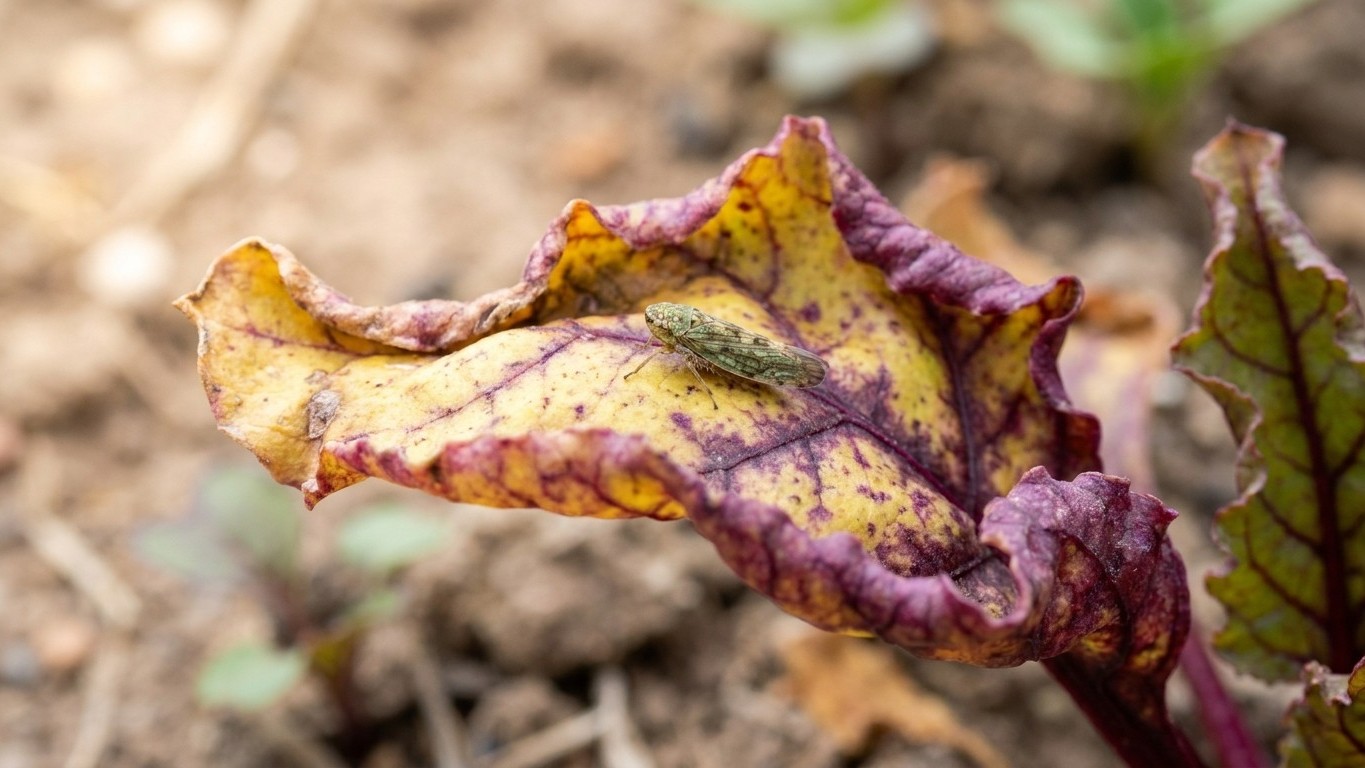

Beet leafhopper doesn’t wreck a garden by chewing it up. It shows up quietly in spring, feeds for a few minutes, and leaves behind curly top virus, a disease with no cure. In Arizona, the window to act is short, and it closes before most gardeners even notice the insect was there.
When Beet leafhopper turns up in Arizona

The University of Arizona Cooperative Extension publishes a seasonal guide to garden pests for the state, but it doesn’t set aside a specific window for beet leafhopper the way it does for some other insects. That guide notes that thrips and false chinch bugs peak in spring and decline once summer heat climbs above the 90s in June, that green fruit beetle adults emerge in summer, that grasshoppers hatch in spring, and that squash bugs lay eggs from early spring into midsummer. Beet leafhopper isn’t named in that list, so there’s no official local window to quote for it directly.
What gardeners can lean on instead is the general pattern that guide describes for spring-active insects across the state: activity builds as temperatures warm in late winter and early spring, then tapers once the heat becomes extreme in June. Beet leafhopper is well documented elsewhere as an insect that follows a similar rhythm, moving off drying wild vegetation and into cultivated gardens as spring vegetation cures out. That means the highest-risk stretch for Arizona gardens sits in that same early-to-mid spring window the extension service already flags for other spring pests, even without a dedicated line item for this species.
The honest takeaway is that Arizona’s local source names the pattern, not this exact pest. Treat the spring-into-June decline as the working model, and watch new transplants closely during that stretch rather than waiting for a published date that doesn’t exist yet in the local record.
Reading the calendar from your last frost
In most of the country, gardeners plan around the last spring frost. Arizona’s low desert breaks that rule. NOAA’s 1991-2020 climate normals for the Phoenix-area station show a frost-free season of 365 days, and daily records confirm that a 32F reading only happened in 6 of the last 30 springs, usually as a brief cold snap between late December and mid-January rather than anything predictable in spring. There simply isn’t a reliable frost date to count backward from in the low desert. Flagstaff and the high country are a different climate entirely, with hard freezes that do shape planting decisions, but that calendar doesn’t apply to Phoenix, Tucson, or similar low-desert zones.
Beet leafhopper doesn’t answer to a frost date anyway. It answers to soil and air warming, which is why an early or late spring shifts its arrival regardless of what the calendar says. Instead of counting weeks from a frost that may never come, the more useful marker is the same one the extension service uses for other spring pests: early warmth pulls the insect in, and the arrival of sustained heat past the 90s in June pushes it back out.
For row covers, that means the practical schedule follows the plant, not the frost. Covers go on at transplanting, while the weather is still mild, and they need to stay in place through the early weeks of establishment, since that’s the stretch when the insect is most active and the plant is most vulnerable. Once June heat sets in, leafhopper activity naturally falls off, which is also when many low-desert crops are winding down anyway.
What it attacks, and what the damage looks like
The insect itself is easy to miss. It’s small, wedge-shaped, and jumps rather than crawls, which means most gardeners never actually see it before the damage shows up. What they do see is a plant that looks sick in a way that doesn’t match drought stress or nutrient trouble: leaves curl upward and inward, turn a dull yellow or bronze, and the whole plant takes on a stiff, stunted look. In tomatoes, that often shows as a sudden, uniform curling of the upper leaves and a plant that stops growing almost overnight. In beans, beets, spinach, melons, and peppers, the pattern is similar, thickened, brittle leaves and stunted growth that spreads through the plant within days.
That symptom set is curly top virus, and beet leafhopper is its vector. The insect doesn’t need to feed heavily to cause damage. A brief feeding period is enough to inject the virus into the plant’s vascular system, after which the insect can move on while the disease keeps spreading internally on its own.
Adults do the bulk of the damage because they’re the mobile stage, flying in from wild host plants and moving freely between garden rows before anyone notices them. By the time the curling and yellowing show up, the virus is already established inside the plant, which is why treating the visible symptoms does nothing. Nothing sprayed on the leaves at that point reverses an infection that’s already systemic.
How Arizona sits in this pest’s range

This site currently documents Beet leafhopper in 2 territories, which is a narrow footprint compared to pests that show up across a dozen states or more. A range that small usually means one of two things: the insect’s distribution genuinely is limited, or the documentation for it is still thin in places where it likely occurs but hasn’t been formally logged. Either way, Arizona sitting inside that count puts it near an edge of what’s currently published here, not in the middle of a well-mapped range.
No neighboring territory’s data was cited as the source for Arizona’s guidance in the material available here, so there’s no borrowed figure to flag. What can be said plainly is that Arizona’s own local source, the University of Arizona Cooperative Extension, doesn’t rank the severity of beet leafhopper pressure or compare it against other states, and neither should this article. A narrow documented range is a statement about how many territories have published guidance, not a measure of how bad the problem is in any one of them.
For a home gardener, the practical read is simple: Arizona is one of only two places this site currently tracks this pest, so local, state-specific guidance is limited, and general beet leafhopper biology from wherever it’s been studied is doing more of the work here than a deep bench of Arizona-specific research.
What actually works against it
The available defenses line up from cheapest to most involved, though none of them can undo an infection once it happens.
- Timing transplants early: getting plants into the ground and past their most tender early weeks before the spring migration peaks reduces the window during which they can be fed on at all, though the insect’s arrival shifts with the weather each year so this isn’t a guarantee.
- Row covers: a physical barrier between the insect and the plant means no feeding and no virus transmission, but that protection only holds while the cover stays on and sealed, since a single leafhopper getting underneath a torn or gapped cover can transmit the virus in one brief feeding.
- Clearing garden debris and managing weedy margins: this matters because beet leafhopper builds up on wild vegetation nearby and moves into cultivated beds once that vegetation dries out or gets disturbed, so mowing or removing weedy borders reduces the population sitting next door to the garden.
- Hand-picking and crop rotation are not realistic options: the insect jumps the instant it senses movement and has usually already fed and moved on by the time it’s spotted, and rotation does little against a flying vector that arrives from outside the garden each season rather than overwintering in the soil.
None of these measures do anything once curly top virus is inside a plant, since there’s no way to spray, cut, or treat a plant back to health once the virus has spread through its vascular system. At that point, the only useful step is pulling the infected plant to keep it from serving as another source the insect can feed on before moving to its neighbors.
Common questions
Can beet leafhopper survive Arizona’s summer heat?
The general pattern the extension service describes for other spring pests, activity falling off once temperatures push past the 90s in June, applies to beet leafhopper as well. Extreme summer heat in the low desert isn’t hospitable to the insect or its wild host plants, which is part of why the risk window sits in spring rather than year-round.
Is there a treatment once a plant shows curly top symptoms?
No. Once the curling, yellowing, and stunting appear, the virus is already established inside the plant’s tissue. Removing the infected plant is the only step that helps, since it stops that plant from being a source the leafhopper can feed on and spread further.
Does row cover need to stay on all season?
Not necessarily, but it needs to stay sealed through the early spring weeks when transplants are young and migration risk is highest. Many gardeners remove covers once plants are established and flowering starts requiring pollinator access, timing that removal to when local leafhopper activity would already be tapering under the general spring-to-June pattern.