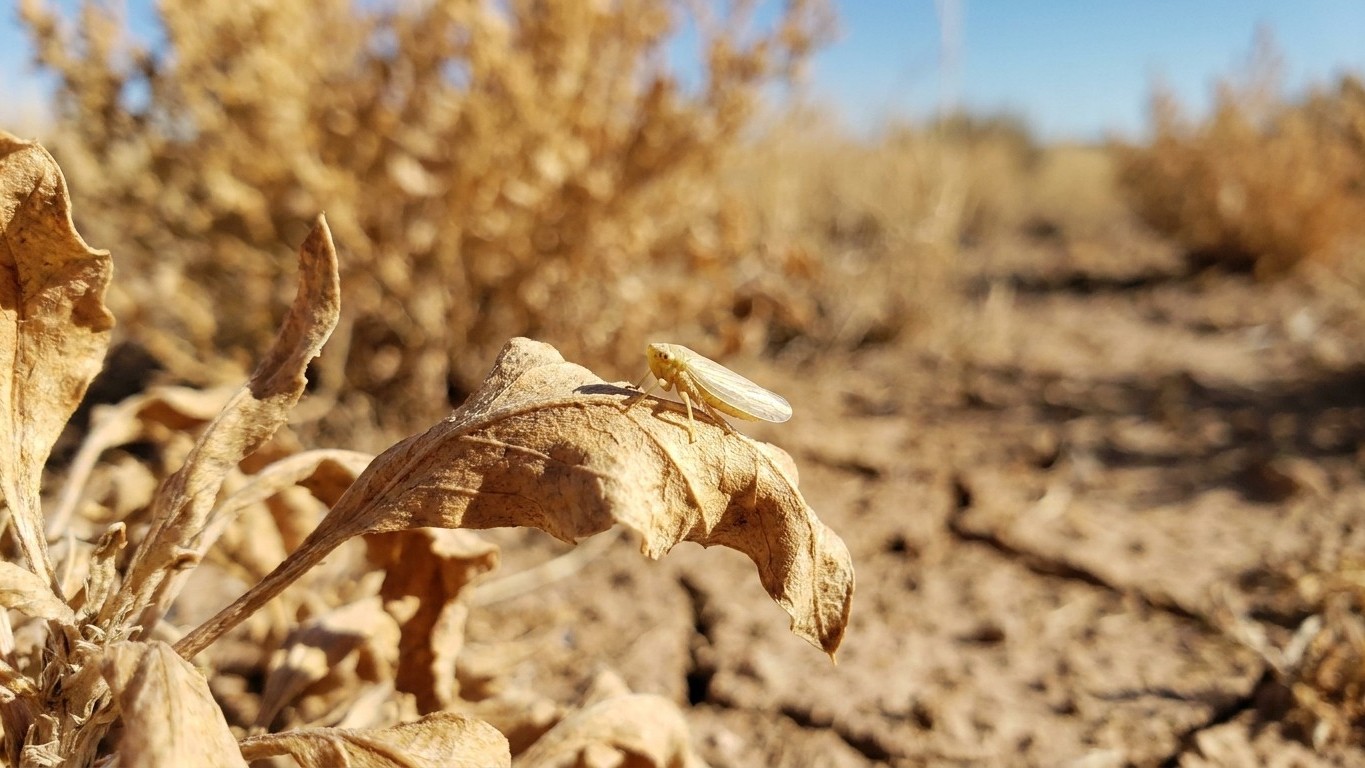

Beet leafhopper (Circulifer tenellus) doesn’t arrive on a fixed date in New Mexico. It moves in when wild hosts dry out, carrying curly top virus into gardens and fields. Here’s when to watch, what it damages, and what a home gardener can actually do about it.
When Beet leafhopper turns up in New Mexico

New Mexico State University Extension’s Guide H-176, which covers the state’s common garden insect pests, doesn’t publish a specific seasonal window for beet leafhopper the way it does for squash bugs, cucumber beetles, or Lygus bugs. So there’s no local date range to quote for this particular species, and it would be misleading to invent one.
What’s known about the insect’s general behavior fills that gap. Beet leafhopper is a migratory feeder. It breeds on wild, weedy hosts, especially annual weeds like Russian thistle and mustards that thrive on disturbed, arid ground, then moves into cultivated crops once those wild plants dry up and stop offering good feeding sites. That shift usually happens as spring turns to early summer, when rangeland vegetation cures out under heat and low humidity.
New Mexico’s high desert climate, with its long dry stretches and sparse native cover, is exactly the kind of landscape that supports this pattern. The insect doesn’t check a calendar. It checks the condition of the weeds around it. A wet spring that keeps rangeland green longer can push the migration into gardens later than usual. A dry, hot spring can pull it in earlier. That’s the honest version of “When It Shows Up” here: a behavior tied to moisture and vegetation, not a printed date.
Because the local extension service doesn’t name a window, the safest approach for a home gardener is to treat the entire late-spring-through-early-summer stretch as a watch period, and to pay closer attention as surrounding wild vegetation starts to brown out.
Reading the calendar from your last frost
The one date most New Mexico gardeners actually plan around is the last spring frost. For the reference weather station used in NOAA’s 1991-2020 climate normals, that date falls between March 31 and April 12. That’s a range, not a single day, and it reflects freeze probability at one airport station, not a statewide guarantee. Suburban and rural gardens, especially at higher elevation, often see their last frost one to two weeks later than that figure. Check your own county’s typical date before you plant.
Beet leafhopper doesn’t answer to frost dates directly. It answers to soil warmth and, more specifically, to how fast nearby wild hosts dry out. An early, warm spring speeds up that drying and can push the insect into gardens sooner after transplants go in. A cool, wet spring slows the whole process down.
For timing purposes, gardeners generally start seeing the first signs of curly top virus damage within a few weeks of setting out transplants, once the insect has had a chance to feed and the virus has had time to show. That means a physical barrier, like a row cover, needs to go on at transplanting, not after the first curling leaf appears. Waiting for symptoms means the infection has already happened. The cover has to come off once plants start flowering and need pollinator access, which is also roughly the point where many crops have outgrown the worst of their vulnerability.
What it attacks, and what the damage looks like
Beet leafhopper feeds on a wide range of garden plants, but its real damage comes from what it carries, not what it eats. The insect is the main vector for curly top virus, and that virus is what actually wrecks a crop.
Tomatoes are the classic victim in home gardens. Beans, peppers, spinach, beets, and various cucurbits get hit too. The symptom usually appears before anyone spots the insect: leaves curl upward and inward, turn yellow or take on a bronze cast, and the whole plant looks stunted and tight, almost as if it’s been shrink-wrapped. Veins on the underside of leaves can turn purple. Fruit that has already set often stays small and ripens early, sometimes before the plant is ready to support it, and the plant frequently dies before producing a normal harvest.
Host crops and what to look for
| Crop | Typical symptom |
|---|---|
| Tomato | Upward leaf curl, yellowing, stunted growth, early fruit ripening |
| Beans | Leaf curling, purpling of veins, stunted pods |
| Peppers | Leaf curl and yellowing, reduced fruit set |
| Beets and spinach | Leaf puckering, yellowing, stunted roots or leaves |
| Cucurbits (squash, melon) | Stunting, leaf curl, poor vine growth |
The adult leafhopper does the real damage, not because it chews much (its feeding punctures are minor), but because it’s the mobile life stage that carries the virus from infected weeds into the garden and injects it while probing plant tissue. That detail matters for treatment. Once an adult has fed and transmitted the virus, no spray or intervention cures the infected plant. The window for stopping the problem is before that feeding happens, which is why prevention has to start at planting, not after the first curled leaf shows up.
How New Mexico sits in this pest’s range

On this site, beet leafhopper is documented in 2 territories so far. That count describes how many state-specific pages currently exist in this series, not the insect’s actual biological range, which stretches across much of the arid and semi-arid West wherever weedy hosts and hot, dry summers coincide. New Mexico’s high desert terrain, with its mix of rangeland, disturbed soil, and irrigated cropland sitting close together, fits the pattern the insect favors well.
With only 2 territories tracked here, it’s not accurate to call New Mexico central, peripheral, or worse-off than the other one. The honest statement is narrower: the difference between the two documented territories is mostly a matter of timing and local vegetation conditions, not whether the insect shows up at all. Where wild hosts dry out earlier in the season, the migration into gardens tends to happen earlier too. Where irrigation keeps weedy hosts green longer, the pest may hold off before moving into cultivated plots.
New Mexico State University Extension is the local source cited for pest management guidance in this state, though as noted, its published pest guide doesn’t single out beet leafhopper with its own seasonal entry. That gap doesn’t mean the insect is rare here. It means the state’s flagship pest guide focuses its detailed calendars on other, more commonly reported garden pests.
What actually works against it
Cheap, low-effort measures matter most here because once curly top virus is inside a plant, nothing reverses it.
- Timing of planting before wild vegetation nearby dries out reduces the odds that a migrating leafhopper finds your garden at its most vulnerable, seedling stage.
- Row covers work by physically blocking adult leafhoppers from reaching plants at all, though the cover has to be sealed at the edges and stay on through the early vulnerable weeks, since it stops working the moment it comes off or once plants grow large enough to gap the fabric.
- Clearing weedy hosts like Russian thistle and mustards from field edges and empty lots near the garden removes the breeding and staging ground the insect relies on before it migrates, reducing local population pressure around a home garden even though it won’t eliminate the pest regionally.
- Crop rotation offers little benefit against this particular pest, because the leafhopper flies in from outside sources each season rather than overwintering in garden soil, and rotation only disrupts pests tied to soil-borne stages.
- Hand-picking isn’t practical either, because the insect is small, quick, and highly mobile, and by the time it’s noticeable on a plant, feeding and virus transmission may have already occurred.
The hard limit on all of these measures is the same: once curly top virus is inside a plant’s vascular system, no cover, no cleared weed patch, and no rotation schedule reverses it. Removing and discarding infected plants promptly is the only remaining step, done mainly to reduce any lingering source of infection nearby, not to save the plant itself.
Common questions
Does beet leafhopper overwinter in New Mexico gardens?
The insect relies on wild host plants for breeding and typically migrates into cultivated areas as those hosts dry out, rather than establishing a permanent population inside a home garden bed.
Can a tomato plant recover once it shows curly top symptoms?
No. Once the virus is transmitted, the plant’s growth and fruiting are permanently affected, and removing the infected plant is the standard response rather than waiting for recovery.
Is a row cover enough on its own to prevent curly top virus?
A properly sealed row cover put on at transplanting blocks adult leafhoppers from reaching the plant, which is the main line of defense, but it only works while it’s in place and sealed at the edges.