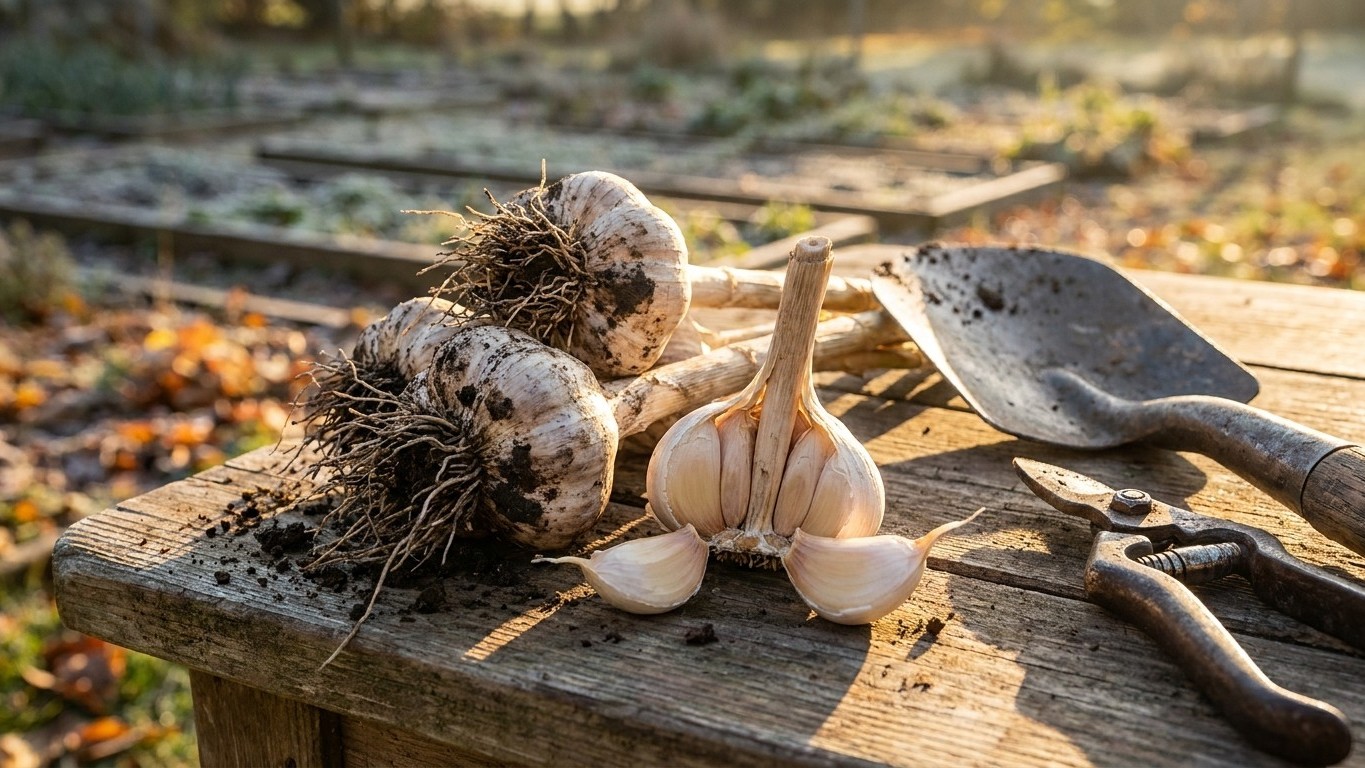

German Extra Hardy garlic is a hardneck, a stiffneck type with classic garlic flavor and 5 to 8 large cloves per head. It keeps well once cured but not as long as a softneck. Plant it in fall, timed to your first frost, so the cloves root before the ground locks up but don’t push top growth. Where winters run cold, it thrives without help.
What Music actually is
German Extra Hardy belongs to the hardneck family, what older seed catalogues still call a stiffneck type. That’s a meaningful distinction, not just an older word for the same thing: hardneck garlics send up a rigid central stalk, called a scape, that a softneck never grows. The finer botanical groupings you’ll see on other garlic pages, Porcelain, Rocambole, Purple Stripe, aren’t published for this variety, so it gets labeled simply as hardneck here rather than guessing at a subgroup nobody has confirmed.
The flavor is described as classic garlic taste, without a signature note of its own. It’s the plain reference variety, the one other garlics get compared against when someone says a bulb tastes “sharper” or “sweeter” than usual. In the kitchen it’s an all-purpose garlic: nothing exotic, but reliable in a way that makes it a good starting point for a first-time grower.
Each head runs 5 to 8 large cloves, fewer and bigger than what you’d get from a softneck variety, which typically packs in more, smaller cloves. It cures well and stores for a solid stretch, though not for the many months a softneck can manage. No disease or pest resistance is published for this variety, which is worth stating plainly rather than pretending otherwise. That’s not a red flag, most garlic varieties don’t carry published resistance data, but it does mean you shouldn’t expect this one to shrug off rust or white rot any better than an unlabeled bulb from a farmers market.
Will it get the cold it needs where you are
Here’s the mechanism that most garlic guides skip past: a garlic clove doesn’t automatically split into a multi-clove head just because you stuck it in the ground. It needs a sustained stretch of cold weather after planting, a process plant scientists call vernalization, to trigger that division. Skip the cold, and what you dig up the following summer isn’t a head of cloves at all. It’s one smooth, undivided round bulb, edible but useless for replanting and disappointing on a cutting board.
Hardneck types like German Extra Hardy are the most cold-dependent garlics there are. That’s the flip side of the deal: the same hardneck habit that gives you the bigger cloves and the more complex flavor structure also makes the plant fussier about winter. A softneck can shrug off a mild winter and still divide reasonably well. A hardneck grown where winter barely arrives often won’t.
Practically, that breaks down into three rough situations, and it’s worth being honest that region-by-region cold totals for garlic vernalization aren’t something this page can cite with a precise figure, no verified source here breaks that down station by station. What can be said with confidence is the pattern gardeners and extension programs consistently report.
| Winter type | What typically happens | What to do |
|---|---|---|
| Cold winters (Upper Midwest, Northeast, Mountain West, northern Plains) | Ground freezes hard and stays cold for weeks to months | Plant as usual in fall; cold requirement is met without intervention |
| Mild winters (mid-Atlantic, Pacific Northwest lowlands, transitional zones) | Cold arrives but is inconsistent or short | Often still workable, but division can be uneven some years |
| Warm winters (Gulf Coast, Florida, low-desert Southwest, Southern California) | Ground rarely freezes and stays warm most of winter | Cold requirement usually not met without help |
If you garden somewhere in that third category, you have two honest options, not one polite dismissal. The first is to refrigerate your seed cloves before planting, typically for several weeks in a home refrigerator, to simulate the cold the ground won’t provide. Gardeners in warm-winter states do this routinely with hardneck garlic and get workable results. The second option is simpler: grow a softneck variety instead, one bred to need less cold to divide properly. Neither path means giving up on garlic. It means matching the variety, or your prep, to the winter you actually have.
When to put the cloves in
Garlic goes in the ground in autumn and comes out the following summer, and that single fact trips up more first-time growers than anything else about this crop. There’s no spring-planting shortcut here. The timing question isn’t which calendar date to circle, it’s how that date relates to your first fall frost, because frost dates shift by hundreds of miles and a fixed date on a seed packet is close to meaningless from one state to the next.
In cold-winter regions, growers generally plant four to six weeks before the ground is expected to freeze solid, often landing sometime in mid to late fall depending on elevation and latitude. In milder regions with a later, gentler frost, planting can push later into fall or even into early winter, since the ground stays workable longer. In the warmest parts of the country, where a true hard frost may not show up at all some years, timing shifts toward the cooler stretch of the year regardless of frost, simply to give the plant its best shot at cool root-establishment weather.
What actually decides the window isn’t tradition, it’s biology working in two directions at once. Plant too early, and the clove pushes too much green top growth before winter, growth that then gets damaged or killed back by hard freezes, weakening the plant going into spring. Plant too late, and the clove hasn’t had time to send down roots before the ground locks up, leaving it vulnerable to frost heave and slow spring emergence. The target is a clove that’s rooted but not yet leafing out heavily when the cold really sets in.
Regional guides genuinely disagree on the exact number of weeks, and that’s not sloppiness on anyone’s part, it reflects real variation in soil type, snow cover, and microclimate that a single national rule can’t capture. Local extension offices and experienced regional growers remain the better tiebreaker than any one-size chart.
Hardneck or softneck: what this one asks of you
German Extra Hardy is a hardneck, and that habit shapes almost everything about growing and using it. Midway through the growing season, the plant sends up a scape, a curling flower stalk that needs to be cut off, not left to bloom. Cutting the scape redirects the plant’s energy back into bulb growth instead of stalk development, and most growers harvest the scapes anyway since they’re edible and mild, good in a stir-fry or blended into a pesto.
In exchange for that extra step, you get cloves that are fewer per head but noticeably larger, easier to peel than the small multi-layered cloves on a softneck bulb, and carrying more complex flavor. The tradeoff is storage life: hardneck garlic like this one keeps for a solid stretch after curing but doesn’t last as long in the pantry as a braided softneck can, which is one reason softnecks dominate grocery store shelves and hardnecks dominate farmers markets and home gardens instead.
That tradeoff maps almost perfectly onto climate. Hardneck varieties, including this one, make sense where winters run long and cold, exactly the conditions that reward the plant with proper vernalization and reward the grower with bigger, more flavorful cloves. Softneck varieties make more sense in mild-winter regions, both because they tolerate a weak winter better and because they’re the ones that store into the following spring without much fuss. Choosing German Extra Hardy is, in part, a decision to accept a shorter storage window in trade for flavor and clove size, a fair trade for most home cooks who go through garlic steadily rather than hoarding it.
Growing and curing it without losing the crop
Plant individual cloves pointed end up, about 2 inches deep and roughly 6 inches apart, in loose, well-drained soil. Garlic sitting in heavy, waterlogged ground rots before it ever gets the chance to root. A layer of mulch, straw or shredded leaves a few inches thick, matters more here than with a spring-planted crop, because it’s insulating cloves through an entire winter, buffering the freeze-thaw cycles that heave cloves partway out of the ground and expose them to cold air and drying wind.
Watering matters at both ends of the season and for opposite reasons. In fall, cloves need consistent moisture to root before the ground freezes. In the weeks before harvest, the opposite is true: stop watering roughly two weeks before you expect to lift the bulbs, since wet soil at harvest time promotes staining and shortens storage life, sometimes ruining an otherwise good crop in the curing shed.
Readiness to harvest shows up in the leaves. When the lower third to half of the leaves have browned while the upper leaves are still green, the bulbs are generally ready, usually in early to midsummer depending on your fall planting date and regional climate. Pulling too early means underdeveloped cloves with loose skins that don’t store well. Pulling too late risks the bulb splitting open in the ground, which invites rot and cuts storage life sharply.
Curing is where a lot of home-grown garlic quietly goes to waste, and it’s the single most common mistake with this crop. Bulbs need to hang or lay out somewhere warm, dry, and shaded, with decent airflow, for two to four weeks before you trim the roots and stalks and move them to storage. Curing in direct sun or in a humid space invites mold and shrinkage. Skip curing altogether, and even a variety described as keeping well can go soft or sprout within weeks instead of lasting through the following season.
Common questions
Is German Extra Hardy the same as regular German Red garlic?
No. They’re both hardneck varieties sold under related names, but they’re treated as distinct varieties in seed catalogues, with their own harvest data and clove counts. Don’t substitute one for the other assuming identical performance.
Every garlic silo page is different, so let’s write these next question pairs the same careful way once we’re deep into that section.