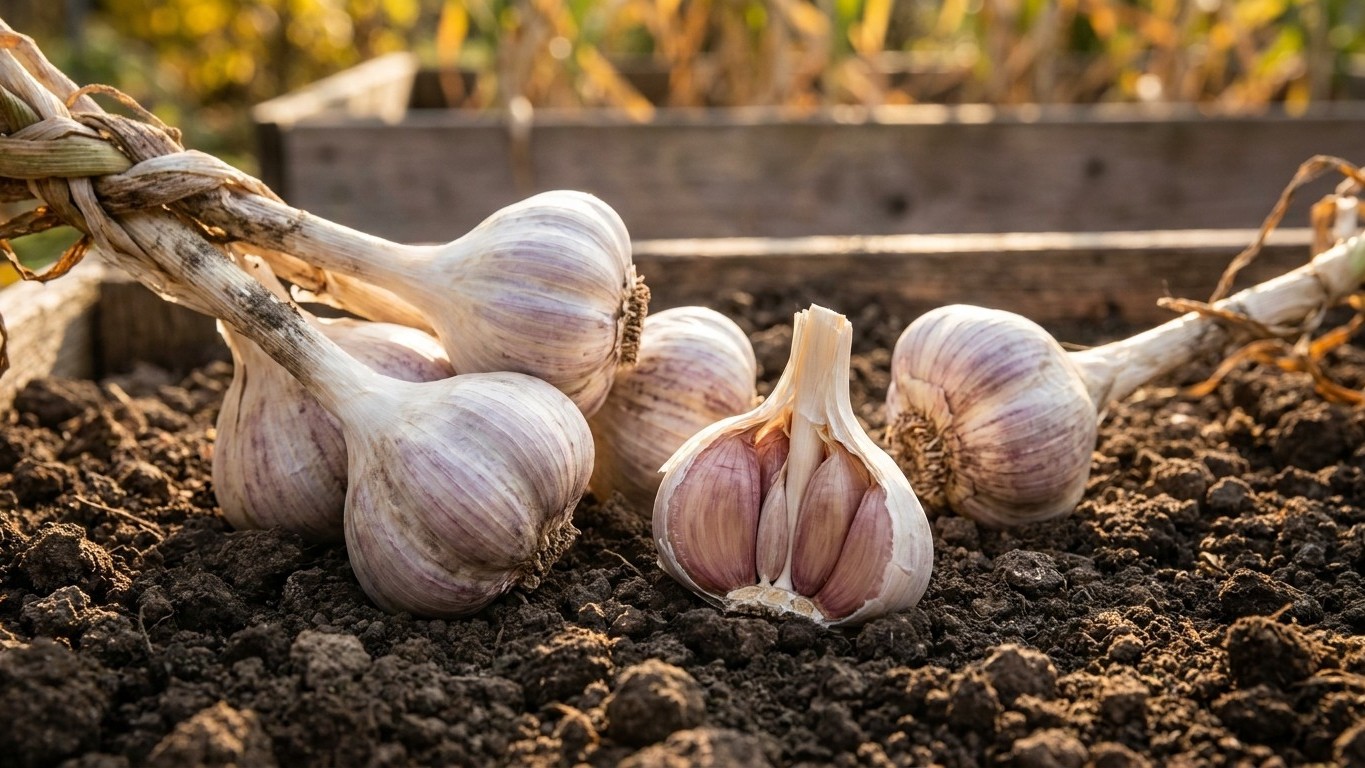

Italian Late Garlic goes into the ground in fall, like every true garlic, but its softneck habit makes it one of the safer bets where winter barely bites. This is an Artichoke type, white-skinned, pungent enough for real cooking, and built to braid and store for six to nine months. The planting date moves with your first frost, not a fixed week on a calendar, and how much cold the clove gets after planting decides whether you dig a full head or one round, undivided bulb next July.
What Italian Late Garlic actually is
Garlic splits into a handful of recognized types, and where a variety sits in that list tells you more than any marketing copy. Porcelain and Rocambole are hardneck cousins built for brutal winters. Silverskin is the softneck at the other extreme, mild and built for endless storage. Italian Late Garlic sits in the Artichoke camp: a softneck with cloves arranged in loose, overlapping layers around the core, the way an artichoke’s leaves stack around its heart.
The catalog description for this one is blunt: a pungent softneck, used mainly as a cooking garlic. That’s not a delicate table garlic meant for eating raw. It’s the kind you reach for when a recipe calls for real bite, sautéed or roasted rather than shaved thin over a salad.
Each bulb carries a wide range, anywhere from 10 to 40 cloves, which is a much bigger spread than most hardneck types offer. That range comes from the softneck habit itself: no central stalk taking up space in the middle, so the plant packs in layer after layer of smaller cloves. Braided together, a bunch of Italian Late Garlic keeps for six to nine months at room temperature, which is why growers call this style the winter keeper. No disease resistances are published for it, which isn’t a red flag so much as an honest gap: some varieties get tested and labeled, this one hasn’t been marketed that way.
Will it get the cold it needs where you are
Garlic isn’t like a tomato seedling you can plant whenever the soil warms up. A clove has to go through a real stretch of cold after it’s in the ground, or it never differentiates into separate cloves at all. Skip that cold period and you don’t get a head of garlic in July. You get one smooth, round bulb, basically a scallion-sized onion wearing a garlic disguise. That’s the single biggest reason generic planting advice fails gardeners: it treats every garlic variety as if it needs the same winter, and it doesn’t.
Hardneck types are the demanding ones. They evolved for places with long, hard winters and they sulk without one. Softneck types, and Italian Late Garlic falls squarely in that camp, ask for less. That’s exactly why this variety gets paired with mild winters in gardening circles: it can complete its cold requirement in a climate where the ground barely freezes, if it freezes at all. Gardeners along the Gulf Coast, in coastal California, and through much of the milder Southeast routinely grow softneck garlic like this one with no extra intervention, just a normal fall planting and an ordinary mild winter.
No specific chill-hour figure or weather-station threshold is published for this variety here, so treat the guidance as directional rather than a hard cutoff. What is well established is the general pattern: softneck garlic tolerates less cold than hardneck garlic, and Artichoke types in particular have a reputation for adapting to warmer regions where hardneck varieties struggle to divide properly.
For gardeners in genuinely warm-winter zones, the ones where frost is rare or absent entirely, there are two real paths forward instead of giving up on garlic altogether. The first is to refrigerate the seed cloves before planting, storing them in a cold refrigerator for several weeks to simulate the winter chill the ground won’t provide on its own. The second is simpler: lean even harder into the mildest-adapted softneck types, since Italian Late Garlic’s Artichoke lineage already asks for less than a Porcelain or Rocambole would. Neither path is a guarantee, but both beat planting a hardneck variety that was bred for a Minnesota winter and expecting it to perform in a Phoenix backyard.
When to put the cloves in
Garlic planting is an autumn job across the entire country, but the actual week shifts a lot depending on where you garden, and it’s better to anchor the date to your first fall frost than to a page on a calendar. The goal is narrow: the clove needs enough time in the ground to root before the soil freezes solid, but not so much time that it pushes a lot of leafy top growth before winter sets in. Too much green growth going into winter leaves the plant vulnerable; too little rooting leaves it unanchored.
In cold-winter regions, think the Upper Midwest, New England, and the mountain states, gardeners generally plant a few weeks ahead of the ground freezing hard, which usually lands in October. In milder transitional climates, the Mid-Atlantic and the Pacific Northwest among them, the window stretches from October into November, since the ground stays workable longer. In genuinely warm-winter areas, the Gulf Coast and coastal California especially, planting often waits until November or even into December, sometimes later, because there’s no rush to beat a hard freeze that may never really arrive.
It’s worth being upfront that regional planting guides don’t fully agree on the exact timing even within the same climate band. Some growers plant six weeks ahead of the average freeze date, others wait until soil temperatures drop into the 50s Fahrenheit, and the right call often comes down to how a particular fall is shaping up rather than a fixed rule. That disagreement isn’t a flaw in the advice, it’s just a reflection of how variable fall weather actually is from one year to the next, even within the same county.
Hardneck or softneck: what this one asks of you
Italian Late Garlic is a softneck, and that single fact shapes almost everything about growing it. There’s no scape, the tall, curling flower stalk hardneck varieties send up in early summer that gardeners have to snap off to redirect the plant’s energy into the bulb. Softneck plants skip that step entirely, which means one less garden chore in June.
What you get instead is a bulb built differently: more cloves, smaller on average, packed into those tight overlapping layers, matching the 10-to-40-clove range noted earlier. That cloves-per-bulb range is far wider than a hardneck like Rocambole, which typically offers a tidy ring of large, easy-to-peel cloves and not much more. Softnecks trade that easy peeling for volume and, crucially, for shelf life: braided softneck garlic like this one holds for six to nine months at room temperature, while most hardneck types start declining within four to six months.
The pattern lines up with climate for a reason. Hardneck varieties are the ones bred for regions with long, punishing winters, the exact cold they need to divide properly. Softneck varieties, Italian Late Garlic included, are the better fit where winter is short or mild, precisely because they don’t demand as much cold to begin with. If your winters rarely dip hard or stay frozen for long, you’re planting the type built for exactly that.
Growing and curing it without losing the crop
Individual cloves go in about 2 inches deep, pointed end up, spaced roughly 4 to 6 inches apart with about a foot between rows. That spacing gives each bulb room to bulk up without competing too hard for water and nutrients underground.
Mulch matters more for an overwintered crop than it does for almost anything else in the garden. A few inches of straw or shredded leaves buffers the soil against freeze-thaw cycles that can heave young roots right out of the ground before they’ve had a chance to establish. That same mulch layer also suppresses the weeds that would otherwise compete with garlic through a long, slow spring growing season.
Watering should taper off two to three weeks before harvest, since wet soil right up to the end delays curing and invites rot in storage. The bulb tells you when it’s ready: the lower leaves start browning and drying out while the upper leaves are still green, usually in early to mid summer depending on when it was planted. Pulling too early means underdeveloped cloves and thin skins; waiting too long risks the bulb splitting open in the ground, which ruins its storage potential entirely.
Curing is the step most home gardeners rush, and it’s the one that decides whether that six-to-nine-month storage window actually happens. Freshly pulled bulbs need two to four weeks hanging or laid out in a shaded, dry, well-ventilated spot, never in direct sun and never somewhere humid. Only after the outer skins have fully dried down should the roots and stems be trimmed for storage or braiding. Skip the cure or rush it in a damp garage, and even a variety built for long storage will rot within weeks instead of lasting through winter.
Common questions
Does Italian Late Garlic need to be refrigerated before planting?
Not in a genuinely mild-winter climate, where the softneck habit already asks for less cold than a hardneck variety would. In areas with little or no frost at all, refrigerating cloves for several weeks before planting is a real option to make up for the missing chill.
Can I grow Italian Late Garlic in a warm climate without a real winter?
It’s a better candidate than a hardneck type for exactly that situation, since Artichoke softnecks are known to tolerate less cold. There’s no published chill-hour figure to rely on for this variety specifically, so results will vary and refrigerating cloves beforehand is worth trying if a season underperforms.
How is Italian Late Garlic different from a hardneck like Rocambole?
No scape to cut, more cloves per bulb (10 to 40 versus Rocambole’s tidy ring of large cloves), and a much longer storage life of six to nine months versus a hardneck’s typical four to six. The tradeoff is slightly fussier peeling on the smaller cloves.
How long does Italian Late Garlic keep after harvest?
Braided and stored at room temperature after a proper cure, it holds for six to nine months, which is why it’s described as a winter keeper. Skipping or rushing the curing process cuts that storage life dramatically, regardless of the variety.