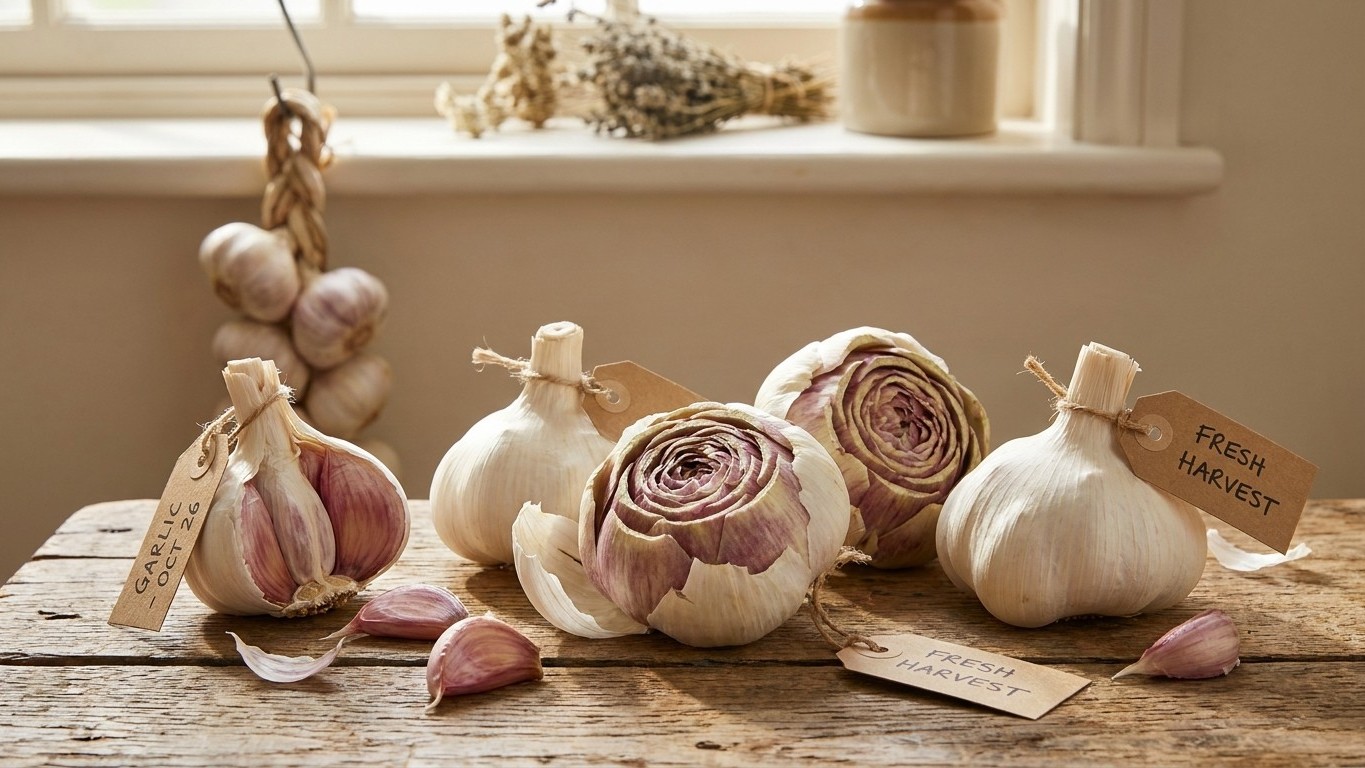

Sicilian Artichoke garlic is a softneck, white-skinned artichoke type built for regions where winter doesn’t bite hard. Its bold, spicy bite when fresh mellows to a rich, mild sweetness in cooking, and each bulb holds 10 to 40 cloves that braid well and keep 6 to 9 months at room temperature. That combination, mild climate tolerance plus long storage, is what makes this variety worth a second look for growers south of the traditional hardneck belt.
What Music actually is
Sicilian Artichoke is an artichoke-type garlic, the softneck category that wraps its cloves in layered, overlapping rows the way an artichoke stacks its leaves. Its habit is softneck, meaning no rigid central stalk pushes up through the plant at maturity. The skin is white, plain and unmarked, the kind of clean wrapper that looks good hanging in a kitchen braid.
The flavor runs from a bold, spicy bite when fresh to a rich, mild sweetness once cooked, which is why it’s pitched as an everyday cooking garlic rather than a specialty clove for raw use. Storage life is the other half of the pitch: 10 to 40 cloves per bulb, braiding well, and holding 6 to 9 months at room temperature, solidly in the “winter keeper” category. No disease or pest resistances are published for this variety, worth stating plainly rather than guessing at a resistance profile that isn’t on record.
Will it get the cold it needs where you are
Every garlic clove needs a stretch of cold weather after planting to trigger vernalization, the process that tells the clove to divide into multiple sections instead of growing back into one solid, round bulb. Skip the cold, and a grower digs up something closer to a shallot than a head of garlic. This is where most general planting guides fall short: they tell you to plant garlic in fall and lift it in summer, without connecting the variety in your hand to the actual winter your yard receives.
Hardneck types demand a hard, sustained cold, the kind found in USDA zones 3 through 6. Softneck types, including artichoke varieties like this one, ask for less. They’re the traditional choice across the Gulf Coast, coastal California, the warmer Southeast, and other regions where winter is more of a cool season than a hard freeze. That’s why softneck garlic dominates commercial production in California and why it’s handed to home gardeners in zones 7 through 9 who want something that will actually divide into cloves.
Where it’s marginal
The gray zone sits in the upper edge of zone 6 and the cooler pockets of zone 7, places that get some winter chill but not always a consistent run of it. In those spots, an artichoke softneck like Sicilian Artichoke can still produce, but bulb size and clove division may come in smaller and less uniform than in a colder or more reliably cool climate.
What to do when the cold falls short
Two real options exist for a marginal or genuinely warm climate, and neither involves giving up on the crop.
- Refrigerate the cloves before planting. Separate the cloves and hold them in a refrigerator for several weeks ahead of planting to simulate the chilling period the ground itself won’t provide.
- Lean on the variety’s own tolerance. Softneck artichoke types are already the lower-chill end of the garlic spectrum, which is why this one gets recommended in mild-winter regions in the first place, rather than a hardneck type that would sulk without a proper freeze.
What doesn’t work is treating this like a coin flip and hoping. A gardener in a true warm-winter region who plants Sicilian Artichoke straight from the bag, with no pre-chill and no attention to timing, is the one most likely to lift a disappointing, undivided bulb come summer.
When to put the cloves in
Garlic goes into the ground in autumn and comes out the following summer, but the exact window shifts by region and is anchored to the first fall frost rather than a fixed calendar date. The cloves need enough time to root before the ground freezes solid, but not so much time that they push a lot of leafy top growth before winter sets in. Too much top growth leaves young shoots exposed to freeze damage; too little rooting leaves the clove vulnerable to heaving out of loose soil during freeze-thaw cycles.
In cold northern regions, that generally means planting four to six weeks before the ground is expected to freeze hard, often mid to late October. In milder, temperate zones, growers typically wait until October or November, letting soil temperatures cool first so cloves don’t sprout early. In genuinely warm-winter regions, the ones this artichoke variety suits best, planting can stretch into November or December, since the goal is simply a period of cool soil rather than racing a hard freeze that may not come.
Regional planting guides don’t always agree on the exact number of weeks before frost, and that’s a real feature of garlic growing, not a gap in the advice. Local soil, mulch practices, and how mild or erratic a given winter turns out to be all shift the ideal date by a week or two. The more useful anchor than any single date is the first fall frost for a given area, working backward from there rather than trusting a generic “plant in October” rule.
Hardneck or softneck: what this one asks of you
Sicilian Artichoke is a softneck, and that habit shapes almost every practical decision a grower makes with it. Hardneck varieties send up a rigid central stalk called a scape, which has to be cut off partway through the season so the plant’s energy goes into the bulb instead. Softneck types like this one skip that step entirely: no scape to manage, no extra trip through the garden with pruning shears.
The tradeoff runs through clove count and storage. Hardneck garlic typically produces fewer, larger cloves that peel easily but don’t keep especially long, often just a few months. Softneck garlic packs in more cloves per bulb, generally smaller and slightly more fiddly to peel, but with a real storage advantage. Sicilian Artichoke’s 10 to 40 cloves per bulb and 6 to 9 month shelf life sit squarely in that softneck strength. It’s also the type that braids, since the pliable, leafless stem makes decorative kitchen braids possible, something no hardneck variety can offer.
All of this ties back to climate. Hardneck garlic is bred for long, hard winters, the kind found across the northern tier of the country. Softneck garlic, including this artichoke type, is the pick for milder winters and for anyone who wants garlic that stores through spring without a root cellar. Choosing Sicilian Artichoke means choosing the low-maintenance, long-storage side of that tradeoff.
Growing and curing it without losing the crop
Plant individual cloves pointed end up, about 2 inches deep and 4 to 6 inches apart, in rows spaced roughly 12 inches apart to give bulbs room to expand. A layer of mulch, straw or shredded leaves work well, matters more for an overwintered crop than for almost anything else planted in the garden, since it buffers soil temperature swings and helps prevent cloves from heaving out of the ground during freeze-thaw cycles.
Watering matters through spring as the plant builds leaves and bulb, but should stop roughly two to three weeks before harvest. Continuing to water right up to lifting keeps bulb wrappers wet and soft, shortening storage life before the garlic even leaves the ground. The signal that a bulb is ready is the foliage: once the lower third to half of the leaves have browned while the upper leaves are still green, the bulb is at its peak, wrappers intact and cloves fully formed.
Curing is where a lot of otherwise good harvests get ruined. Bulbs need to hang or lay in a warm, dry, shaded, well-ventilated spot for two to four weeks before trimming roots and tops, letting outer wrappers dry down and seal the cloves inside. Curing in direct sun, in a humid spot, or in a pile with no airflow invites mold and rot that won’t show up until weeks later, when the garlic is already in storage. Lifting too late, after wrappers split, or curing too fast causes the same problem: a harvest that looked fine in July and turned soft by October.
Common questions
Can Sicilian Artichoke garlic be grown in a warm climate without any chilling?
It can be attempted, but bulb division is likely to be weak or incomplete without either natural winter chill or a pre-plant refrigeration period for the cloves. As a softneck artichoke type, it needs less cold than hardneck varieties, but it still needs some.
Does this variety produce a scape that needs cutting?
No. Sicilian Artichoke is a softneck type, and softneck garlic does not send up the rigid central scape that hardneck varieties do, so there’s no scape to remove during the growing season.
How long will harvested bulbs actually keep?
Properly cured bulbs keep 6 to 9 months at room temperature, making this one of the longer-storing garlic types available, well suited to a kitchen that wants garlic on hand through winter and into the following spring.
Is this variety resistant to common garlic diseases or pests?
No resistances are published for Sicilian Artichoke. That absence should be read as a lack of published data rather than an implied weakness, and standard garlic-growing precautions around soil drainage and rotation still apply.