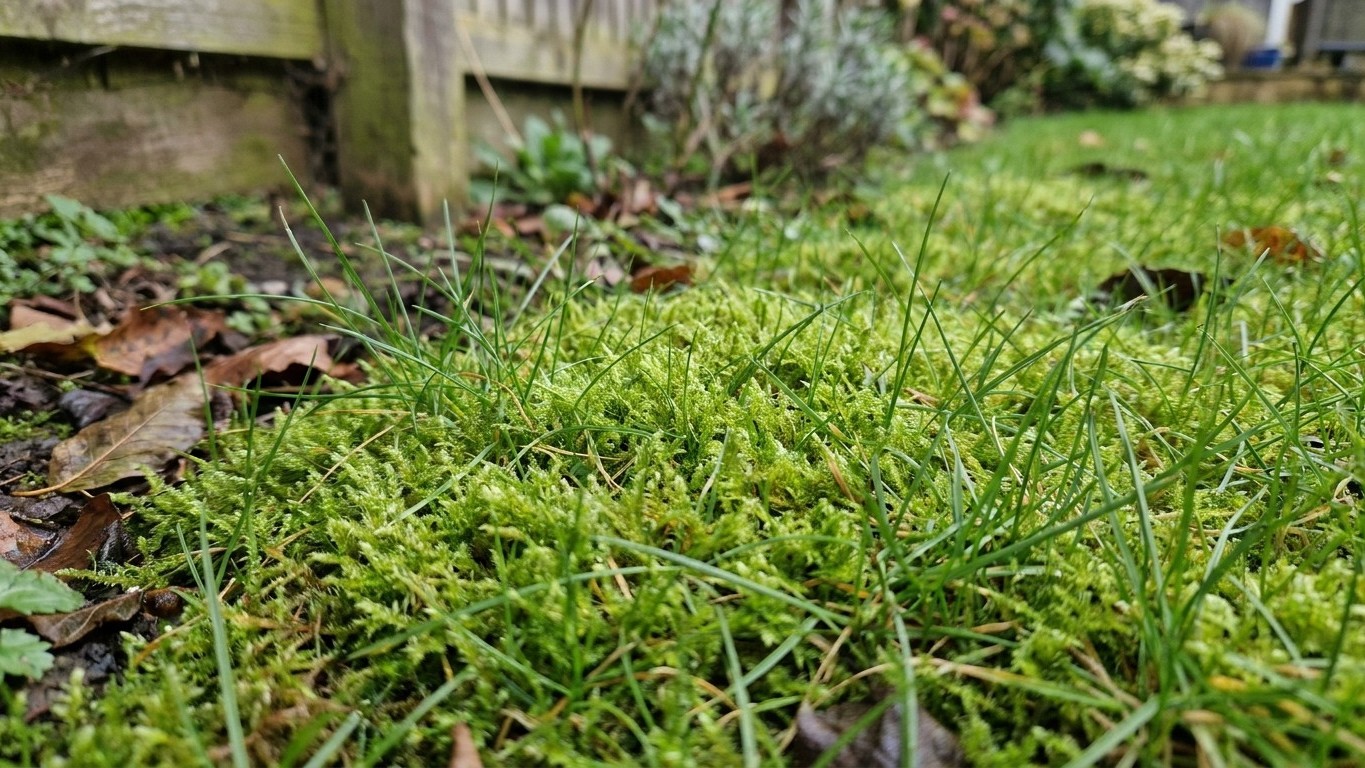

Moss in a lawn is not a disease and it will not kill healthy grass. It moves in wherever turf has already thinned, because moss needs no soil nutrients and no deep root system, so it can take hold in the damp, shaded, compacted ground where grass struggles to compete. Before buying anything, look at the site itself: how much direct sun that patch gets, whether water stands there after rain, and how the grass around the edge of the moss compares to the rest of the lawn. Pull a plug of turf from the mossy patch and check the root depth before spending money on lime, fertilizer, or a moss killer.
What you are looking at

Moss shows up in two forms on a home lawn. Sheet moss forms flat, feathery mats that hug the soil surface, deep green when moist and often bleaching to a dull olive or brown when the weather turns dry. Cushion or star moss grows in small tufted clumps, each one only an inch or two across, with a bristly texture that looks almost like a miniature shrub rather than a mat.
Shape tells you the cause before you dig
Pay attention to the outline. Moss that follows the drip line of a tree canopy, or spreads along the north side of a fence or the house, is following shade, not soil chemistry. Moss that pools in a low spot in the middle of the yard, especially one that stays soft underfoot for a day or two after rain, is following water. An irregular drift with a ragged, fading edge, thickest at the center and thinning outward, is typical of long-term shade or compaction. A hard, straight-edged line usually means something mechanical is involved, like a walkway shadow or a section that gets scalped by a mower at a different height than the rest of the lawn.
Color is a second clue. Bright, almost neon green moss after a wet week is normal and does not mean anything is wrong beyond the conditions that let it establish. Moss that looks gray-green and crusty rather than soft is more likely a lichen, which is a different organism entirely and points toward compacted, undisturbed soil rather than standing water.
What it is not
The most common mix-up is between moss and algae. Algae forms a thin, slick, blackish-green film directly on bare soil or thatch, and it smears under a finger rather than lifting as a mat. Moss, even the flattest sheet type, has enough structure that you can pick up an edge and peel back a small section like a piece of carpet.
The thirty-second pull test
Grab a handful of the questionable patch and pull. Moss lifts away easily in a shallow mat with no true root system attaching it to the soil below, just fine hair-like rhizoids that barely anchor it. If instead you feel resistance and the piece holds together with soil clinging to real roots, you are looking at thin, weak grass or a grub-damaged patch, not moss, and the fix is completely different. If it lifts like a doormat with nothing holding it down, it is moss. If it resists and tears, look at grubs, drought stress, or disease instead.
A third look-alike is matted, discolored thatch, the layer of dead stems and roots that can build up between the soil and the green blades. Thatch is fibrous, tan to brown, and dry to the touch even after rain, where moss stays cool and damp underneath. If you are not sure which you are dealing with, it is worth measuring the thatch layer directly before deciding whether it needs removing at all, as described in Thatch: How to Measure It Before You Decide to Remove It.
What actually causes it
Moss does not cause thin grass. Thin grass causes moss. Once turf density drops below what it takes to shade out competitors, moss spores that are already present in almost every yard get the light and moisture they need to germinate and spread. The four conditions that thin grass enough to let that happen are shade, soil compaction, poor drainage, and mowing too low for the species growing there.
The lag between cause and symptom
What you see in spring is usually the result of conditions from the previous fall and winter, not anything that happened last week. Tree canopies thicken through a growing season and cast progressively deeper shade by late summer, so a spot that got adequate light in May can be shaded out by August, and the grass under it has thinned by the time moss becomes obvious the following spring. Compacted soil from foot traffic or equipment squeezes out the air pockets roots need, and that damage accumulates over a season or more before the grass on top visibly fails. Standing water after storms suffocates roots in the same slow way. None of these are things a single week of bad weather causes.
Mowing height matters more than most people expect, because it is the one variable in a lawn’s care that a homeowner controls directly. Cutting a lawn shorter than the species tolerates removes leaf area the grass needs to shade its own soil and outcompete moss for light. Clemson Cooperative Extension’s HGIC 1205, Mowing Lawns, sets species-specific ranges for exactly this reason, and cutting below the low end of that range on a regular basis is one of the most common, and most fixable, reasons turf loses ground to moss.
Fixing it
Start with the physical removal, not a product. Raking moss out with a stiff garden rake or a dethatching rake pulls the shallow rhizoids loose and opens the soil surface, and it costs nothing but time. Do this before overseeding or fertilizing, because moss left in place will simply recolonize bare soil faster than new grass seed can establish.
Match the fix to the actual cause
If the patch is shaded, the real fix is more light, not more grass seed. Thinning overhead branches, even modestly, changes the outcome more than anything applied to the soil. If the patch is a low spot that holds water, regrading or adding drainage is the only fix that lasts, and it is worth reading through the grading and drainage options in Standing Water on a Lawn: Drainage Fixes That Actually Hold before doing anything to the surface.
Where the cause is genuinely thin turf rather than deep shade or standing water, overseed with a species suited to the site. Cool-season lawns dealing with shade do best with Fine Fescue, rated excellent for shade tolerance and mowed at 2.5 to 3.5 inches, according to Penn State Extension’s Lawn Establishment guidance. Warm-season lawns in shade should look at St. Augustinegrass or Zoysiagrass, both rated excellent for shade by Clemson Cooperative Extension’s HGIC 1214, Selecting a Lawn Grass, though Zoysiagrass tolerates a much lower mowing height, 0.75 to 2 inches, against St. Augustinegrass at 2.5 to 4 inches.
Several products sold as moss control for lawns use ferrous sulfate as the active ingredient and work by drying out the moss on contact rather than changing the underlying soil. They are widely available at garden centers, but they treat the symptom for a season at best. Without fixing the shade, compaction, or drainage problem underneath, the moss returns. Follow the label rate for whatever specific product you buy, since concentrations differ by brand.
Keeping it from coming back
The single habit most worth changing is mowing height. A lawn cut consistently at the low end, or below, the range for its species stays thinner than one cut at the high end, and thinner turf is exactly what moss needs to get started. Clemson’s HGIC 1205, Mowing Lawns, and the species figures in HGIC 1214 give the ranges to check your mower deck against.
Choosing the right grass for the site, not just the region
Overseeding with a species that fits the actual light and traffic conditions on that patch beats fighting moss every spring with a species that does not. The table below lines up the shade-tolerant options by mowing height and drought performance so you can weigh the trade-offs for a specific spot rather than the whole yard.
| Grass | Season | Mowing height | Shade tolerance | Drought tolerance |
|---|---|---|---|---|
| Fine Fescue | Cool-season | 2.5 to 3.5 in | Excellent | Good |
| Rough Bluegrass | Cool-season | 2 to 3 in | Excellent | Poor |
| Tall Fescue | Cool-season | 2.5 to 3.5 in | Good | Fair |
| St. Augustinegrass | Warm-season | 2.5 to 4 in | Excellent | Good |
| Zoysiagrass | Warm-season | 0.75 to 2 in | Excellent | Good |
| Centipedegrass | Warm-season | 1.5 to 2 in | Fair | Fair |
Rough Bluegrass and Fine Fescue both rate excellent for shade, but Rough Bluegrass rates poor for drought, so it is a poor match for a dry shaded spot even though the shade rating alone would suggest it. This is the kind of trade-off worth checking against the full species list in HGIC 1214 before choosing seed for a specific problem area, rather than assuming a bag labeled “shade mix” is automatically right for the site. For anything beyond a single patch, it is worth stepping back and reviewing how the whole lawn is managed through the season, covered in Lawn Problems.
Common questions
Will moss spread and kill the rest of my lawn?
No. Moss does not attack or smother living grass roots the way a disease would. It simply occupies ground where grass has already failed, so it spreads only as far as the thin or bare soil extends.
Can I just spray moss killer every spring and skip the rest?
You can, but it will not stop the moss from coming back, because a moss killer treats the moss present at the time, not the shade, compaction, or drainage problem that let it establish. Skipping the underlying fix means repeating the treatment indefinitely.
Does moss mean my soil pH is off?
Moss growing in a spot does not by itself confirm a soil pH problem. Shade, compaction, and excess moisture are more directly tied to where moss appears, and a proper soil test through your local extension office is the only reliable way to check pH before adding lime.
Is moss actually bad for my lawn, or just ugly?
Mostly it is a cosmetic and vigor issue rather than active damage. It signals a spot where grass is losing the competition for light, water, or air in the soil, and treating it as a warning sign about that specific patch is more useful than treating it as an enemy to eliminate.